


If you’re building a growing business, you’ve probably heard this advice: “You need a CRM.”
Others say, “No, you need marketing automation.”
Now you’re stuck comparing CRM vs marketing automation, wondering which tool actually solves your real problem — and which one is just another expensive subscription.
If you’re a beginner or non-technical founder, this guide will make it simple. No jargon. No fluff. Just clear answers.
By the end, you’ll know:
- What CRM and marketing automation actually mean
- How they’re different
- When you need one over the other
- And which one your team should implement first
Let’s break it down step by step.
What Is CRM vs Marketing Automation?

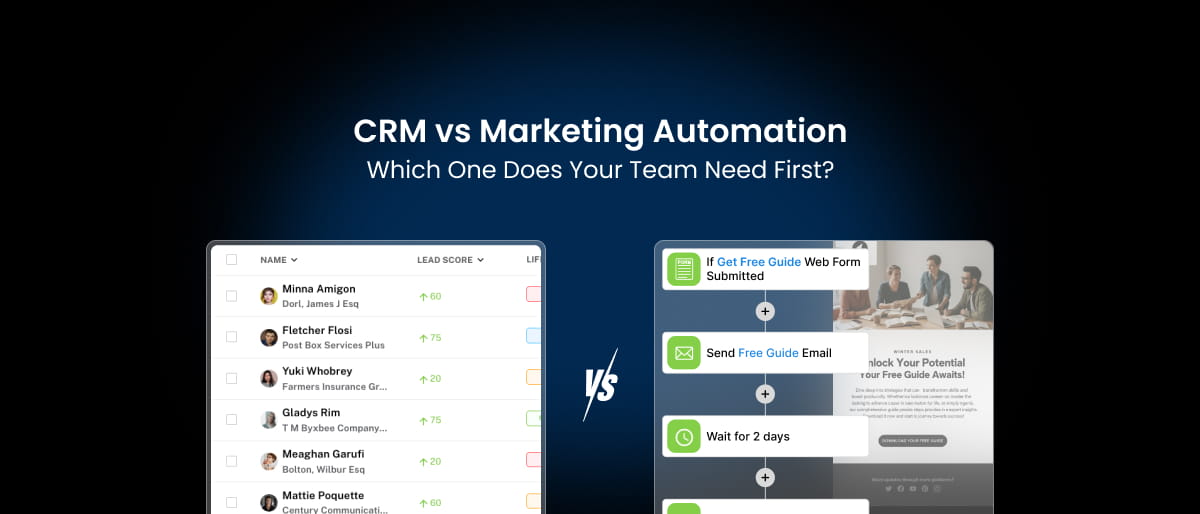
CRM vs marketing automation refers to the comparison between two business tools: a CRM (Customer Relationship Management system) that manages sales interactions and customer data, and marketing automation software that automates lead nurturing, email campaigns, and marketing workflows. CRM focuses on sales relationships, while marketing automation focuses on attracting and nurturing leads.
In simple terms:
- CRM = Managing relationships
- Marketing automation = Nurturing and engaging leads at scale
Both are powerful. But they solve different problems.
Why Does This Problem Matter?
Choosing the wrong tool first can cost you time, money, and growth momentum.
Many businesses rush into marketing automation because it sounds advanced. Others buy a CRM and never use it properly. The result?
- Wasted budget
- Low team adoption
- Scattered data
- Missed sales opportunities
Let’s see why this decision matters more than you think.
How This Problem Affects Users
Here’s what I’ve observed while consulting small teams:
- Leads fall through the cracks
Without a CRM like HubSpot CRM, Zoho CRM, or Salesforce, sales conversations are scattered across email and WhatsApp. - Email campaigns feel random
Without tools like Mailchimp, ActiveCampaign, or HubSpot Marketing Hub, follow-ups are manual and inconsistent. - No clear visibility
You don’t know:- Which leads are hot
- Which campaigns are working
- Where revenue is coming from
- Revenue stagnates
When sales and marketing are disconnected, growth slows down.
Common Myths or Misunderstandings
Let’s clear up some confusion.
Myth 1: CRM and marketing automation are the same thing
They’re not. They often integrate, but they serve different functions.
Myth 2: Marketing automation replaces a sales team
No. It supports sales. It doesn’t close deals by itself.
Myth 3: CRM is only for big enterprises
Even a 3-person team benefits from structured contact management.
Myth 4: You need both immediately
Not necessarily. The order depends on your current bottleneck.
Common Challenges People Face With CRM vs Marketing Automation

When businesses evaluate CRM vs marketing automation, they usually struggle with:
- Not knowing where revenue leaks are happening
- Confusion about feature overlap
- Fear of choosing the wrong platform
- Limited budget for multiple tools
- Low team adoption after purchase
- Overcomplicated systems no one uses
Ignoring this decision leads to:
- Poor customer experience
- Slower sales cycles
- Duplicate data
- Misaligned marketing and sales teams
So how do you decide the right way?
How to Solve CRM vs Marketing Automation
The key is not asking, “Which tool is better?”
The real question is:
“What is my biggest growth bottleneck right now?”
Let’s break this into a practical framework.
Step 1 – Identify Your Primary Bottleneck
Before buying any tool, audit your current process.
Ask yourself:
- Are we losing track of leads?
- Do we struggle to follow up consistently?
- Is our sales pipeline unclear?
- Or do we struggle to generate and nurture leads?
If your biggest issue is:
Disorganized sales process → You need a CRM first.
Inconsistent lead nurturing → You need marketing automation first.
Why This Works
According to Salesforce and HubSpot documentation, CRM systems are designed to centralize customer data and improve pipeline visibility. Marketing automation platforms, on the other hand, optimize campaign efficiency and lead nurturing workflows.
Solving your biggest bottleneck first creates immediate ROI.
Step 2 – Understand What Each Tool Actually Does
Let’s simplify this comparison.
What Does a CRM Do?
A CRM like Salesforce, Zoho CRM, or HubSpot CRM helps you:
- Store contact information
- Track deals
- Manage sales pipelines
- Assign tasks
- Log communication history
- Generate sales reports
It answers:
“Where is this deal in the sales process?”
If you don’t know:
- How many active deals you have
- Your conversion rate
- Which sales rep is performing best
You need a CRM.
What Does Marketing Automation Do?
Marketing automation tools like:
- HubSpot Marketing Hub
- ActiveCampaign
- Mailchimp
- Marketo
Help you:
- Send automated email sequences
- Segment leads
- Score prospects
- Run drip campaigns
- Trigger follow-ups based on behavior
It answers:
“How do we nurture leads automatically before sales talks to them?”
If you struggle with:
- Cold leads not responding
- Manual email follow-ups
- Low engagement rates
You need marketing automation.
Step 3 – Decide Based on Your Business Stage
Here’s a simple framework I use with early-stage teams.
Stage 1: Early Startup (0–100 leads/month)
You likely need a CRM first.
Why?
Because:
- Manual nurturing is manageable
- Sales conversations matter more
- Relationship tracking is critical
Even a free CRM like HubSpot CRM works.
Stage 2: Growing Business (100–1,000 leads/month)
Now marketing automation has become powerful.
Why?
- Manual emails don’t scale
- Lead segmentation matters
- Behavior tracking improves conversions
Tools like ActiveCampaign or HubSpot Marketing Hub help here.
Stage 3: Scaling Company
At this point, you need both — fully integrated.
Integration between CRM and marketing automation:
- Aligns marketing and sales
- Improves reporting accuracy
- Reduces data duplication
Platforms like HubSpot offer both in one ecosystem. Salesforce integrates with Marketo and Pardot.
CRM vs Marketing Automation: Side-by-Side Comparison
| Feature | CRM | Marketing Automation |
| Primary Focus | Sales management | Lead nurturing |
| Main Users | Sales teams | Marketing teams |
| Tracks | Deals, contacts, revenue | Campaigns, engagement |
| Automation Level | Moderate | High |
| Best For | Relationship tracking | Scaling communication |
This table makes one thing clear:
They complement each other. They don’t replace each other.
Which One Should You Choose First?

Let’s simplify this into a decision checklist.
Choose CRM first if:
- You don’t track deals properly
- Sales data is scattered
- You lack pipeline visibility
- Follow-ups are inconsistent
Choose Marketing Automation first if:
- You generate many leads but struggle to nurture
- Email marketing is manual
- Segmentation is missing
- You need automated engagement
In 80% of small businesses I’ve worked with, the correct first investment was a CRM.
Why?
Because without organized data, automation becomes chaos.
Beginner-Friendly Tool Recommendations
If you’re non-technical, start simple.
Easy CRM Options
- HubSpot CRM (Free version available)
- Zoho CRM
- Pipedrive
These are beginner-friendly and well-documented.
Easy Marketing Automation Tools
- Mailchimp (Great for beginners)
- ActiveCampaign
- Brevo (formerly Sendinblue)
Start small. Don’t over-engineer.
Advanced Insight: The Integration Advantage
One major gap I see in many competitor discussions is this:
They compare CRM vs marketing automation — but ignore integration maturity.
When integrated properly:
- Marketing sees which campaigns drive revenue
- Sales sees which content prospects consumed
- Lead scoring improves
- Conversion rates increase
For example:
HubSpot’s unified platform connects CRM and marketing automation in one dashboard. Salesforce integrates deeply with Pardot (Marketing Cloud Account Engagement).
Integration is where true ROI happens.
But integration only works if foundational data (CRM) is clean.
FAQs About CRM vs Marketing Automation
Because many software companies bundle features together, making it hard to see the difference. Marketing pages blur lines between sales tools and automation features. Without understanding your business bottleneck, everything looks necessary.
Common mistakes include:
. Buying advanced automation before organizing sales data
. Choosing tools based on popularity, not need
. Ignoring team training
. Overpaying for features you won’t use
With a CRM, improved visibility can happen within weeks. With marketing automation, meaningful results typically appear after 1–3 months once workflows and segmentation are optimized.
Yes. You may face:
Low adoption
Wasted budget
Data migration headaches
Team frustration
The biggest risk is building automation on messy data.
Very early-stage businesses can temporarily manage with spreadsheets. But as soon as leads and revenue grow, tools like CRM and marketing automation become essential for scalable growth.
Final Thoughts: Make the Smart First Move
When comparing CRM vs marketing automation, remember:
- CRM organizes relationships
- Marketing automation scales engagement
- Both are powerful
- Order matters
Key Takeaways
- Identify your biggest growth bottleneck first
- If sales process is messy → Start with CRM
- If lead nurturing is inconsistent → Start with marketing automation
- Clean data before automating
- Integration creates long-term advantage
The right tool, implemented at the right time, can completely transform your growth trajectory.
And if you’re unsure where to start or how to structure everything properly, that’s exactly where Saleoid comes in with $5 a month plan.
We help growing teams choose the right system, set it up correctly, and build a clean sales and marketing engine — without overcomplicating things or wasting budget.
Don’t buy software because it sounds advanced.
Build systems that actually drive revenue.