


TL;DR – Best Sales CRM for Startups at a Glance
Quick Answer: The best sales CRM for startups in 2026 depends on your stage.
- For affordability + AI automation: Saleoid ($5/mo).
- For a free starting point: HubSpot CRM.
- For sales pipeline clarity: Pipedrive.
- For scalable budgets: Zoho CRM.
- For ease-of-use + automation: Freshsales.
Most startup founders invest heavily in marketing, ads, landing pages, influencer campaigns, only to watch leads quietly go cold because there was no system to manage them after they arrived. The problem is rarely a lack of leads. It is a lack of structure.
A CRM for startups solves this at the root. It replaces scattered spreadsheets, missed follow-ups, and memory-dependent pipelines with a single system that tracks every lead, automates routine tasks, and gives your team visibility into exactly where every deal stands.
This guide cuts through the noise. We have evaluated the five most practical sales CRM software for early-stage startups based on real pricing, automation capability, ease of adoption, and how well each fits different startup stages, from pre-seed to growth. No vague feature lists. No $ symbols instead of prices. Just what you actually need to make the right call.
What Is a Sales CRM for Startups?
A sales CRM for startups is a type of CRM software for small businesses that helps early-stage companies organize leads, track customer interactions, automate follow-ups, and manage their sales pipeline from one centralized system. Unlike enterprise CRMs built for large organizations with dedicated sales operations teams, a startup sales CRM is designed for speed, simplicity, and low overhead.
The core jobs a startup CRM should do:
- Store every lead and customer interaction in one place, no more scattered inboxes or spreadsheets
- Track deals through a visual sales pipeline so everyone knows what stage each opportunity is in
- Automate follow-up reminders, email sequences, and task notifications so nothing falls through the cracks
- Give founders and small sales teams real-time visibility into pipeline health and revenue bottlenecks
- Scale alongside the business without requiring a full platform migration
If deal visibility is your biggest challenge, choosing the right sales pipeline CRM for startups can help you structure stages, ownership, activities, and next steps before the sales process becomes harder to manage.
In 2026, the best startup CRM tools also include AI CRM software capabilities such as smart follow-up scheduling, lead scoring, and chatbot-based lead capture that previously required enterprise budgets or dedicated RevOps teams to configure.
How We Evaluated These Sales CRM Software
Every CRM in this guide was assessed against five criteria that matter specifically to startups not enterprise buyers. We deliberately excluded tools that require dedicated admins, charge per-seat fees that make scaling expensive, or bury essential automation behind high-tier plans.
1. Real pricing transparency: We verified actual starting prices at the time of writing. Tools were assessed not just on entry-level cost but on how pricing scales as team size and contact volume grow. Hidden upgrade triggers are flagged explicitly.
2. Speed to operational, onboarding time: We evaluated how quickly a founder or small sales team can go from sign-up to actively managing leads. Anything requiring more than a day of setup without technical help was noted as a barrier.
3. Automation depth for small teams: Automation is the multiplier that allows a 2-person startup to operate like a 10-person team. We assessed whether meaningful automation, follow-up sequences, deal movement triggers, and reminders are available at entry-level pricing or only on paid upgrades.
4. AI capabilities in 2026: The CRM landscape has shifted. AI-powered lead scoring, chatbots, and predictive follow-up scheduling are now relevant even for startups. We assessed which tools include genuine AI features versus marketing labels with no functional impact.
5. Usability for non-technical founders: A CRM only creates value if the team uses it every day. We evaluated dashboard clarity, pipeline intuitiveness, and how easily a new team member can adopt the system without formal training.
Best Sales CRM for Startups in 2026 – Full Comparison
| CRM Tool | Starting Price | Free Plan? | Ease of Use | AI/Automation | Best For | Startup Stage |
| Saleoid | $5/month, billed every 2 years | No, 15-day trial | Very Easy | AI-assisted CRM + automation | Low cost, modular CRM | Pre-seed to growth |
| HubSpot | Free; paid Starter pricing varies by current offer | Yes, up to 2 users | Easy | Basic on lower tiers, more advanced on higher plans | First-time CRM users | Idea to early stage |
| Pipedrive | $14/user/month, billed annually | No, 14-day trial | Easy | AI features + sales automation by plan | Sales pipeline clarity | Early to growth |
| Zoho CRM | $14/user/month, billed annually | Yes, up to 3 users | Medium | Automation + AI capabilities by edition | Budget scalability | Growth to scaling |
| Freshsales | Free; Growth from $9/user/month, billed annually | Yes, up to 3 users | Easy to Medium | Automation + Freddy AI capabilities by plan | Automation + usability | Early growth |
Note: Pricing and plan availability verified in 2026. Promotional rates, billing terms, feature limits, and add ons can change, so check each vendor’s current pricing page before purchasing.
1. Saleoid – Best $5 AI CRM for Startups
Best for: Founders and small startup teams that want to begin with an affordable CRM and add communication, marketing, billing, or workflow tools as their requirements grow.
Not ideal for: Companies that need the integration depth, advanced reporting, or complex enterprise administration available in larger CRM ecosystems.
Ideal user: A founder or small team that wants lead management, pipeline visibility, follow-up support, and automation without buying a large software bundle upfront.
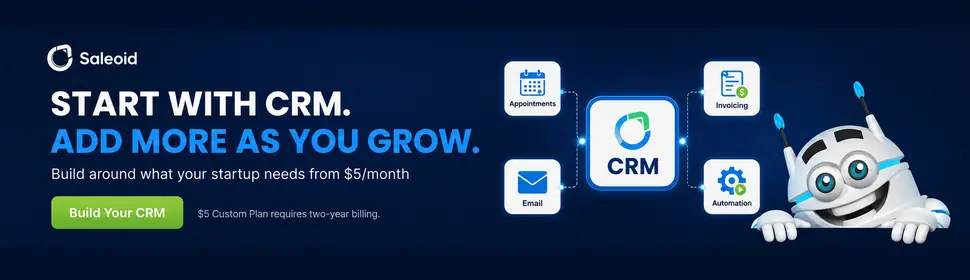
Saleoid takes a modular CRM pricing approach. Its Custom Sales CRM starts at $5 per month when billed every two years. The current starting allowance includes one user, 2,500 contacts and companies, three accounts, and five automations. Additional users cost $6 each, while optional apps start from $1 per app per month.
The CRM includes lead capture, pipeline management, tasks, follow-ups, customer activity tracking, lead scoring, and AI-assisted follow-up functionality. Startups can then add applications for email marketing, WhatsApp marketing, appointments, client portals, and workflow automation. They can also configure a CRM with invoicing or add AI chatbots rather than purchasing every module from day one.
That structure makes Saleoid particularly relevant when keeping the initial software bill low matters more than having every advanced feature immediately.
Key features
- Lead and customer management
- Sales pipeline tracking
- Tasks, notes, notifications, and customer activity history
- Lead scoring
- AI-assisted follow-ups
- Five automations in the starting Custom plan
- Roles and permissions
- Custom dashboards and advanced filters
- Additional business apps available as requirements expand
Pricing
- Custom Sales CRM: $5/month when billed every 2 years
- Extra apps: from $1/app/month
- Additional users: $6/user
- Starting allowance: 2,500 contacts and companies
- Starting allowance: 3 accounts
- Starting allowance: 5 automations
- Free trial: 15 days
Pros
- Low $5 starting rate for startups willing to choose two-year billing
- Modular pricing lets teams add functions selectively
- AI-assisted follow-up functionality is available in the CRM offering
- CRM and additional business apps can operate within one platform
- Useful limits for a founder or small early-stage team
Cons
- The advertised $5 monthly rate requires a two-year billing commitment
- The starting Custom plan includes one user
- Additional apps and users increase the actual monthly equivalent cost
- Smaller third-party integration ecosystem than long-established CRM platforms
Startup stage fit: Pre-seed through early growth, particularly for founders, agencies, consultants, service businesses, and small teams that prefer to start with core CRM functionality and expand gradually. Teams serving multiple clients can also review what separates the best CRM for agencies.
2. HubSpot CRM – Best Free CRM for First-Time Startup Users
Best for: Founders and very small startup teams that want to organize contacts, deals, and early sales activity before committing to a paid CRM.
Not ideal for: Startups that expect to need advanced sales automation, sequences, forecasting, or sophisticated reporting quickly, since those requirements can move the team into substantially more expensive tiers.
Ideal user: A solo founder or two-person team that needs a structured CRM without an initial software bill. For this audience, automation for solo business owners becomes especially useful once manual follow-ups become difficult to manage.
HubSpot remains one of the strongest free starting points for a startup. Its Free tools support up to two users and 1,000 contacts, with no time limit. You can manage contacts and deals, connect supported email accounts, schedule meetings, use basic sales tools, and start building a structured pipeline without entering a credit card.
The important consideration is what happens after your needs grow. HubSpot separates basic CRM functionality from many of its more advanced sales capabilities. Starter adds additional functionality and removes some HubSpot branding, while features such as sales sequences, deeper workflow automation, forecasting, and more advanced reporting are associated with higher Sales Hub tiers.
HubSpot also runs promotional pricing, so quoting one permanent Starter price can become misleading. Check its current pricing page when comparing costs and calculate what the plan containing the features you actually need will cost for your expected number of users.
Key features
- Contact, company, and deal management
- Visual deal pipeline
- Gmail and supported Outlook integrations
- Email tracking and templates with Free plan limits
- Meeting scheduling
- Live chat and limited conversational bots
- Large integration ecosystem
- Mobile CRM access
Pros
- Free tools have no time limit
- Supports up to two users and 1,000 contacts on the current Free offering
- Low barrier to entry for first time CRM users
- Large ecosystem of integrations and educational resources
- Clear upgrade path for companies that later need a broader platform
Cons
- Free tools have usage and feature limits
- HubSpot branding remains on some Free functionality
- Sequences and extensive sales automation require higher tiers
- Costs can rise substantially when a team needs Professional-level sales capabilities
- Promotional Starter pricing can make long-term cost comparisons harder unless you check the normal post-offer price
Startup stage fit: Best for idea stage and very early startups that want a capable free CRM first. Before committing long term, compare the cost of the tier you would need once automation, reporting, or a larger sales team becomes necessary.
Startups deciding between the two platforms can use a detailed Saleoid vs HubSpot comparison to evaluate long-term pricing, automation, and upgrade requirements.
3. Pipedrive – Best Sales Pipeline CRM for Founder-Led Startups
Best for: Startups with an active outbound or inbound sales process that needs crystal-clear pipeline visibility and nothing else getting in the way.
Not ideal for: Startups that need built-in invoicing, marketing automation, or project management. Pipedrive is sales-focused and requires integrations for functions beyond the pipeline, so teams wanting a wider platform may prefer a Pipedrive alternative.
Ideal user: A founder-led B2B startup or a 2–8 person inside sales team focused on moving deals from first contact to close, who wants a system that makes pipeline management effortless.
Pipedrive earns its reputation as the cleanest sales pipeline CRM for small teams. The interface is built around the pipeline. Deals move visually through stages, activities are tracked automatically, and the system surfaces what needs attention next without requiring complex configuration.
For startups transitioning from spreadsheets to structured sales management, Pipedrive is often the fastest path to operational clarity. It is not trying to be a marketing platform or an operations tool; it is built for one purpose: helping sales teams close more deals with less friction.
Key features
- Visual lead, deal, calendar, and pipeline management
- AI-powered report creation on the Lite plan
- Real-time sales feed for overdue tasks and opportunities
- 500+ integrations
- Full email sync and email tracking from the Growth plan
- Automations and nurturing sequences from the Growth plan
- Subscription and forecast reporting on Growth and above
Pros
- Best-in-class visual pipeline interface, low learning curve
- Activity tracking keeps sales reps focused on the right next step
- AI assistant available on standard plans, not just premium tiers
- Clean, distraction-free interface built specifically for sales
Cons
Lite starts at $14 per seat per month when billed annually, while teams needing full email sync and workflow automation need Growth, currently $39 per seat per month billed annually.
Startup stage fit: Early-stage through growth. Best for B2B sales-led startups where deal velocity and pipeline clarity are the primary operational needs.
4. Zoho CRM – Best Budget-Scalable CRM for Growing Startups
Best for: Startups on a tight budget that want deep customization, strong automation, and AI capabilities and are willing to invest time in initial setup to get there.
Not ideal for: Teams that need to get up and running in a day. Zoho CRM’s depth and configuration options create a steeper learning curve than simpler tools, which may lead these teams to consider a Zoho alternative.
Ideal user: A growth-stage startup with 5–20 people that wants a powerful, affordable CRM they can customize as the sales process matures without paying enterprise prices.
Zoho provides workflow automation, multichannel communication tracking, and AI-powered insights (via its Zia AI assistant) at pricing that remains competitive even as team size grows.
Key features
- Lead, contact, account, and deal management in one system
- Zia Zoho’s AI assistant for lead scoring, deal predictions, and anomaly detection
- Workflow automation with conditional logic and multi-step rules
- Multichannel communication: email, phone, social media, live chat
- Canvas, drag-and-drop interface customization without code
- Deep integration with the broader Zoho ecosystem (Books, Campaigns, Desk)
Pros
- Exceptional value feature depth; rivals’ platforms costing 3x as much
- Zia AI is available on mid-tier plans, not just enterprise
- Highly customizable to match specific sales processes
- Strong ecosystem if you use other Zoho tools
- Free plan available (up to 3 users) for very early testing
Cons
- Steeper learning curve; meaningful configuration takes time
- Interface can feel dated compared to modern alternatives
- Support quality varies; community forums are more reliable than direct support on lower tiers
- Full potential requires several days of setup, not hours
Startup stage fit: Growth through the scaling stage. Best for startups that have validated their sales process and want a robust, customizable platform that can evolve with the business.
5. Freshsales – Best CRM for Startups Wanting Automation Without Complexity
Best for: Startups that want sales pipeline management, built in communication tools, and a clear upgrade path into more advanced automation and AI capabilities.
Not ideal for: Teams expecting advanced Freddy AI functionality on the cheapest paid plan. Several of Freshsales’ stronger AI sales features sit on Pro or Enterprise.
Ideal user: A growing sales team that wants to combine contact management, pipeline tracking, email, chat, and phone capabilities without adopting a complex enterprise CRM.
Freshsales remains competitively priced for startups. Its Growth plan currently starts at $9 per user per month when billed annually, while a Free edition is available for up to three users.
Growth covers the fundamentals most early teams need, including Kanban views, contact lifecycle stages, built in chat, email and phone, email templates, custom fields, and basic workflows.
Key features
- Contact, account, and deal management
- Kanban pipeline views
- Contact lifecycle stages
- Built in chat, email, and phone
- Email templates and custom fields
- Basic workflows on Growth
- Sales sequences on Pro
- Contact Scoring by Freddy AI on Pro
- Deal Insights by Freddy AI on Pro
- Forecasting Insights by Freddy AI on Enterprise
Pros
- Free edition available for up to three users
- Growth starts at $9/user/month billed annually
- Communication tools are built into the CRM
- Clear progression from basic CRM to more advanced automation
- Pro adds meaningful AI-assisted sales functionality
Cons
- Key Freddy AI insights are not included in the $9 Growth plan
- Pro rises to $39/user/month billed annually
- Enterprise is required for Freddy AI forecasting insights
- Per-user pricing becomes more significant as the team expands
Startup stage fit: Early stage through growth. Growth works well for teams that primarily need pipeline management and basic automation, while startups buying specifically for Freddy AI scoring and deal insights should budget for Pro.
What Makes the Best Sales CRM for Startups in 2026?
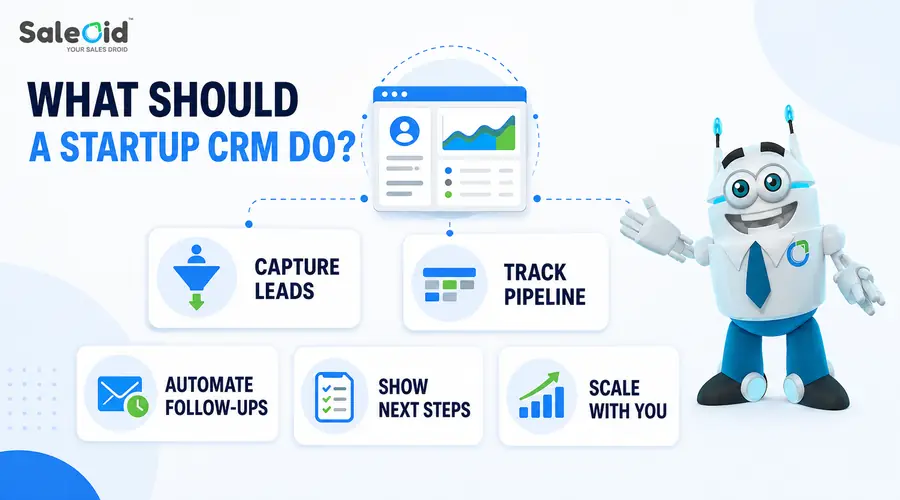
The CRM landscape in 2026 is meaningfully different from three years ago. AI automation is no longer only an enterprise add-on. The most important sales CRM features for small businesses and startups now include the following five non-negotiables:
1. AI-powered automation that works out of the box
Manual follow-up is the single biggest reason leads go cold at startups. The best CRM tools in 2026 automate this at entry level, not as a premium upgrade. Look for: AI-triggered follow-up sequences, smart reminders based on lead behavior, and chatbot-based lead capture. These should be available without a $100/month plan.
A structured automated sales follow up process can also help small teams respond consistently without relying on individual reps to remember every next action.
2. Transparent, scalable pricing
Startup budgets are tight and unpredictable. The right CRM should have pricing you can calculate over 12 months without surprises. Watch for: per-seat fees that compound quickly, contact-count limits that force upgrades, and features marketed as “included” but locked behind add-on costs. As a general rule, keep CRM spending within 5–8% of monthly revenue during early growth stages.
Before committing to a plan, review the current CRM pricing alongside user limits, contact allowances, automation caps, billing terms, and optional app costs.
3. Fast onboarding, measurable in hours, not weeks
If a CRM requires more than a day to get operational, adoption will suffer. Startups cannot afford a 2-week implementation project. The best tools for early-stage companies should get you from sign-up to managing live leads within a single working session.
4. Pipeline visibility without feature overload
Founders need to answer one question instantly: where is every deal right now? Understanding how to manage sales pipeline for small businesses starts with clear stages, ownership, activities, and follow-up status. The CRM should show these without burying them under enterprise dashboards, complex permission structures, or analytics modules the team will not use for another two years.
5. Scalability that grows with you rather than forcing migration
The most expensive CRM decision is choosing the wrong one and migrating data 18 months later. Evaluate not just what you need today, but whether the platform can support 10x your current lead volume, a larger team, and more complex workflows without requiring a full system change. Still evaluating your options? Read our detailed guide on choosing the best CRM for small businesses to understand how CRM requirements change as teams scale.
6 Common CRM Mistakes Startups Make and How to Avoid Them
Choosing the wrong CRM creates friction that compounds over time. These are the mistakes that consistently set startups back:
| Mistake | Why It Hurts |
|---|---|
| Choosing enterprise tools too early | Paying for unused features; overwhelmed team; low adoption |
| Picking free plans without exit plan | Costly migration later; locked into limited features at scale |
| Ignoring onboarding complexity | Weeks of setup; low team adoption; incomplete pipeline data |
| Confusing marketing suites with CRMs | Poor sales pipeline tracking; no structured follow-up workflow |
| Overpaying per seat too soon | Budget pressure; slows hiring and product investment |
| Prioritizing features over usability | Team stops updating CRM; leads slip; pipeline data becomes stale |
The pattern across all six mistakes is the same: choosing based on brand recognition, feature count, or perceived future needs rather than what the team will actually use consistently right now.
Step-by-Step: How to Choose the Right Startup CRM (5-Minute Framework)
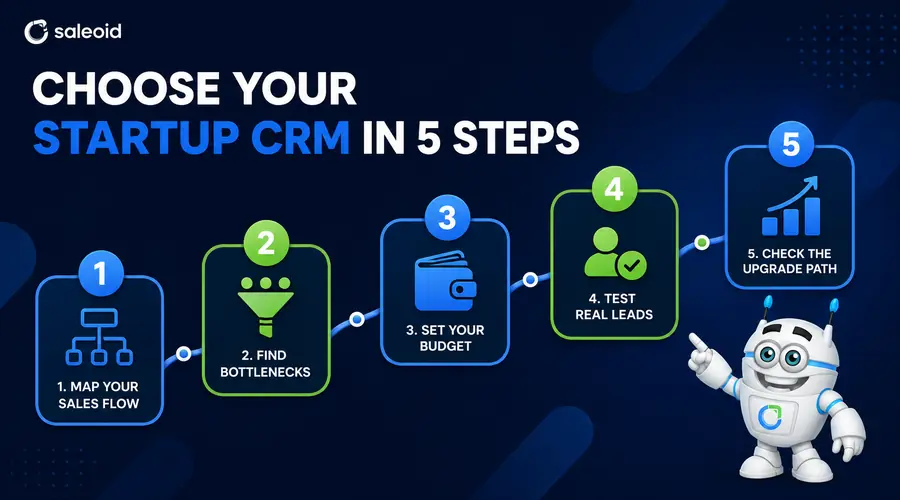
Use this structured process before committing to any platform. It takes five minutes and prevents costly mistakes.
Step 1: Map your current sales flow
Before testing any tool, write down how leads currently move through your process. Where do they come in (ads, referrals, forms, WhatsApp, cold email)? Who handles them first? How many touchpoints happen before a decision? How do you define a closed deal?
A CRM should match your process, not force you to redesign it around the software’s assumptions.
Step 2: Identify your top 3 manual bottlenecks
List the three tasks your team currently does manually that take the most time or cause the most missed opportunities. Common answers: sending follow-up reminders, updating deal stages, scheduling next calls. These are your automation priorities, any CRM you choose must address them at entry-level pricing.
Step 3: Set a hard budget ceiling
Decide the maximum you will spend per month before evaluating tools. Include per-seat scaling, if you plan to add 3 team members in 6 months, calculate that cost now, not after you have committed. Free plans are appealing but plan for the moment they stop being sufficient.
Step 4: Run a real trial not a demo walkthrough
Do not judge a CRM by a sales demo. Import 20 real leads, build your actual pipeline stages, and run your real follow-up process for 3–5 days. If the system does not feel natural by day 3, it will not get adopted by your team at scale.
Step 5: Check the upgrade path
Before signing up, look at the next pricing tier. Understand exactly what triggers an upgrade (contact count, user seats, automation limits). If the trigger point matches your 12-month growth trajectory, factor that cost into your decision now.
Quick decision checklist:
1. Sales flow mapped before tool evaluation
2. Top 3 manual bottlenecks identified
3. 12-month budget ceiling set (including seat scaling)
4. Real lead data tested during trial, not just demo content
5. Upgrade triggers checked against growth plan
6. Team adoption tested, not just founder preference
Which CRM Should You Choose? Final Decision Guide
Use this guide to match your current priority to the right tool.
| Your Priority | Choose This CRM | Key Reason |
| Need a free entry-level CRM | HubSpot CRM | Free tools for up to 2 users and 1,000 contacts |
| Need a low-cost AI-assisted CRM | Saleoid | Starts at $5/month with two-year billing and supports modular expansion |
| Need the clearest sales pipeline | Pipedrive | Sales-focused visual pipeline with a strong activity-based workflow |
| Need long-term customization on a budget | Zoho CRM | Starts at $14/user/month annually with extensive customization options |
| Need built-in communication and an AI upgrade path | Freshsales | Growth starts at $9/user/month annually, with stronger Freddy AI tools on Pro |
The best sales CRM for startups is the one your team updates every single day. Consistent daily usage creates the data that drives better follow-ups, clearer pipeline visibility, and ultimately more closed deals. Start simple, build the habit, and add capability as your process matures.
FAQs on Sales CRM for Startups
The best sales CRM for startups in 2026 is Saleoid for affordability and AI automation ($5/month), HubSpot CRM for a free starting point, and Pipedrive for the clearest sales pipeline experience. The right choice depends on your startup stage: pre-seed teams benefit most from free or low-cost tools, while early-growth startups need automation and pipeline clarity as a priority. All five tools in this guide are evaluated with real pricing, honest pros/cons, and startup-stage fit.
HubSpot CRM is the most common starting point for startups because it has a genuinely free plan with no time limit. However, many startups migrate away as they scale due to rising costs on paid plans. Pipedrive is widely used among sales-led B2B startups. In 2026, AI CRM tools like Saleoid are growing in adoption among budget-conscious founders who want automation from day one without paying enterprise prices.
Saleoid is the cheapest full-featured CRM for startups at $5/month on a 2-year plan, making it the lowest verified entry price among tools that include genuine AI automation. HubSpot CRM offers a free plan but with limited automation. Zoho CRM has a free tier for up to 3 users. Freshsales also has a free plan for small teams. For startups that need AI-powered follow-ups and automation at the lowest ongoing cost, Saleoid offers the best price-to-capability ratio.
Simple CRM tools like Saleoid, HubSpot, and Pipedrive can be set up in 1–4 hours for a basic pipeline with imported contacts. Zoho CRM typically requires 1–3 days for meaningful configuration. A rule of thumb: if you cannot get to your first active lead in the system within the same day you sign up, the tool is too complex for your current stage. Prioritize onboarding speed over feature depth when you are under 10 people.
HubSpot’s free CRM is good enough for very early-stage startups managing under 1,000 contacts with a simple pipeline and no automation requirements. Once you need email sequences, automation workflows, or custom reporting, the free plan becomes limiting and paid plans start at $20/user/month or higher. Use the free plan as a starting point with a clear decision point for when you will move to a more capable or more affordable platform.
AI CRM software helps startups automate the tasks that cause leads to go cold, follow-up reminders, lead prioritization, and initial qualification. Specific AI capabilities in 2026 CRM tools include: AI-triggered follow-up sequences (Saleoid), Freddy AI lead scoring (Freshsales), Zia AI predictions (Zoho CRM), and AI sales assistant recommendations (Pipedrive). For a team of 1–5 people, AI automation can effectively double the number of leads that receive timely follow-up without adding headcount.
Startup CRMs prioritize speed, simplicity, and low cost; enterprise CRMs prioritize customization, integration depth, and advanced analytics, often at 10–50x the price. Enterprise platforms like Salesforce require dedicated admins, weeks of implementation, and significant per-seat fees. Startup CRM tools are designed to be operational within hours, managed by non-technical founders, and priced for early-stage budgets. In 2026, the gap has narrowed somewhat as AI features have become available at startup price points, but the operational complexity difference remains significant.
It depends on whether automation is a current need. If you have under 200 contacts and a simple pipeline with no follow-up sequences, a free CRM (HubSpot free or Freshsales free) is a reasonable starting point. If lead volume is growing and manual follow-up is already causing missed opportunities, a paid AI CRM like Saleoid at $5/month delivers significantly more value than a free tool with no automation. The cost of missed leads from a free plan with no automation typically exceeds the cost of a paid plan within the first month of active use.
Which CRM Should You Choose? (Final Decision Guide)
Choosing the best sales CRM for startups ultimately depends on your current growth stage, team size, and operational priorities. Instead of focusing on brand popularity, align your choice with the problem you’re trying to solve right now.
Use this quick decision guide:
- Need a free starter CRM: HubSpot CRM is ideal for early teams testing structured sales processes.
- Need strong sales pipeline focus: Pipedrive works well for founder-led sales teams that need visibility and activity tracking.
- Need budget simplicity and quick adoption: Lightweight tools like Saleoid help early-stage startups create structure without increasing operational costs.
- Need long-term scalability with customization: Zoho CRM suits startups preparing for growth and expanding workflows.
- Need automation with ease of use: Freshsales offers a balance between automation capabilities and simple onboarding.
The best CRM for small businesses is the one your team consistently uses to manage conversations, track deals, and move opportunities forward. Start simple, build operational discipline, and scale your CRM capabilities as your startup grows.