



There is a version of Freshsales that works perfectly. You’re a small team with a simple pipeline and a straightforward sales motion. But for many, that honeymoon phase ends when the team hits 15+ reps.
However, as your operations mature, you encounter the “Growth Wall”, where rigid pipelines break, automation lacks branching logic, and per-user pricing becomes a massive budget line item. If you’re feeling the friction, it’s time to look at the best Freshsales alternatives for growing sales teams in 2026.
To help you navigate this, this guide isn’t just a list of features. We’ve analyzed the top CRM shifts this year, where modular CRM software for small businesses like Saleoid lets you pay only for what you use. We’ve reviewed these alternatives based on how they handle the transition from 10 to 50+ reps, so you can stop fighting your tools and start scaling your revenue.
Before we move forward, if you’re still evaluating how CRM tools support your sales process end to end, this breakdown of what sales CRM software actually does is worth reading before you commit to any switch. Understanding what you actually need from a CRM makes the comparison far easier.
This blog has been designed for growing sales teams that deserve a clear picture of what’s available before they’re locked into a contract that no longer fits the team they’ve become.
Why Growing Teams Look for Freshsales Alternatives
In reality, it rarely comes down to one thing. It’s usually a slow build. Small friction points that compound until the team starts asking questions.
- Pipeline flexibility hits a wall: To begin with, when you’re managing one or two sales motions, a rigid pipeline structure is fine. When you’re running multiple products, segments, or deal types, the lack of customization becomes a daily inconvenience.
- Automation gets complicated fast: In addition, Freshsales has automation, but teams scaling up often find that building multi-step sequences or branching logic requires more workarounds than it should. Time you spend configuring the CRM is time not spent selling.
- Pricing doesn’t stay friendly: On top of that, the starting tier looks accessible. But once you add seats, unlock the features you actually need, or move to a higher plan, the cost curve gets steep quickly, especially for teams at 10–30 reps.
- Workflow visibility stays limited: At the same time, sales managers need to see what’s happening across the team without pulling reports manually. When your CRM makes visibility hard, coaching and forecasting both suffer.
- Integration depth varies: Finally, many teams discover mid-implementation that connecting Freshsales to their existing stack. These include support tools, marketing platforms, and finance systems requires more engineering effort than expected.
On that note, many teams also try to hold on to spreadsheets alongside their CRM for longer than they should. This comparison between CRM and Excel explains exactly where those workarounds start to break down.
How We Evaluated These Tools
To ensure this list is practical, our research for 2026 focused on what we call “growth friction”, the challenges sales teams face as they scale from around 10 to 50 reps.
To build this list of best Freshsales alternatives for growing sales teams, we reviewed feedback across platforms like G2 and Capterra, paying close attention to patterns in real user experiences. Instead of just looking at feature lists, we focused on where tools start to slow teams down, whether that’s pricing changes, workflow limitations, or usability issues that show up as teams grow.
“In fact, the biggest mistake growing teams make is staying on a ‘Starter CRM’ for too long. Once your admin time exceeds your selling time, the cost of switching is actually lower than the cost of staying.”
Saleoid’s Sales Ops Insight
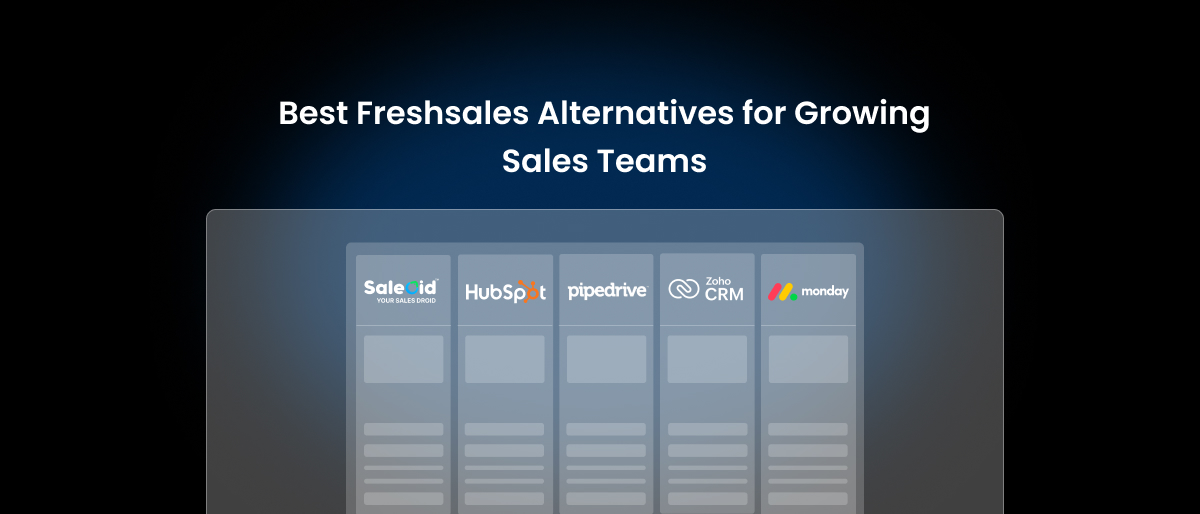
Best Freshsales Alternatives for Growing Sales Teams: Features & Pricing Comparison
| Tool | Best For | Key Strength | Automation Depth | Pricing Model | Starting Price |
|---|---|---|---|---|---|
| Saleoid | Growing sales teams that want flexibility without complexity | Modular CRM + operations in one system | Advanced (workflow automation + CRM + billing) | Modular + bundled plans | Starts from $5/month (long-term); $19/month Starter |
| HubSpot CRM | Teams building a full sales + marketing ecosystem | Strong free CRM + ecosystem integration | Moderate to Advanced (depends on tier) | Per user + tiered hubs + contact scaling | Free; paid plans from ~$15–$20/user/month |
| Pipedrive | Sales-focused teams prioritizing pipeline visibility | Simple, highly visual pipeline management | Moderate (automation from higher tiers) | Per user (tiered plans) | Starts ~$14–$15/user/month |
| Zoho CRM | Budget-conscious teams needing customization | Deep customization + wide feature set | Advanced (workflows, AI, process automation) | Per user (tiered plans) | Starts ~$14/user/month |
| Close | Inside sales teams with high outreach volume | Built-in calling + email + SMS workflows | Advanced (outreach-focused automation) | Per user (no free plan) | Starts ~$59/user/month |
| Monday Sales CRM | Teams prioritizing workflow visibility and flexibility | Visual boards + customizable workflows | Moderate (automation builder available) | Per user (tiered plans) | Starts ~$12/user/month |
| Salesforce Starter Suite | Teams planning for long-term scaling into enterprise systems | Enterprise-grade CRM foundation with ecosystem access | Moderate (basic automation + workflows in Starter) | Per user (tiered Salesforce ecosystem) | Starts ~$25/user/month |
Top 7 Freshsales Alternatives for Growing Sales Teams
1. Saleoid
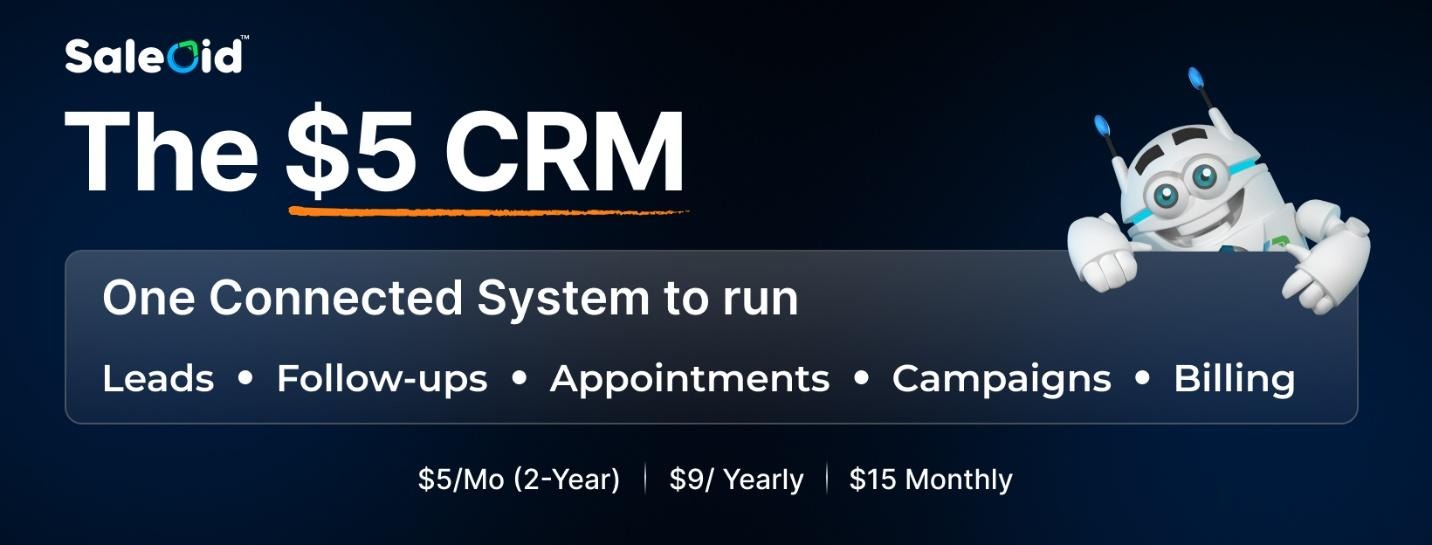
Saleoid is built for the kind of teams this blog focuses on, i.e. sales teams that have moved beyond the early stage but aren’t running large enterprise operations yet. It fits well for teams between 10 and 60 reps who need better pipeline control, simple automation, and clear visibility without dealing with complex systems or high costs.
More importantly, what makes Saleoid one of the best Freshsales alternatives for growing sales teams is how the platform is structured. It follows a modular approach, so you can set it up based on how your sales process actually works, instead of adjusting your process to fit the tool.
It also helps solve a common problem many teams face today. They pay for features they don’t use. Instead of upgrading to a bigger plan just to unlock one feature, you can add what you need as your requirements grow.
Best for: Growing B2B sales teams that want a flexible CRM without unnecessary complexity or pricing pressure.
Key features for scaling teams:
- Customizable pipelines that support different sales processes
- Easy workflow automation without needing technical setup
- Role-based access for better team control
- Pipeline dashboards for clear deal visibility
- Reports focused on real sales metrics like conversion rate, deal movement, and team activity
- Ability to connect with other tools your team already uses
Pricing: Starts from $5/month on long-term plans, with bundled plans from $19/month. You can also add features individually (around $1 per app), so you only pay for what you actually use.
Why it’s a stronger fit than Freshsales for growing teams: Freshsales works well when you’re starting out. But as your sales process becomes more detailed and your team grows, you need more flexibility and better cost control. Saleoid is a strong Freshsales alternative built for that stage, so you don’t have to switch tools again after a short time.
2. HubSpot CRM

On the other hand, HubSpot is the most recognized name on this list, and its free CRM tier is one of the most capable free CRM offerings available by a meaningful margin. For teams that also have marketing or customer success functions, the appeal is even stronger. HubSpot’s ecosystem connects sales, marketing, and service in ways that most standalone CRMs simply can’t replicate.
Best for: Teams that want sales CRM tightly integrated with marketing automation, or organizations building a unified revenue platform across multiple functions.
Key features for scaling teams:
- Visual deal pipeline with drag-and-drop stage management
- Email sequences, meeting scheduling, and real-time contact activity tracking
- Native connection to HubSpot’s Marketing Hub and Service Hub
- Solid reporting at Professional and Enterprise tiers
- Large partner ecosystem and integration library
- Sales playbooks and conversation intelligence at higher tiers
Pricing: Free plan available with meaningful functionality. Paid Sales Hub tiers start around $15–$20 per user/month, but advanced automation, reporting, and forecasting features are available in higher tiers that significantly increase overall cost.
Why it’s worth considering over Freshsales: If you’re running inbound sales or have a marketing team that needs to share pipeline data with sales reps, HubSpot’s ecosystem is genuinely hard to match. The caution for growing teams is cost. HubSpot can become expensive fast, especially when you’re also paying for Marketing Hub. If you only need the CRM, you may find you’re paying for infrastructure you don’t use.
3. Pipedrive
Similarly, Pipedrive built its reputation on one thing: putting the pipeline front and center. For sales teams that operate with well-defined, repeatable processes and want their reps spending time selling rather than navigating a CRM, that focus is still one of the cleaner experiences available.
Best for: Teams with structured, repeatable sales processes where pipeline visibility and activity management are the top priorities.
Key features for scaling teams:
- Highly visual Kanban-style pipeline that’s fast to learn and easy to use
- Activity-based selling with reminders, task management, and follow-up tracking
- Workflow automation from the Advanced plan up
- Revenue forecasting and goal tracking tools
- Solid mobile app for reps on the go
- Good API and integration options for connecting to your stack
Pricing: Starts around $14–$15 per user/month for the Essential plan. Automation features unlock from around $29 per user/month at the Advanced tier.
Why it edges out Freshsales for certain teams: Freshsales packs in more features on paper, but Pipedrive wins consistently on one metric that actually determines CRM success. When reps actually log deals and update stages consistently, your pipeline data becomes trustworthy. And trustworthy pipeline data is what managers and forecasting depend on.
4. Zoho CRM
In contrast, Zoho CRM is arguably the most customizable platform at its price point in the market. If your sales process has unusual complexity, multi-tier approval workflows, territory management, or non-standard deal structures, Zoho can almost certainly accommodate it. This makes it one of the best Freshsales alternatives for growing sales teams.
Best for: Budget-conscious teams that need significant customization depth without moving to enterprise-tier pricing.
Key features for scaling teams:
- Highly configurable modules, fields, layouts, and workflows
- Zia AI assistant for lead scoring, deal predictions, and anomaly detection
- Territory management and multi-currency support for teams with geographic complexity
- Strong mobile app experience for field sales
- Canvas design studio for customizing the CRM interface
- Blueprint feature for defining and enforcing sales processes at scale
Pricing: Standard plan starts around $14/seat/month, with the Professional tier unlocking the features most scaling teams need at around $23/seat/month.
Why it’s a genuine Freshsales alternative: Freshsales and Zoho CRM operate in the same competitive space, but Zoho offers significantly more customization flexibility. The tradeoff is honest: the learning curve is steeper, and getting the most out of Zoho requires genuine investment in setup. Teams willing to make that investment often find it pays back.
5. Close

For teams with a different need, Close is purpose-built for inside sales teams running high outreach volume. The core design philosophy is that a sales CRM should eliminate as many steps as possible between a rep and their next conversation. Close platform delivers on that in ways Freshsales doesn’t even attempt.
Best for: Inside sales teams with high call volume, fast deal cycles, and reps who spend most of their day in outreach mode.
Key features for scaling teams:
- Built-in power dialer with call recording and voicemail drop
- Email and SMS sequences managed entirely within the CRM
- Smart Views for prioritizing daily tasks without manual triage
- Activity-based reporting that shows managers exactly what’s happening at the rep level
- Fast search and contact management built for speed
- Clean, opinionated interface that doesn’t get in the way
Pricing: Starts around $59 per user/month. Higher than most alternatives on this list, but worth evaluating against the cost of the calling and sequencing tools it replaces.
Why it beats Freshsales for inside sales: Freshsales requires third-party integrations and the ongoing management that comes with them to match what Close does natively. For teams where outreach volume directly determines revenue, the operational simplicity of having calling, email, and CRM in one place is worth paying for. Less context-switching means more conversations.
6. Monday Sales CRM
Monday Sales CRM is the natural choice for teams already working inside the Monday.com ecosystem, but it holds up as a standalone CRM option too. Its strength is workflow visibility, which makes it unusually easy for managers to see deal status, team activity, and pipeline health without pulling a separate report.
Best for: Teams that prioritize transparency and workflow visibility, or organizations already using Monday.com for project management.
Key features for scaling teams:
- Visual board-based pipeline that’s highly customizable
- Flexible column types and status tracking that adapt to your process
- Automation builder with straightforward if/then logic
- Integrations with popular tools including Gmail, Outlook, Slack, and Zoom
- Dashboards that pull data across multiple boards for a combined view
- Easy collaboration features for cross-functional deals
Pricing: CRM plans start around $12 per user/month, with more advanced tiers ranging from $14 to $24 per user/month depending on features and automation limits.
Why it works as a Freshsales alternative: Monday gives teams more flexibility in how they structure and visualize their pipeline. It’s less opinionated about what a sales process should look like, which is an advantage for teams with non-standard workflows. The tradeoff: because it’s flexible, it requires thoughtful setup. Teams that invest in configuring it properly get a strong tool. Teams that stand it up without a plan end up with an expensive spreadsheet.
7. Salesforce Starter Suite
Finally, Salesforce’s entry-level offering deserves a mention for one specific type of team: companies that know they’re headed toward enterprise complexity and want to start on a platform they won’t have to migrate away from in two years. Salesforce Starter Suite brings the broader Salesforce ecosystem into a more accessible, small-business-friendly package.
Best for: Growth-stage teams with a clear trajectory toward enterprise-scale sales operations and long-term platform standardization.
Key features for scaling teams:
- Core CRM functionality – accounts, contacts, opportunities, and activity tracking
- Built-in email marketing and basic automation capabilities
- Web-to-lead capture and lead management
- Reporting dashboards for pipeline visibility and performance tracking
- Access to the AppExchange ecosystem for integrations and extensions
- Foundation for scaling into Sales Cloud and other Salesforce products
Pricing: Starts at $25 per user/month (Starter Suite), which combines CRM, email marketing, and basic automation. Costs increase as teams move into more advanced Salesforce products and higher-tier plans.
Why it matters: Freshsales doesn’t scale to Salesforce territory. If your roadmap includes enterprise deals, complex processes, or a full revenue operations setup, starting on a platform you can grow into, even at a basic tier, can help avoid a migration later. The tradeoff is real. Higher complexity, more setup effort, and a steeper learning curve compared to most tools on this list.
Best Freshsales Alternative Based on Use Case
So, not every growing sales team has the same bottleneck. Below, we’ve discussed where each option makes most sense based on what you’re actually trying to solve:
- Need better pipeline visibility across multiple reps, products, or segments? Choose Saleoid or Monday Sales CRM.
- Need the most affordable CRM that still handles real complexity? Choose Zoho CRM.
- Running inbound sales with a marketing team in the same org? Choose HubSpot CRM.
- Need fast adoption and a clean pipeline tool reps will actually use? Choose Pipedrive.
- Running high-volume inside sales with heavy calling and sequencing? Choose Close.
- Building toward enterprise-scale and want to avoid a future migration? Choose Salesforce Starter.
If you want to explore further, this roundup of the best sales CRM tools for startups covers additional platforms that might fit depending on where your team is in its growth curve.
Final Take
Ultimately, Freshsales is a capable CRM. It earns its place in a lot of early-stage sales stacks, and there’s nothing wrong with starting there. But capable and scalable aren’t the same thing. And for growing sales teams, the distance between those two words starts to cost real money, real pipeline, and real rep time.
The best CRM for agencies and growing teams isn’t the one with the longest feature list. It’s the one that matches where you are now and doesn’t become an obstacle six months from now. It means thinking about what your managers need to see, not just what your reps need to log. It means thinking about what the pricing looks like at 30 seats, not just at 8.
Use growth stage, not feature count, as your primary filter. A 12-person team closing 30-day deals has fundamentally different CRM needs than a 40-person team managing six-month enterprise sales cycles, even if both are “growing sales teams” on paper.
In conclusion, if you need a CRM that’s modular enough to adapt as your process matures, doesn’t penalize growth with sudden cost jumps, and gives sales managers the pipeline clarity they need, Saleoid is worth a serious look.
It’s not trying to serve every type of team. It’s built specifically for the stage most Freshsales users find themselves in when they start asking whether there’s something better.
That focus, honestly, is what makes the difference.
In the end, don’t wait until your pipeline breaks. Start a 15-day trial of Saleoid today to see how modular CRM scales with your 2026 goals. Check Saleoid’s CRM Pricing.