

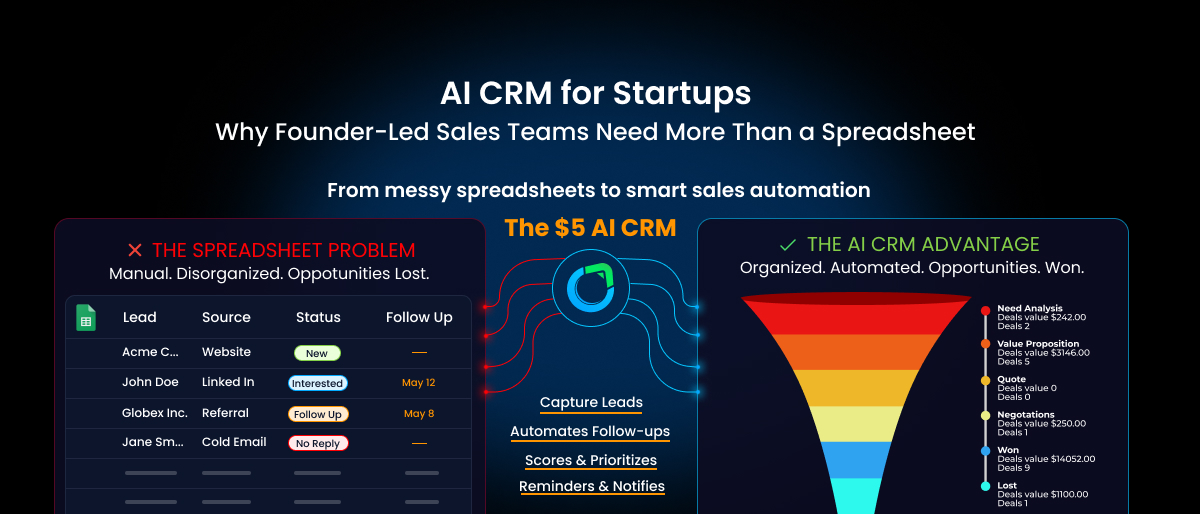

In the early stage of a startup, sales usually live inside a spreadsheet. One tab for leads. One column marked “follow up.” A few notes from discovery calls that only make sense to the founder who wrote them. It works for a while, until the pipeline grows faster than the system managing it.
That is usually the moment things start slipping. The founder should have followed up with a lead last week, but product work, hiring, customer support, and other daily responsibilities pushed that lead to the bottom of the priority list. Someone who sounded interested disappears quietly, and a deal that could have closed ends up going to a competitor simply because nobody followed up at the right time.
The issue is not that spreadsheets are bad. The issue is that spreadsheets only store information. They do not remind you which lead needs attention, identify cold prospects, draft follow-up emails, or help manage customer conversations automatically.
This is where AI CRM for startups becomes valuable. A modern startup sales CRM helps founders track leads, organize conversations, automate follow-ups, and manage founder-led sales without adding operational complexity. Platforms like Saleoid are built specifically for this stage. Explore AI CRM for small businesses to see how it works before reading the full breakdown below.
In this guide, we will look at how AI CRM software works for startups, why spreadsheets eventually break down, and what founders should actually look for in a CRM for early-stage startups.
The Spreadsheet Problem Nobody Talks About
Most startups begin with a spreadsheet, and honestly, that makes sense. It is fast, familiar, free, and easy to set up. At the beginning, when you are handling a handful of leads and customer conversations, a spreadsheet feels more practical than spending days learning a complicated CRM system.
The problem starts when the business grows but the system managing sales does not.
Founder-led sales move quickly. Leads come from LinkedIn messages, website forms, referrals, networking calls, email introductions, and demo requests. Conversations happen across inboxes, calendars, WhatsApp chats, and meeting notes. Over time, the spreadsheet stops being a clear sales pipeline and becomes a list that depends entirely on memory.
That is usually where startups begin losing opportunities without realizing it.
According to Spendbase, 32% of sales reps spend more than an hour every day on manual data entry instead of selling. For startup founders managing sales alongside hiring, product, fundraising, and operations, that hour is not just inefficient. It directly affects revenue and follow-up consistency.
An AI CRM for startups solves this by turning lead tracking, follow-ups, reminders, conversation history, and pipeline management into an active system instead of a passive spreadsheet.
What a Spreadsheet Cannot Do That Costs You Deals
A spreadsheet cannot tell you when a lead has gone cold. Someone who replied positively two weeks ago quietly disappears because there is no automated reminder telling you the follow-up window is closing.
- It cannot draft follow-up emails or organize customer communication. Every reply starts from scratch, even when the conversation is similar to the last ten leads you handled.
- It cannot score leads based on activity or engagement. A high-intent prospect and a dead lead sit next to each other in the same sheet with no indication of which deserves attention first.
- It also cannot track complete conversation history. The notes might live in one tab, the proposal in email, the meeting in your calendar, and the last customer reply somewhere inside a long message thread.
This is why many startups eventually move from spreadsheets to AI CRM software that can organize conversations, automate follow-ups, and manage sales activity in one place.
When the Spreadsheet Breaks
The spreadsheet usually fails before founders realize it has failed.
You lose opportunities when a lead signs with a competitor because nobody follows up in time. Important prospects also slip through the cracks when you cannot find their details because someone buried the conversation in a spreadsheet tab months ago. Missed meetings become more likely when a reminder stays hidden in a notes column instead of a real workflow.
Many early-stage businesses are still managing customer relationships manually at the exact stage where follow-up consistency starts affecting revenue.
That is the point where startups stop needing a spreadsheet and start needing a startup sales CRM that actively helps manage leads, conversations, reminders, and customer relationships before opportunities disappear.
What “AI CRM” Actually Means for an Early-Stage Startup
The term “AI CRM” is everywhere right now, but it does not always mean the same thing. Many CRM platforms describe themselves as AI-powered because they added an email summarizer, chatbot, or writing assistant to an existing system. That improves a few tasks, but it does not fundamentally change how the CRM works.
For an early-stage startup, the real value of AI CRM software is not having another feature sitting inside the dashboard. It is reducing the mental load that comes with founder-led sales.
At this stage, founders are usually managing product development, hiring, customer support, fundraising, and sales at the same time. The problem is rarely forgetting how to sell. The challenge is remembering which lead needs attention today, who has gone quiet, what you discussed in the last meeting, and which follow-up you should make next.
This is where AI CRM for startups becomes useful. Instead of acting like a passive database, the CRM actively helps manage follow-ups, lead prioritization, customer communication, and pipeline activity.
That difference matters because startups do not need more software to maintain. They need systems that reduce operational overhead while helping sales move faster.
Experts believe that businesses using generative AI in their CRM are 83% more likely to exceed their sales goals. For early-stage startups where growth depends heavily on follow-up consistency and sales velocity, that advantage becomes difficult to ignore.
If you want a deeper breakdown of how AI CRM software works, read our guide on what is an AI CRM.
AI-Enhanced vs AI-Native: What the Difference Means in Practice
Many traditional CRM platforms now include AI features. In most cases, vendors keep the original CRM system and layer AI features on top of it.
| AI-Enhanced CRM | AI-Native CRM |
|---|---|
| AI added to an existing CRM | AI built into the CRM workflow |
| Mostly assists after manual work | Helps move sales activity forward automatically |
| Requires manual lead management | Identifies leads needing attention |
| AI summarizes notes or emails | AI drafts follow-ups proactively |
| User controls most workflows manually | AI assists with prioritization and next actions |
| Better suited for larger enterprise setups | Better suited for founder-led sales teams |
| Often requires setup and customization | Faster onboarding and simpler workflows |
| AI features usually locked behind higher plans | AI included in the core workflow |
For early-stage startups, the difference is practical. An AI-enhanced CRM still depends heavily on manual management. An AI-native CRM helps founders manage leads, follow-ups, appointments, and customer conversations with far less operational overhead.
5 Things an AI CRM Should Do for a Founder Without You Asking
- Score your leads automatically: An AI CRM should identify the leads that are most active or most likely to convert. Founders should not have to build manual scoring systems or complicated workflows.
- Draft follow-up emails from context: Instead of relying on generic templates, the CRM should generate follow-ups using previous conversations, customer activity, and deal history.
- Flag deals before they go cold: A startup sales CRM should proactively identify stalled conversations. It should also remind founders to take action before opportunities disappear.
- Answer questions about your pipeline in plain language: Founders should be able to ask questions like “Who have I not contacted this week?” and get immediate answers directly from the CRM.
- Handle appointment booking automatically: The CRM should simplify scheduling by allowing leads to book meetings, receive reminders, and log appointments without long back-and-forth email chains.
Why Founder-Led Sales Is the Hardest Sales Motion to Run Without AI
In the early stage of a startup, the founder is usually the sales team.
That sounds manageable when you have only a handful of leads. Founder-led sales becomes much harder because founders must sell while keeping the business running. Product decisions, hiring, customer support, fundraising, onboarding, operations, and sales all compete for attention at the same time.
Sales opportunities rarely disappear because founders cannot sell. They disappear because follow-ups get delayed, conversations lose momentum, and pipeline visibility breaks down during periods of heavy context switching.
This is where AI CRM for founders changes the workflow. Instead of relying on memory, sticky notes, inbox searches, and spreadsheet reminders, an AI CRM for startups actively tracks conversations and highlights the leads that need attention. It also drafts follow-ups and keeps the sales process moving while founders focus on other priorities.
According to Capterra, 43% of businesses say CRM software reduces workload by 5 to 10 hours per week. For an early-stage founder, that is not just productivity improvement. It is additional time to sell, follow up, and keep revenue moving.
What Founder-Led Sales Looks Like Without a CRM
A warm lead replies positively after a product demo. Meanwhile, the founder spends the next two weeks closing another customer and preparing for investor meetings. By the time they remember to follow up, the lead has already signed with a competitor.
A discovery call ends on Tuesday with genuine buying intent. The founder opens a draft follow-up email and plans to send it later. By Friday, they have forgotten about it, and the momentum from the conversation is gone.
An investor introduces a potential customer through LinkedIn messages. The conversation gets buried under dozens of notifications, never makes it into the spreadsheet, and quietly disappears from the pipeline.
None of these failures happen because the founder is careless. They happen because founder-led sales creates too many moving parts for manual systems to manage consistently.
What Changes When AI Handles the Sales Admin
With an AI CRM in place, the workflow changes completely.
The lead from the product demo gets flagged automatically after several inactive days, and the CRM drafts a follow-up email before the opportunity goes cold.
The discovery call follow-up is generated immediately using conversation context, meeting notes, and pipeline activity, reducing the delay between conversation and response.
The investor introduction is automatically captured inside the CRM, attached to the contact record, and added to the sales pipeline with reminders and follow-up tracking already in place.
This is why AI CRM software matters so much for startups. The value is not just automation. The value is removing the operational overhead that causes founder-led sales pipelines to break under pressure.
Platforms like Saleoid are built around this exact stage of growth by helping founders manage leads, follow-ups, conversations, and sales activity from one AI-powered CRM without adding enterprise-level complexity or pricing.
What to Look for in an AI CRM as an Early-Stage Startup
Choosing a startup sales CRM is difficult because most CRM platforms are built for companies much larger than the one you are running today. Early-stage founders often evaluate software based on where they hope the business will be in three years instead of what the sales process actually looks like right now.
At the startup stage, the best AI CRM for founders is usually the one that reduces manual work immediately, helps maintain follow-up consistency, and keeps the pipeline organized without adding setup complexity.
The challenge is knowing which features matter now and which ones only become useful later.
6 Criteria That Matter at the Startup Stage
- Zero setup time: If it takes days or weeks to configure your CRM before adding the first lead, it is too heavy for an early-stage startup. A good AI CRM for startups should let founders start managing leads almost immediately.
- AI at the base price: Many CRM platforms advertise AI features but restrict them to expensive plans. Before committing, check whether lead scoring, AI follow-ups, conversational CRM features, and workflow assistance are actually included in the entry-level pricing.
- No minimum seats: A founder-led sales process should not require paying for unused seats. Early-stage startups need CRM pricing that works for solo founders and small teams.
- Lead scoring that works from day one: An AI CRM should automatically identify active leads without requiring months of historical sales data or complex scoring rules.
- Follow-up drafting, not just reminders: Reminders still depend on founders stopping what they are doing and writing emails manually. A startup CRM with AI should help draft follow-ups using existing conversation context.
- Pricing built for startups: For most early-stage companies, the practical pricing range for CRM software is usually between $5 and $20 per user per month. Anything significantly above that starts competing with other critical startup expenses.
Platforms like Saleoid are designed around these realities by offering AI-powered CRM features, conversational CRM workflows, and startup-friendly pricing from the beginning.
For a full breakdown of what each CRM actually costs beyond the headline price, see our guide to affordable CRM for startups.
3 Things That Do Not Matter Yet
- Deep reporting and forecasting: At an early stage, most startups do not have enough historical sales data for advanced forecasting dashboards to provide meaningful insight.
- Advanced workflow automation: You do not need hundreds of automation workflows when the sales team is one or two people. A few reliable automations for follow-ups, reminders, and lead management are usually enough.
- Integrations with dozens of tools: Most early-stage startups operate with a simple stack: email, calendar, meetings, and communication tools. A CRM does not need to connect to 40 platforms to be useful at this stage.
One of the most common startup mistakes is choosing CRM software designed for a much larger company. A platform built for a 50-person sales organization usually comes with layers of reporting, configuration, permissions, and workflow management that slow down a founder-led sales process instead of helping it.
The best AI CRM for an early-stage startup is not the one with the biggest feature list. It is the one that helps founders manage leads, customer conversations, follow-ups, and appointments with the least operational overhead possible.
Top AI CRM Software for Startups in 2026
Choosing the right AI CRM for startups depends on your sales process, budget, team size, and how much operational complexity you can realistically manage at an early stage. Some startup sales CRM platforms focus heavily on enterprise reporting and customization, while others prioritize speed, automation, and founder-led sales workflows.
For most early-stage startups, the best AI CRM is usually the one that helps manage leads, follow-ups, customer communication, and pipeline activity without requiring weeks of setup or expensive upgrades for AI features.
| AI CRM for Startups | Best For | Starting Price | AI Features Included at Base Plan | Startup-Friendly Setup | Key Strength |
|---|---|---|---|---|---|
| Saleoid | Founder-led sales, startups, small teams | $5/user/month | Yes | Very fast | AI-native CRM built for startups |
| HubSpot CRM | Startups with growing marketing teams | Free/Paid plans | Limited on lower tiers | Moderate | Marketing and sales ecosystem |
| Zoho CRM | Startups needing customization | ~$14/user/month | Limited by plan | Moderate to complex | Workflow flexibility |
| Freshsales | Small sales teams | ~$11/user/month | Partial | Fast | Sales-focused CRM workflows |
| Attio | Modern collaborative startups | Custom pricing | Yes | Fast | Relationship-driven CRM experience |
For a more detailed platform-by-platform comparison including scorecard ratings, setup times, and honest limitations, read our guide to the best AI CRM for small businesses.
Which Startup CRM Is the Right Fit?
- Choose Saleoid if you want an affordable AI CRM built specifically for founder-led sales and early-stage startup workflows.
- Choose HubSpot CRM if your startup already depends heavily on marketing automation and inbound lead management.
- Choose Zoho CRM if you need deeper customization and are comfortable with more setup complexity.
- Choose Freshsales if your priority is sales pipeline management for a growing sales team.
- Choose Attio if you want a more relationship-focused CRM with a modern collaborative interface.
For most startups with teams under 10 people, simplicity, follow-up consistency, AI assistance, and affordable pricing usually matter more than enterprise reporting or advanced infrastructure.
Saleoid: Built for the Startup Stage, Priced to Match
Most CRM platforms are designed for companies that already have dedicated sales teams, operations support, and larger software budgets. Early-stage startups usually need something much simpler. It includes a CRM that works immediately, keeps follow-ups organized, and does not create extra operational overhead.
That is the stage Saleoid is built for.
The platform is designed around founder-led sales and small startup teams that need AI-powered CRM functionality without paying enterprise pricing or spending weeks configuring workflows. Instead of treating AI as an expensive add-on, Saleoid includes conversational CRM features, lead scoring, follow-up drafting, and pipeline assistance from the beginning.
For startups still managing leads through spreadsheets, inboxes, and scattered notes, the difference is practical. The CRM actively helps organize conversations, surface opportunities needing attention, and reduce the manual work that usually slows down early-stage sales processes.
This is especially useful for startups where every missed follow-up has visible consequences and the person managing sales is also handling product, hiring, customer support, and growth at the same time.
What Saleoid Includes at $5/Month for a Startup
Startups need a CRM that helps them organize leads and manage customer relationships without stretching a limited budget. Saleoid’s Custom plan offers an affordable starting point, with pricing from $5 per month when billed every two years, or $15 per month with monthly billing.
The plan includes one user, up to 2,500 contacts and companies, and five workflow automations. This gives solo founders a starting point for organizing customer data and automating selected tasks as they build their sales process.
As your startup grows, you can compare Saleoid’s Growth and Premium plans for higher user and contact limits. Before choosing a plan, review the current feature list to confirm that it covers your specific needs, such as lead scoring, email tracking, appointment scheduling, custom dashboards, and AI-powered assistance.
Saleoid also offers a 15-day trial, so you can explore the platform before committing. Check Saleoid pricing plans for the latest features, limits, and billing options.
When to Start and When to Graduate to Something Else
Saleoid works best for founder-led sales teams with one to five people that need a startup CRM they can begin using immediately without enterprise setup costs or operational complexity.
It is especially useful during the early growth stage when consistency in follow-ups, lead tracking, and customer communication matters more than advanced reporting infrastructure.
As the business grows, the CRM requirements usually change. Once a startup builds a larger marketing operation, requires deeper attribution reporting, or expands into a larger multi-layered sales organization, platforms like Freshsales Pro or HubSpot Professional may become more relevant.
That shift usually happens at a different stage of growth, with a different team structure and a very different software budget.
Common Questions About AI CRM for Startups
For early-stage startups doing founder-led sales, Saleoid at $5 per user per month is the most practical starting point with full AI capability, no setup overhead, no minimum seats. Freshsales is the best mid-range option once the team grows and reporting depth becomes a priority. HubSpot is the right choice when a marketing function is in place and automation at scale is needed.
A spreadsheet works until it does not, usually around 30 to 50 active leads, when the manual overhead of tracking follow-ups, conversation history and lead priority starts to cause real deal losses. An AI CRM replaces that overhead from day one and prevents the specific failure mode of losing a warm lead because nobody followed up at the right time.
A traditional CRM stores data. An AI CRM acts on it. It scores your leads without manual configuration, drafts your follow-up emails using context from the lead record, flags deals going quiet before you notice, and answers plain-language questions about your pipeline. The difference in a startup context is the difference between a database you have to manage and a system that manages itself.
Between $5 and $20 per user per month is the right range for an early-stage startup. Spending more than that before hitting $500k ARR typically means paying for features that are not yet useful. Saleoid at $5 per user is the most affordable option with genuine AI capability at that price.
One person can use an AI CRM effectively, and in many ways it is more valuable for a solo founder than for a team, because the AI replaces the support structure that larger teams have built in. Saleoid has no minimum seat requirement and is designed to work for a one-person sales operation from day one.
Earlier than most founders think. The right time is when you have more than 20 active leads and are spending more than 30 minutes a day on manual follow-up tracking. At that point, the cost of a CRM is less than the cost of the leads you are losing to missed follow-ups.
Conclusion
The biggest cost of not using an AI CRM at the startup stage is rarely the software itself. It is the missed follow-up, the forgotten lead, the delayed response, and the customer conversation that disappears while sales are still being managed manually through spreadsheets and inboxes.
For early-stage startups, the best CRM is not the one with the longest feature list or the deepest enterprise reporting. It is the one that works immediately, stays affordable as the team grows, and actively helps founders manage leads, follow-ups, appointments, and customer communication without adding more operational overhead.
That is why many startups are moving toward AI CRM software built specifically for founder-led sales workflows instead of adapting enterprise systems too early.
[Book a free demo] [See what Saleoid includes at $5/month]