


You have already made the decision. You need the best AI CRM software for small business. What you do not have yet is a comparison you can actually trust.
6 tabs open and 3 of them have HubSpot ranked first. Two have Zoho, and one has a product you have never heard of ranked second, and when you look closely, you realize the site runs on affiliate commissions. Every list is different because every list is written for a different financial arrangement, not a different type of buyer.
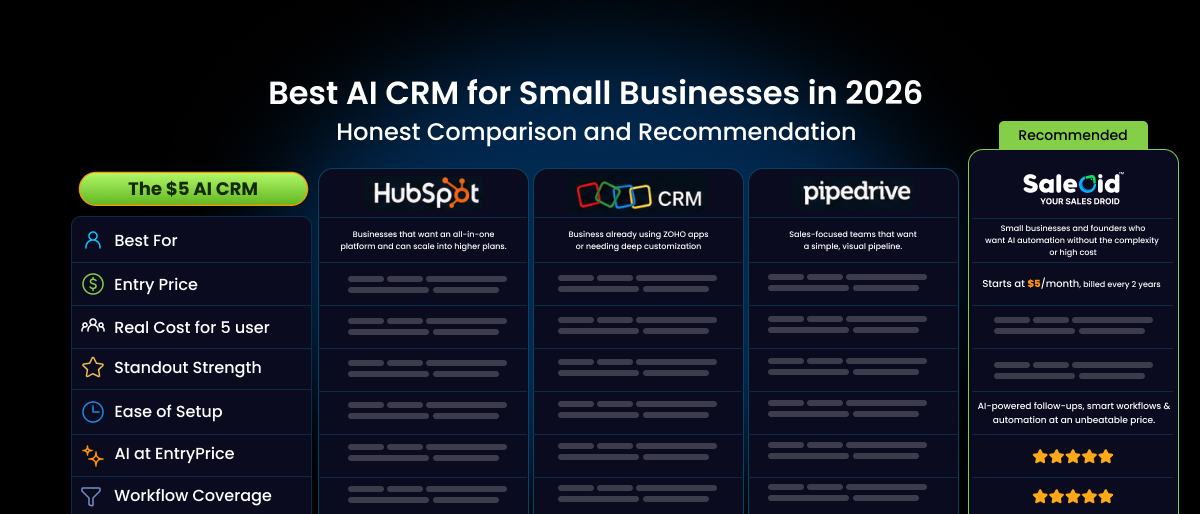
This one is written for a small business with 1 to 5 users that needs to know what these products actually cost, what their AI actually does at the base price, and how quickly a team can get up and running without a setup project.
The products in this comparison are HubSpot, Zoho CRM, Freshsales, Pipedrive, Salesforce and Saleoid. We compare each on 8 criteria.
The comparisons in this guide are based on information from trusted sources such as G2, Capterra, customer reviews, product documentation, pricing pages, and other publicly available resources. We considered both published product information and real user experiences to provide a balanced view of each CRM.
What Makes an AI CRM Worth Using for a Small Business?
The question is how does AI CRM help small businesses? Most CRM comparisons rank products by feature count. The one with the most features wins. That is also why most CRM comparisons are not useful for a small business because feature count is how enterprise procurement teams evaluate software, and you are not an enterprise procurement team.
If you are still evaluating whether AI CRM is the right move, start with the AI CRM for small businesses overview before diving into comparisons.
AI use among small businesses in the United States has risen sharply. The share using generative AI grew from 23% in 2023 to 40% in 2024, before reaching 58% in 2025. Even with this rapid adoption, choosing software based on feature volume alone remains a mistake.
How We Evaluated Each AI CRM
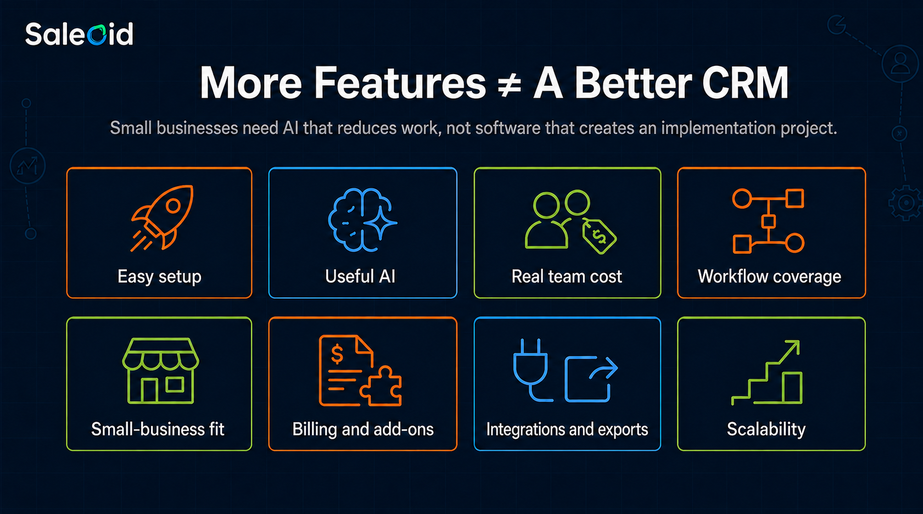
We evaluated each CRM based on 8 key purchasing criteria.
1. Ease of Setup: A small business should be able to create an account, import contacts, connect email, build a pipeline, invite users, and record a follow-up without a lengthy implementation project.
2. AI Usefulness at the Required Plan: We looked beyond whether a vendor uses the word AI. Meaningful functions include record summaries, contextual writing, scoring, recommendations, forecasting, natural language data queries, workflow assistance, and agent actions.
3. Cost for One to Five Users: The quoted entry price may not represent the plan you need. We considered per-user charges, flat package costs, annual billing, longer commitments, onboarding fees, AI usage, and common add-ons.
4. Workflow Coverage: The review considers lead capture, contact management, pipeline tracking, follow-ups, appointments, email, automation, reporting, calling, marketing, proposals, and invoicing.
5. Small Business Fit: A suitable platform should work without a full-time administrator and should not require a small team to purchase enterprise capabilities it will rarely use.
6. Billing Commitment and Additional Costs: Annual discounts can lower the monthly equivalent while increasing the upfront commitment. AI credits, communication usage, contact limits, onboarding, API access, and add-ons may also change the real bill.
7. Integrations and Data Portability: Your CRM should connect with the tools you already use. Clean contact import, complete export, API availability, and access to historical records matter when you migrate or cancel.
8. Scalability and Limitations: The lowest-priced option is not always the least expensive long-term choice. We considered what happens when users, contacts, workflows, reporting needs, and communication volumes increase.
AI CRM Comparison at a Glance
Numbers on a pricing page can mean different things depending on what the product is designed to sell. This section compares all 7 platforms using the same criteria and calculates the actual 12-month cost for a two-person team at the tier where the AI features are genuinely useful, rather than relying on the lowest advertised entry price. The goal is to show what you would realistically pay for the capabilities discussed in this article.
| CRM | Lowest practical option | Plan relevant to stronger AI | Approximate cost for five users | Billing basis | Best for |
| Saleoid | $5 per user/month | $119.40 Premium | $29.40 total | Monthly package, or lower modular price with two year term | Connected small business operations |
| HubSpot | Free tools | Sales Hub Professional from $90 per seat | $450 before onboarding | Annual billing for quoted rate | Marketing-led growth |
| Zoho CRM | Free for three users | Edition depends on Zia function | $70 on Standard | Annual billing | Customization |
| Freshsales | Free for three users | $39 Pro for scoring and deal insights | $195 | Annual billing | Communication heavy sales |
| Pipedrive | Lite from about $14 per user/month | Growth or higher for more AI tools | From about $70 | Annual billing for lowest rate | Visual pipelines |
| Salesforce Starter | $25 per user/month | Starter includes assistive AI | $125 | Monthly or annual | Salesforce ecosystem entry |
The Best AI CRM Options for Small Businesses in 2026
Every product in this section was assessed against the evaluation methodology. No platform paid to be included. No platform was excluded because it competes with Saleoid. Salesforce is in here even though it is almost never the right answer for a small business, because leaving it out would make this guide less useful, and you would know.
1. Saleoid: Best for Connected Small-Business Operations
Best For
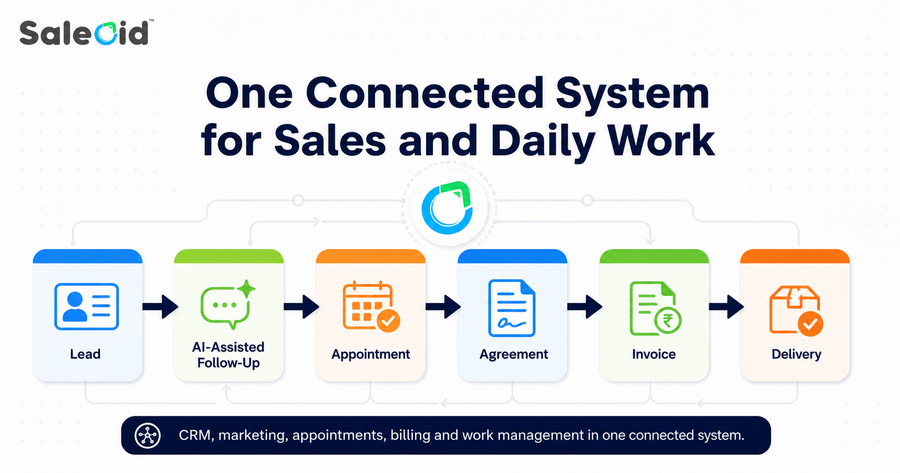
Saleoid suits freelancers, consultants, agencies, founders, and small teams that want CRM, marketing, appointments, billing, and related business tools under one account.
Key Features
- Core sales CRM with lead and pipeline management
- Modular tools for estimates, quotes, forms, billing, appointments, agreements, and projects
- Email and WhatsApp communication
- Marketing automation and SMS marketing
- AI features within the Unlimited package
- API access with Unlimited or as a custom plan addition
- Support for up to 20 users on the Unlimited plan
- Flat package pricing that can replace several separate business tools
Pricing
Saleoid’s Custom CRM plan starts at $5 per month with two-year billing, for a total commitment of $120 over 24 months. With monthly billing, the plan costs $15 per month. It includes one user, 2,500 contacts and companies, and five workflow automations.
For teams that need more capacity, the Growth plan costs $29.40 per month with two-year billing or $49 with monthly billing. It includes five users and 5,000 contacts and companies. The Premium plan costs $119.40 per month with two-year billing or $199 with monthly billing, and includes 15 users and 25,000 contacts and companies.
Businesses comparing Saleoid for AI capabilities should verify which AI features each plan includes rather than assuming they all come with the entry-level CRM. See our AI CRM pricing guide for current plan details.
Limitations
Saleoid provides less public detail about AI allowances, approval controls, security certifications, prompt retention, and data residency than larger vendors.
2. HubSpot: Best for Marketing-Led Small Businesses
Best For
HubSpot is best suited to small businesses that rely on inbound marketing and want sales, content, customer service, and marketing activity connected through one customer record.
Key Features
- Free CRM tools for contacts, deals, meetings, forms, and email tracking
- Connected sales, marketing, content, service, and commerce hubs
- Breeze AI for drafting, summaries, contextual assistance, enrichment, and data analysis
- Customer Agent and Prospecting Agent on eligible Professional and Enterprise plans
- Sales workflows, sequences, automation, and advanced reporting on paid tiers
- Large application marketplace
- Extensive learning resources and partner support
- Shared customer data across marketing, sales, and service teams
Pricing
Sales Hub Professional costs $90 per user each month with annual billing. One user costs $90, two users cost $180, and five users cost $450 per month.
A one time onboarding fee of $1,500 applies. Marketing Hub Professional is priced separately at around $800 per month, so a combined marketing and sales configuration can cost substantially more than the Starter price suggests.
Credit based AI charges may also apply. Current examples include 50 credits for a completed customer resolution and 100 credits for a recommended prospecting lead.
Limitations
HubSpot can become expensive when a business needs Professional automation, additional seats, higher marketing contact allowances, several hubs, onboarding, and AI credits.
Companies that only need a simple sales pipeline may end up paying for a broader ecosystem than they use.
3. Zoho CRM: Best for Customization and Zoho Ecosystem Users
Best For
Zoho CRM suits cost-conscious businesses that need extensive customization or already use products such as Zoho Books, Desk, Campaigns, Projects, or Analytics.
Key Features
- Contact, lead, pipeline, and opportunity management
- Custom fields, modules, layouts, validation rules, and permissions
- Workflow automation and process controls
- Zia AI for summaries, predictions, recommendations, anomaly detection, and content assistance
- Workflow and report creation through AI on eligible editions
- Zia Agents across the wider Zoho ecosystem
- Connections with Zoho Books, Desk, Campaigns, Projects, and Analytics
- CSV import, data export, APIs, and third-party integrations
Pricing
Zoho CRM offers a free edition for up to three users. The Standard plan costs around $14 per user each month with annual billing. One user costs $14, two users cost $28, and five users cost $70 per month.
Advanced Zia functions, analytics, forecasting, and automation may require a higher edition.
Limitations
Zoho CRM requires more configuration than simpler platforms such as Pipedrive. Its interface and broad product catalog can also feel dense to a new user. The system may not suit a team that wants immediate simplicity or lacks the time to manage fields, workflows, permissions, layouts, and connected applications.
4. Freshsales: Best Balance of Usability and Sales Features
Best For
Freshsales suits inbound and inside sales teams that need contact management, email, phone, chat, scoring, and sales automation within one interface.
Key Features
- Contact and account management
- Multiple sales pipelines
- Built-in email, phone, and chat tools
- Workflow automation and sales sequences
- Freddy AI for email assistance, scoring, recommendations, and deal insights
- Contact scoring and deal intelligence on Pro
- Forecasting insights on Enterprise
- Integrations with Freshdesk, Freshmarketer, and third-party tools
Pricing
Growth costs $9 per user each month, Pro costs $39, and Enterprise costs $59 when billed annually. A free plan is available for up to three users.
Five users cost $45 per month on Growth, $195 on Pro, and $295 on Enterprise.
Freddy AI Agent is priced separately at $49 per 100 sessions. This usage based agent is different from the scoring and insight features included in the CRM plans.
Limitations
Freddy capabilities vary by plan, so the $9 Growth price does not represent the cost of every AI function.
Phone usage, messaging, branded documents, email volume, and AI sessions may create additional charges. Freshsales is also less suitable for businesses that want marketing, invoicing, and operational tools within the same CRM package.
5. Pipedrive: Best for Visual Pipeline Management
Best For
Pipedrive works well for consultants, agencies, founders, and small B2B sales teams that value clear deal stages, activity tracking, and quick user adoption.
Key Features
- Visual deal pipelines with drag and drop stage management
- Sales activity tracking and next action planning
- AI Sales Assistant
- Deal summaries and email generation
- Activity suggestions and sales recommendations
- Pipeline analysis and natural language interaction with CRM data
- More than 500 integrations
- Optional tools for lead generation, campaigns, projects, and documents
Pricing
Entry pricing begins at approximately $14 per user each month with annual billing. At this rate, one user costs around $14, two users cost $28, and five users cost $70 per month.
Pipedrive also lists Growth from approximately $39 per user each month. Teams requiring broader AI, automation, or email capabilities may need to use this higher price for comparison.
Limitations
Pipedrive is focused primarily on sales pipeline management. It offers less native coverage for marketing, invoicing, appointments, customer service, and wider business operations.
Add ons can increase the real monthly cost, while some AI capabilities remain restricted by plan or beta availability.
6. Salesforce Starter Suite: Best for Businesses Expecting Complex Growth
Best For
Salesforce Starter Suite suits small companies that expect more complex processes, enterprise customer requirements, several departments, or long-term expansion into the Salesforce ecosystem.
Key Features
- Lead, account, contact, and opportunity management
- Sales flows and lead routing
- Dynamic email marketing and forms
- Customer service tools and analytics
- Record summaries and AI email drafting
- Employee Agent on Starter and Pro
- Payment links and e-commerce capabilities
- Access to the wider Salesforce application and partner ecosystem
Pricing
Starter costs $25 per user each month and can be billed monthly or annually. One user costs $25, two users cost $50, and five users cost $125 per month.
Pro Suite costs $100 per user each month, requires an annual contract, and adds deeper automation and customization.
Limitations
Starter may be more complex than a very small business needs. The total cost can rise sharply when the company moves to Pro, Enterprise, advanced Agentforce use, specialist integrations, or implementation support.
It is not the strongest option when you only need a simple self-service pipeline and have no clear reason to enter the wider Salesforce environment.
Which CRM Has the Most Useful AI Features?
| AI capability | Saleoid | HubSpot | Zoho CRM | Freshsales | Pipedrive | Salesforce Starter |
| Email drafting | Yes | Yes | Yes | Yes | Yes | Yes |
| Lead scoring | Yes | Higher plans | Selected plans | Pro plan | Limited | Higher plans |
| Deal insights | Yes | Advanced AI | Yes | Pro plan | Yes | Higher plans |
| AI agents | Yes | Yes, credit-based | Yes | Yes | Limited | Yes |
| AI usage | 200 credits included | Credit-based | Plan and usage based | Usage based | Plan dependent | Starter includes limited agent access |
Saleoid stands out by bringing email assistance, lead scoring, deal insights, and AI-powered actions into one small-business-focused CRM, with 200 AI credits included in its Unlimited plan.
HubSpot and Zoho CRM offer broader AI ecosystems with capabilities that vary by plan and usage. Freshsales provides useful AI features and agents on eligible plans, while Pipedrive focuses more on AI-assisted sales workflows.
Salesforce Starter has become more capable for small businesses because record summaries, AI assisted email drafting, and Employee Agent are now included.
Freshsales provides practical sales AI through Freddy for prospect identification, personalized emails, and sales insights, while some advanced capabilities depend on the selected plan.
Pipedrive continues to expand its AI tools across sales assistance, summaries, email support, and pipeline guidance.
Which AI CRM Is Right for Your Business?
Different businesses need different types of CRM software. The best AI CRM for a startup founder may not be the best option for a growing sales team or agency.
If You Are a Solopreneur or Freelancer
Most CRM software is designed around teams, not one-person businesses. Saleoid works well for freelancers and solo business owners because there is no minimum seat requirement, no complicated setup, and no expensive onboarding process.
The AI helps manage follow-ups, organize leads, and keep customer conversations moving without adding extra admin work. Instead of manually checking pipelines, you can quickly ask questions like:
“Who have I not contacted this month?”
For solo operators, Saleoid keeps CRM management simple and affordable at $5/month.
If You Are a Startup Founder Doing Founder-Led Sales
Early-stage startups need visibility and consistency more than enterprise reporting features. Saleoid helps founders manage leads, customer conversations, follow-ups, and appointments without spending weeks setting up a CRM system.
The AI helps identify leads needing attention and keeps follow-ups organized while founders focus on product, hiring, and growth.
For startups that want a simple AI CRM without enterprise pricing, Saleoid is an easy starting point. Startups have different priorities than established small businesses. Read our dedicated guide on AI CRM for startups for a founder-specific breakdown.
If You Run a Small Agency or Consultancy
Agencies and consultants often manage multiple client conversations, proposals, follow-ups, and meetings at the same time. Saleoid helps keep those relationships organized from one shared CRM.
Instead of manually reviewing pipelines, teams can quickly identify inactive clients, track proposal stages, and manage ongoing customer communication using conversational CRM features and AI-powered reminders.
The platform also works well for agencies that want affordable CRM software without paying enterprise-level subscription costs.
If You Have a Small Sales Team
For sales teams of 5 to 15 people, the CRM decision usually comes down to simplicity versus reporting depth.
If your team mainly needs stronger reporting and advanced enterprise analytics, larger CRM platforms may offer deeper customization. But if your biggest challenges are consistent lead follow-ups, pipeline visibility, and team adoption, choose Saleoid for a more practical solution.
At $5/month per user, Saleoid gives small teams AI-powered CRM features without the high per-seat pricing common in traditional CRM software.
If You Already Use HubSpot or Zoho CRM
Switching CRM platforms takes effort, so businesses already using HubSpot or Zoho should evaluate whether their current setup still fits their workflow and budget. Also, if you are confused between HubSpot VS Zoho CRM, try alternatives.
Many businesses start exploring alternatives when:
- AI features require expensive upgrades
- Teams stop using the CRM consistently
- Pricing increases as teams grow
- Onboarding and management become too complex
Saleoid makes migration easier with CSV imports, simple setup, and a 15-day free trial that lets businesses test the platform before switching completely.
Conclusion
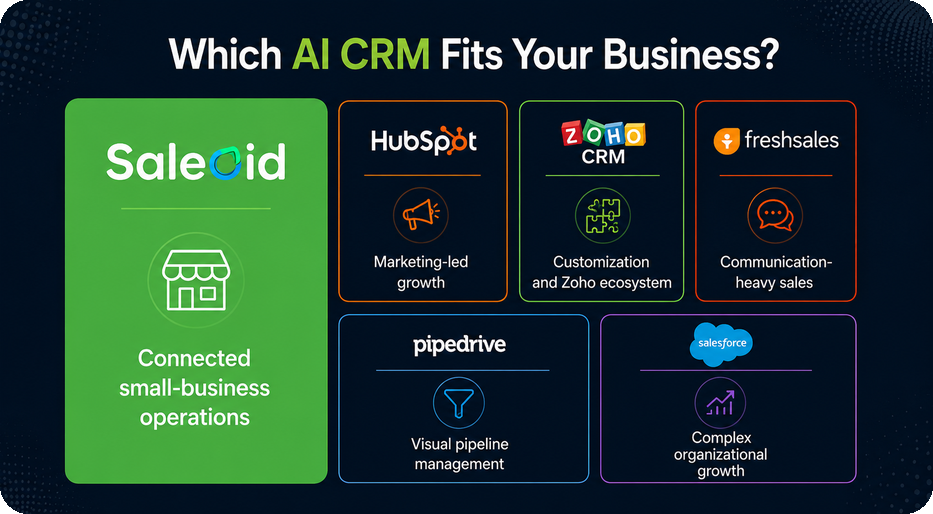
Each CRM in this comparison serves a different type of small business. HubSpot is a strong choice for teams that need marketing and sales in one ecosystem. Zoho CRM offers broad customization. Freshsales works well for communication-focused sales teams. Pipedrive keeps pipeline management simple, while Salesforce suits companies preparing for more complex growth.
The Best AI CRM for Small Businesses is not necessarily the platform with the most features. It is the one your team can afford, understand, and use consistently. Before making a decision, compare the plan that includes the AI tools you actually need, the cost for your full team, the billing commitment, and the effort required to maintain the system.
Saleoid is worth considering when you want a low-cost platform that combines CRM, appointments, marketing, billing, and related business tools. Review the current plan details carefully, confirm which AI capabilities are included, and use the 15 day free trial to test the platform with your own sales workflow before subscribing.
Frequently Asked Questions
The Best AI CRM for Small Businesses depends on the workflow. Saleoid suits affordable modular operations, HubSpot supports marketing led growth, Zoho provides customization, Freshsales combines communication with sales intelligence, Pipedrive simplifies pipeline management, and Salesforce supports complex expansion.
HubSpot CRM can work well for small businesses, especially teams that need strong marketing tools, email campaigns, and reporting. Its free CRM is popular for early-stage businesses, but many AI features, automation tools, and advanced workflows require paid plans that become expensive as teams grow. For businesses with dedicated marketing operations, HubSpot offers strong functionality. For smaller teams focused on affordability and simpler sales management, lighter AI CRM platforms are often easier to adopt and maintain.
Saleoid is one of the most affordable AI CRM platforms for small businesses, with pricing starting at $5 per user per month. It includes automated follow-ups, conversational CRM features, lead scoring, pipeline management, appointment booking, and workflow automation at the entry price. Additional tools can be added individually for $1 per app, allowing businesses to scale without paying for large bundled software plans.
Yes, AI CRM software can be especially useful for solopreneurs because it reduces the manual work involved in managing leads, follow-ups, appointments, and customer communication. Instead of spending hours updating spreadsheets or remembering follow-ups manually, a conversational CRM can organize leads, suggest next actions, draft emails, and keep sales activity moving. For solo business owners, AI CRM often acts like an extra layer of sales support without the cost of hiring additional staff.
Zoho CRM is a capable CRM platform with a wide range of customization options, automation tools, and integrations. However, many small businesses find the setup and configuration process more complex compared to lightweight CRM platforms. Zoho’s AI assistant, Zia, is also limited to higher-tier plans. For businesses willing to spend time customizing workflows, Zoho can be a strong option. For teams looking for faster onboarding and simpler AI-powered workflows, more streamlined CRM platforms may be easier to manage.
Some do. HubSpot uses credits for various AI functions and agents. Freshsales sells Freddy AI Agent sessions. Zoho applies token allowances and credits in some agent scenarios. Other vendors restrict capabilities by plan rather than charging for each action.
Not every business needs predictive scoring or autonomous agents. AI becomes useful when it reduces administrative work, improves response consistency, or helps you identify neglected opportunities. A well-configured basic CRM can still outperform an advanced system your team does not use.
Conclusion
Every platform in this comparison has something going for it. HubSpot has depth. Zoho has breadth. Freshsales has a clean interface at a reasonable mid-range price. Pipedrive has the best pipeline view in the market. Salesforce has everything, for everyone who can afford everything.
But the best AI CRM for a small business is not the one with the longest feature list. Your team should open it every morning without needing a reminder. Adoption determines outcomes, and three factors drive adoption: whether the price makes sense, whether the product is simple enough to use without a learning program, and whether developers built it for the way your business actually sells.
Saleoid fits all three criteria for most small businesses, including freelancers, consultants, agency owners, founders who handle their own sales, and sales teams with fewer than 15 people. The AI works from day one. The price is $5 a month. There is nothing to configure before it becomes useful.
The free trial covers the full product for 15 days. No credit card, no sales call, no implementation timeline.
[Book a free demo] [See what Saleoid includes at $5/month]