
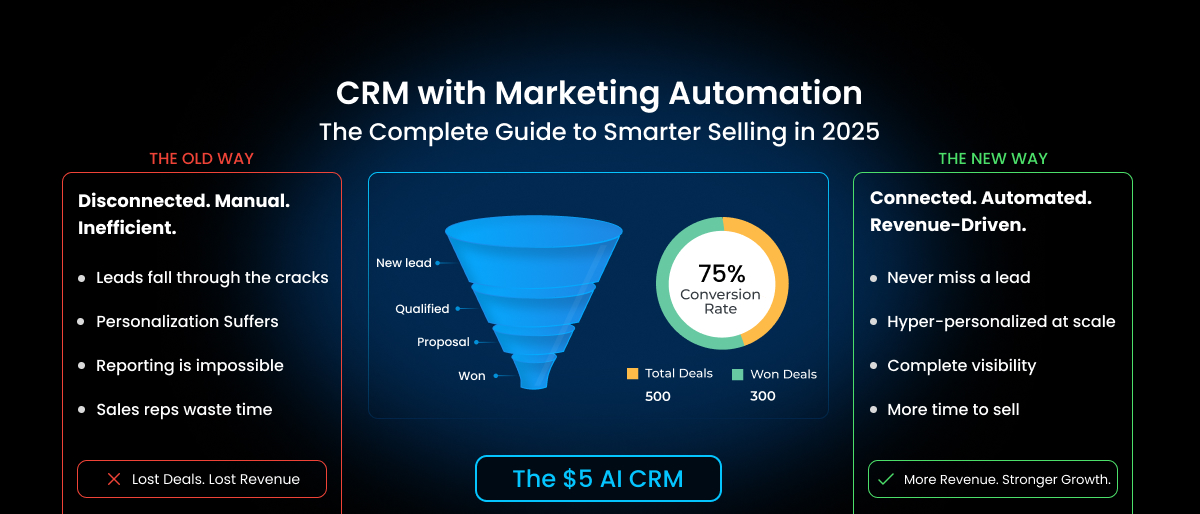

Are you tired of manually following up on every lead, sending one-off emails, and struggling to keep your sales and marketing teams on the same page? You’re not alone.
Businesses that rely on disconnected tools lose deals not because their product isn’t good enough, but because their processes are too slow. Today, the most competitive companies are winning with CRM with marketing automation: a unified approach that turns scattered data into predictable revenue.
In this guide, you’ll learn exactly what CRM with marketing automation is, why it matters, what features to look for, and how a platform like Saleoid can help your business generate more leads, close more deals, and retain more customers, all on autopilot.
What Is CRM with Marketing Automation?
CRM with marketing automation refers to a unified software platform that combines Customer Relationship Management (CRM) capabilities, like contact management, deal tracking, and sales pipeline visibility, with marketing automation tools such as email drip campaigns, lead scoring, behavioral triggers, and campaign analytics.
Rather than maintaining separate tools for marketing and sales, an integrated CRM and marketing automation solution creates a single source of truth for every customer interaction, from the first website visit to post-sale retention.
Think of it this way:
- CRM manages your relationships and tracks where each prospect is in the sales funnel.
- Marketing automation delivers the right message to the right person at the right time without manual effort.
- Together, they create a seamless customer journey that drives consistent revenue growth.
This combination is often referred to as automated CRM software, a sales and marketing automation platform, or a CRM with email marketing automation.
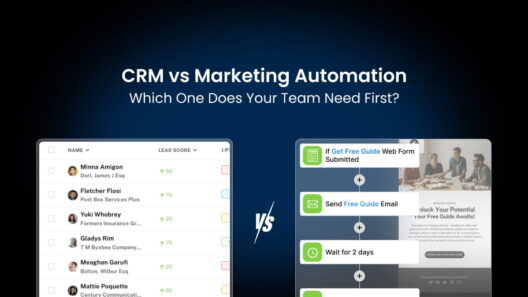
If you’re still unsure whether your business needs a CRM, marketing automation, or both, read our detailed guide on CRM vs Marketing Automation before choosing a platform.
Why Businesses Can’t Afford to Separate CRM and Marketing Automation
Many small and mid-sized businesses start with standalone tools: a basic CRM here, an email marketing platform there, and a spreadsheet to glue them together. This works until it doesn’t. Here’s what happens when CRM and marketing automation are siloed:
- Leads fall through the cracks. Marketing generates leads, but sales doesn’t follow up in time because there’s no automatic handoff.
- Personalization suffers. Without CRM data feeding your marketing automation, campaigns feel generic and irrelevant.
- Reporting becomes impossible. You can’t attribute revenue to campaigns when your data lives in two separate systems.
- Sales reps waste time. Instead of selling, they manually update contacts, log calls, and send templated emails.
According to industry research, companies that align sales and marketing, the core promise of CRM with marketing automation, generate 208% more revenue from marketing and have 36% higher customer retention rates.
The business case is clear that an integrated marketing automation and CRM system isn’t a luxury. It’s a competitive necessity.
Key Benefits of an Integrated CRM and Marketing Automation Platform
Managing leads manually becomes difficult as a business grows. Customer conversations happen across emails, websites, forms, calls, social media, and follow-ups, and without a connected system, important opportunities often get missed.
This is why more businesses are shifting toward integrated CRM and marketing automation platforms. Instead of using separate tools for lead management, email campaigns, follow-ups, and reporting, businesses can manage the entire customer journey from one centralized system.
A CRM with marketing automation not only improves organization but also helps businesses respond faster, nurture leads consistently, and scale customer communication without increasing manual workload.
Below are some of the biggest advantages businesses experience when CRM and marketing automation work together.
1. Automated Lead Nurturing Improves Follow-Ups
Not every prospect is ready to buy immediately. Some leads need time, education, and multiple touchpoints before making a decision.
With automated lead nurturing, businesses can create follow-up sequences that trigger automatically based on customer actions such as:
- downloading a guide
- filling out a contact form
- visiting a pricing page
- booking a demo
- clicking an email campaign
Instead of relying on manual reminders, the CRM automatically moves leads through personalized workflows while keeping sales teams updated on engagement activity.
This helps businesses:
- maintain consistent communication
- reduce missed follow-ups
- build trust gradually
- improve conversion rates over time
For small businesses especially, automation ensures that potential customers do not get forgotten simply because the team becomes busy.
2. Lead Scoring Helps Teams Focus on High-Intent Prospects
Not all leads have the same buying intent. A CRM with lead scoring helps businesses identify which prospects are most likely to convert by analyzing:
- email engagement
- website activity
- form submissions
- company size
- buying behavior
- sales interactions
Higher-scoring leads can be prioritized for direct sales outreach, while lower-intent contacts continue receiving automated nurturing campaigns until they become sales-ready.
This improves:
- sales productivity
- response efficiency
- conversion quality
- pipeline visibility
Instead of guessing who to contact first, teams can focus their time where it matters most.
3. Personalized Customer Journeys Create Better Engagement
Modern customers expect communication that feels relevant to their needs.
An integrated CRM and marketing automation platform allows businesses to combine customer data with automated campaigns to deliver more personalized experiences at scale. Businesses can tailor communication based on:
- customer name
- industry
- business type
- previous interactions
- purchase history
- sales stage
- website behavior
For example:
- new leads may receive educational emails
- returning customers may receive upsell offers
- inactive users may enter re-engagement campaigns
This level of personalization helps businesses improve:
- email engagement
- customer trust
- response rates
- long-term retention
Generic mass messaging is becoming less effective, while personalized communication continues to drive stronger results.
4. Shorter Sales Cycles Increase Revenue Opportunities
When leads are educated and nurtured before speaking with sales teams, conversations become far more productive.
Marketing automation helps prospects:
- understand the product earlier
- engage with useful content
- receive answers automatically
- stay connected through follow-ups
As a result, by the time a sales conversation happens, the prospect is often:
- more informed
- more interested
- more trusting
- closer to making a decision
This reduces delays inside the sales pipeline and helps businesses move leads from first contact to closed deal faster. For growing businesses, shorter sales cycles often mean:
- faster revenue generation
- improved sales efficiency
- better team productivity
5. Better Sales and Marketing Alignment
One of the biggest operational problems inside many businesses is the disconnect between sales and marketing teams.
Marketing may generate leads, but sales teams often lack visibility into:
- which campaigns the lead interacted with
- what content they viewed
- how engaged they actually are
With a shared CRM and marketing automation platform, both teams work from the same customer data. Sales teams can see:
- email engagement
- campaign activity
- website visits
- form submissions
- previous interactions
At the same time, marketing teams can track:
- which campaigns generated revenue
- which channels convert best
- how leads move through the funnel
This creates stronger alignment, better reporting, and a clearer understanding of what actually drives growth.
6. Real-Time Analytics Improve Decision-Making
Businesses today need more than just basic reports. They need visibility into what is actually working. An integrated CRM platform provides real-time analytics for:
- email performance
- lead sources
- campaign engagement
- pipeline growth
- customer acquisition
- revenue attribution
- conversion tracking
Instead of reviewing disconnected spreadsheets or multiple dashboards, teams can analyze performance from one centralized system.
This helps businesses:
- improve campaign strategy
- identify bottlenecks faster
- allocate budgets more effectively
- make data-driven decisions confidently
Better reporting ultimately leads to smarter growth decisions.
7. Scalability Without Increasing Headcount
As businesses grow, manually managing every lead and follow-up becomes difficult without expanding the team.
A CRM with marketing automation allows businesses to scale communication and lead management without increasing workload proportionally.
Automation can handle:
- lead assignment
- follow-up reminders
- email campaigns
- customer segmentation
- appointment confirmations
- onboarding workflows
- re-engagement campaigns
This means businesses can:
- manage larger lead volumes
- maintain customer communication
- improve consistency
- scale operations more efficiently
For startups and small businesses especially, this creates the ability to grow revenue without immediately hiring large sales or marketing teams.
As customer expectations continue to rise, businesses that automate communication, personalize engagement, and streamline follow-ups are often able to grow faster while maintaining better customer relationships.
Core Features to Look For in a CRM with Marketing Automation
Not all CRM platforms offer the same level of automation, flexibility, or usability. Some tools focus mainly on contact storage, while others combine lead management, email marketing, workflow automation, reporting, and customer communication inside one connected system.
Choosing the right CRM with marketing automation becomes easier when businesses focus on the features that directly improve lead management, customer engagement, and sales efficiency.
Below are the most important features businesses should look for before investing in a marketing automation CRM platform.
1. Contact and Lead Management
A strong CRM platform should make it easy to organize and manage customer information from one central place. Businesses should be able to track contacts, communication history, deal progress, customer interactions, and lead sources without relying on spreadsheets or disconnected tools. A complete customer profile helps sales and marketing teams understand where every lead stands and improves follow-up consistency. Features like custom fields, tagging, activity tracking, and segmentation become especially important as the business grows and customer data increases.
2. Email Marketing Automation
Email automation is one of the most valuable features in a CRM with marketing automation because it helps businesses maintain regular communication without manual effort. A good platform should support automated email sequences, drip campaigns, behavioral triggers, personalized messaging, and campaign scheduling. Businesses should also look for drag-and-drop email builders, templates, and A/B testing capabilities. This allows companies to nurture leads, onboard customers, and run campaigns efficiently while saving time for the sales and marketing teams.
3. Visual Workflow Builder
Modern CRM platforms should include a visual workflow builder that allows businesses to automate tasks without technical knowledge or coding. Workflow automation helps teams create customer journeys based on actions like form submissions, email engagement, website visits, or deal stage updates. Instead of manually assigning tasks or sending reminders, businesses can automate repetitive processes and improve operational efficiency. A no-code workflow builder also makes automation easier to manage for small businesses and growing teams.
4. Sales Pipeline Management
A visual sales pipeline gives businesses a clear overview of where every lead or deal stands inside the sales process. This helps teams prioritize follow-ups, identify stalled opportunities, and forecast revenue more accurately. A good CRM should allow customizable deal stages, drag-and-drop movement across the pipeline, activity tracking, and task automation. Integrated CRM platforms can also update pipeline stages automatically based on customer actions, reducing manual work and improving sales visibility.
5. Lead Scoring and Prioritization
Not every lead is equally ready to buy, which is why lead scoring is an important CRM feature. A lead scoring system ranks prospects based on engagement, demographics, buying intent, and customer behavior. Businesses can then prioritize high-intent leads while continuing to nurture lower-scoring prospects through automated campaigns. This helps sales teams focus their energy on leads that are more likely to convert, improving efficiency and reducing wasted effort.
6. Landing Pages and Lead Capture Forms
Businesses running inbound marketing campaigns should look for CRM platforms that include built-in landing pages and lead capture forms. These tools help collect customer information directly into the CRM without depending heavily on third-party software. Features like customizable forms, embedded website forms, pop-ups, and automated lead routing help businesses capture and organize leads more efficiently while improving the overall lead generation process.
7. Segmentation and Audience Targeting
Audience segmentation helps businesses deliver more relevant communication instead of sending the same message to every contact. A CRM with segmentation capabilities allows teams to organize leads based on industry, location, engagement level, customer behavior, deal stage, or custom tags. Better segmentation improves email engagement, campaign performance, and customer experience because communication becomes more personalized and aligned with the customer’s interests or buying stage.
8. Campaign Analytics and Reporting
Reporting and analytics help businesses understand what is working and where improvements are needed. A good CRM with marketing automation should provide real-time visibility into email performance, campaign engagement, conversion rates, pipeline growth, lead sources, and revenue attribution. Custom dashboards make it easier for both sales and marketing teams to monitor performance and make data-driven decisions. Clear reporting becomes increasingly valuable as businesses scale customer acquisition and automation efforts.
9. Integration Capabilities
Most businesses use multiple tools for communication, payments, collaboration, and operations, so CRM integration capabilities are extremely important. A flexible CRM should connect easily with platforms like Google Workspace, Slack, Zapier, social media tools, payment gateways, e-commerce systems, and customer support software. Strong integrations reduce workflow disruption, eliminate repetitive data entry, and help businesses create a more connected operational ecosystem.
10. Mobile CRM Access
Mobile access has become essential for businesses with remote teams, field sales representatives, consultants, or service-based operations. A mobile-friendly CRM allows users to manage contacts, update deals, respond to leads, monitor campaigns, and track activities from anywhere. This improves responsiveness and ensures that sales and customer communication continue smoothly even when teams are away from their desks.
How CRM Marketing Automation Works: A Step-by-Step Flow
Below we’ve shared a practical example of how automated CRM workflows work from lead capture to closed deal:
Step 1 Lead Capture: A prospect visits your website and downloads an eBook. The web form captures their name, email, and company. This data is automatically pushed into the CRM as a new contact.
Step 2 Lead Scoring Begins: The CRM assigns an initial score based on the contact’s company size and industry (demographic fit) and their action (content download = +10 points).
Step 3 Automated Nurture Sequence Triggers: The download triggers a 5-email drip campaign over 14 days, each email delivering relevant content based on the eBook topic. Every open, click, and reply updates the lead score.
Step 4 Sales Alert: When the prospect’s lead score crosses the threshold (say, 60 points), the CRM automatically assigns the contact to a sales rep and creates a follow-up task with context about which emails were opened and which pages were visited.
Step 5 Personalized Sales Outreach: The rep reaches out with context: “Hi Sarah, I saw you downloaded our guide on [topic] and found our pricing page, happy to answer any questions.” Relevance closes deals.
Step 6 Deal Tracking and Pipeline Automation: As the deal progresses, CRM workflow automation updates the pipeline stage, sends internal notifications, and triggers customer-facing emails at each milestone.
Step 7 Post-Sale Retention Automation: After closing, the contact moves into an onboarding automation sequence, welcome emails, check-in reminders, and upsell campaigns, all without manual effort.
This end-to-end flow is the true power of CRM with marketing automation software.
Use Cases Across Industries
A CRM with marketing automation is no longer limited to large enterprises or a single industry. Businesses across different sectors are now using integrated CRM platforms to improve lead management, automate customer communication, and create more personalized customer experiences at scale.
Whether the goal is improving follow-ups, reducing manual work, increasing conversions, or managing long sales cycles, CRM and marketing automation platforms help businesses streamline operations while maintaining stronger customer relationships.
Below are some of the most common ways businesses across industries use CRM with marketing automation.
B2B SaaS and Technology
For SaaS and technology companies, customer journeys are often long and heavily dependent on education, engagement, and product adoption. CRM with marketing automation helps these businesses automate onboarding flows, nurture free trial users, and guide prospects through the buying journey more efficiently.
Businesses can automate:
- free trial onboarding emails
- product usage reminders
- feature education campaigns
- renewal reminders
- upgrade and upsell sequences
- re-engagement campaigns for inactive users
Marketing and sales teams can also track:
- MQL-to-SQL conversion rates
- customer engagement behavior
- onboarding completion
- feature adoption trends
- revenue attribution
This creates a more scalable product-led growth process while reducing the manual workload on customer success and sales teams.
Professional Services (Agencies, Consulting, Legal)
Professional service businesses often deal with relationship-driven sales cycles that involve multiple conversations, follow-ups, proposals, and decision-makers.
A CRM for agencies, consultants, and legal firms helps businesses stay organized while automating repetitive communication tasks.
Automation can support:
- lead nurturing sequences
- consultation reminders
- proposal follow-ups
- client onboarding workflows
- appointment scheduling
- long-term relationship management
Because sales cycles in professional services can stretch over weeks or months, automation ensures leads stay engaged even when teams are managing multiple clients simultaneously.
An integrated CRM also improves visibility into:
- deal stages
- client communication history
- proposal status
- follow-up timelines
- team collaboration
This helps service-based businesses maintain consistency and improve client experience without increasing operational complexity.
Real Estate
Real estate businesses manage large volumes of inquiries, property interest, and long-term buyer nurturing, making automation especially valuable.
A CRM for real estate helps agents and agencies automate communication while keeping track of every lead interaction from the first inquiry to the final transaction.
Common automation workflows include:
- property alert notifications
- follow-up sequences after property visits
- open house reminders
- lead qualification workflows
- long-term nurture campaigns
- appointment confirmations
Many prospects are not ready to purchase immediately, so automated follow-ups help agents stay connected with potential buyers over several months without relying entirely on manual outreach.
Integrated CRM platforms also help real estate teams organize:
- buyer preferences
- property interests
- communication history
- pipeline stages
- sales forecasting
This improves lead management and reduces missed opportunities in highly competitive markets.
E-Commerce and Retail
For e-commerce businesses, customer engagement and repeat purchases are critical for long-term growth.
A CRM with email marketing automation allows retailers to create personalized shopping experiences based on customer behavior, purchase history, and browsing activity.
Automation can help manage:
- abandoned cart recovery emails
- post-purchase follow-ups
- product recommendation campaigns
- loyalty program communication
- seasonal promotions
- win-back campaigns for inactive customers
Segmentation also allows businesses to target customers based on:
- purchase frequency
- average order value
- browsing behavior
- product interests
- engagement activity
This improves customer retention, increases repeat sales, and helps businesses scale marketing efforts more efficiently.
Healthcare and Wellness
Healthcare and wellness providers increasingly use CRM and marketing automation to improve patient communication, appointment management, and long-term engagement.
Automation helps clinics and wellness businesses maintain consistent communication without placing additional pressure on administrative teams.
Common use cases include:
- appointment reminders
- follow-up communication
- wellness check-ins
- educational health campaigns
- patient reactivation campaigns
- feedback and review requests
Integrated CRM systems also help organize patient interactions and improve communication continuity across teams.
For wellness businesses, personalized communication and automated engagement play an important role in improving retention and building long-term relationships with patients or members.
Education and Coaching
Educational institutions, online course creators, coaches, and training businesses often rely on long nurture cycles before enrollment decisions happen.
A CRM with marketing automation helps education businesses guide prospects from initial inquiry to enrollment through automated communication and lead nurturing.
Automation workflows commonly include:
- course inquiry follow-ups
- webinar registrations
- onboarding emails
- payment reminders
- student engagement campaigns
- certification or renewal communication
CRM platforms also help track:
- enrollment pipelines
- student communication history
- application status
- engagement activity
- conversion sources
This helps education and coaching businesses improve enrollment rates while reducing manual administrative work.
Why CRM and Marketing Automation Matter Across Industries
Regardless of industry, businesses today face similar operational challenges:
- managing growing lead volumes
- maintaining timely follow-ups
- personalizing customer communication
- improving visibility across teams
- reducing manual repetitive tasks
An integrated CRM and marketing automation platform helps businesses centralize customer data, automate workflows, and create more scalable customer engagement processes.
As customer expectations continue to rise, businesses that automate communication while maintaining personalized experiences are often able to improve efficiency, strengthen customer relationships, and grow more consistently over time.
CRM vs. Marketing Automation: What’s the Difference?
This is one of the most common questions and the answer matters when choosing a platform.
| Feature | CRM | Marketing Automation |
|---|---|---|
| Primary Focus | Managing relationships and sales pipeline | Automating marketing campaigns and lead nurturing |
| Primary Users | Sales teams | Marketing teams |
| Core Data | Contact profiles, deal stages, call logs | Email engagement, campaign data, web behavior |
| Key Actions | Follow-up tasks, pipeline updates, deal tracking | Email sequences, lead scoring, behavioral triggers |
| Goal | Close deals | Generate and qualify leads |
We’ve covered this topic in greater detail in our guide on CRM vs Marketing Automation, where you’ll find a complete feature-by-feature comparison.
How Saleoid Combines CRM and Marketing Automation
Saleoid is built for businesses that want to stop duct-taping tools together and start running a connected revenue operation. Let’s see what makes Saleoid’s CRM with marketing automation different:
- One Platform, No Integration Tax: Everything lives in one place, such as contacts, deals, campaigns, automations, and reports. No syncing, no data lag, no broken integrations to maintain.
- Smart Lead Scoring Built In: Saleoid’s lead scoring engine automatically weights demographic and behavioral signals, surfacing your highest-intent leads to your sales team before they go cold.
- Visual Automation Builder: Build multi-step workflows without writing a single line of code. Set triggers, conditions, actions, and delays using Saleoid’s drag-and-drop automation canvas. Create sequences for lead nurturing, deal progression, onboarding, and re-engagement.
- Personalized Email Campaigns at Scale: Design beautiful emails with Saleoid’s template library and personalize them dynamically using CRM field data, like first name, company, industry, last interaction, and more. Send one-off campaigns or fully automated sequences.
- Full Pipeline Visibility: See every deal, at every stage, with associated contacts, activity history, and the marketing touches that influenced the opportunity. Know what’s working, and do more of it.
- Real-Time Campaign Analytics: Track every email’s performance from send to closed-won revenue. Saleoid connects marketing activity to sales outcomes so you can make data-backed decisions on where to invest your efforts.
- Seamless Team Collaboration: Sales reps and marketers share the same contact timeline. No more “did marketing email them already?”, every team member sees every touchpoint in one unified view.
Unlike many CRMs that require expensive add-ons for automation, Saleoid keeps pricing simple and affordable for growing businesses. Explore Saleoid CRM Pricing to compare plans and choose what fits your business.
Frequently Asked Questions
A CRM manages customer relationships and sales pipelines, while marketing automation handles campaign execution, lead nurturing, and behavioral triggers. As a result, the best platforms combine both capabilities into a single system, enabling sales and marketing teams to share data and work from the same contact records.
Yes. In fact, small businesses often see the biggest ROI because automation replaces manual work that a lean team simply can’t do at scale. Modern platforms like Saleoid are designed to be affordable and usable for SMBs without dedicated marketing operations staff.
Lead scoring is a method of ranking prospects based on their likelihood to convert. Scores are typically assigned based on demographic fit (industry, company size, job title) and behavioral engagement (email opens, page visits, content downloads). As a result, higher scores trigger sales alerts, allowing reps to focus on the most sales-ready leads.
Marketing automation eliminates repetitive manual tasks, such as sending follow-up emails, updating contact records, and scheduling reminders, allowing sales reps to spend more time on high-value conversations. Furthermore, when leads arrive pre-qualified and pre-educated through nurture sequences, sales cycles become shorter and close rates improve.
Yes. B2B businesses use it to manage long sales cycles, nurture multiple stakeholders, and align sales and marketing. B2C businesses use it for personalized lifecycle marketing, cart abandonment recovery, customer retention, and loyalty programs. The core capabilities apply across both models.
Look for a platform with a visual email builder, behavioral trigger support, segmentation by CRM data, A/B testing, and clear reporting on email performance tied to pipeline and revenue, not just opens and clicks.
With a user-friendly platform like Saleoid, basic setup, such as importing contacts, connecting email, and launching a first automation, can be done in a day. Complex multi-step workflows and full pipeline configuration typically take 1–2 weeks for a thorough implementation.
Conclusion: Stop Managing & Start Automating
The businesses growing fastest right now aren’t necessarily the ones with the biggest budgets or the largest teams. They’re the ones that have invested in CRM with marketing automation, building systems that work around the clock to attract, nurture, qualify, and convert customers.
If your sales process still depends on manual follow-ups, disconnected tools, or your team’s memory, you’re leaving revenue on the table every single day.
Saleoid brings together everything you need, smart CRM, powerful marketing automation, and actionable analytics, in one platform built for teams that want to grow without the complexity.
Ready to see how Saleoid can transform your sales and marketing process?
[Start Your Free Trial] | [Book a Demo] | [See Saleoid Pricing]