


Quick Answer
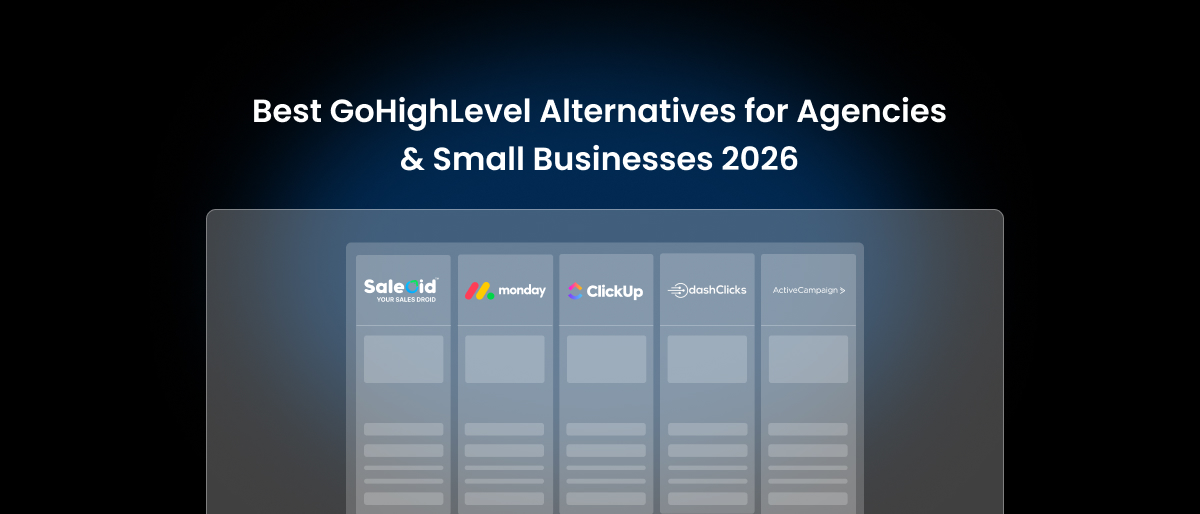
The best GoHighLevel alternatives for agencies in 2026 are:
- Saleoid: It is best for small businesses and startups that want affordable CRM + automation without complexity
- DashClicks: It is best for agencies that need white-label fulfillment and resellable services
- ActiveCampaign: It is best for agencies where email automation is the primary growth channel
- Monday CRM: It is best for visual, project-driven agencies managing clients and delivery in one place
- Systeme.io: It is best for solo operators and freelancers on a tight budget
- ClickUp CRM: It is best for agencies already using ClickUp for delivery work
- EngageBay: It is best for small agencies wanting sales, marketing, and support in one affordable system
Each tool below is evaluated on setup time, real pricing, and practical fit for how agencies actually operate.
Introduction
If you’re running an agency in 2026 and GoHighLevel isn’t quite working for you, you’re not alone. The reason could be anything:
- Bill that’s higher than expected
- The learning curve that keeps slowing down onboarding
- The feeling that you’re paying for twelve tools when you only need four
A growing number of agencies are asking the same question, i.e., is there something better suited to how we actually work?
The short answer is – YES! And it depends on what you need.
GoHighLevel remains a genuinely strong platform for larger agencies that use the majority of its capabilities, such as CRM, SMS automation, funnels, white-label SaaS resale, and multi-client sub-account architecture, all in one.
But that scope is also exactly what makes it the wrong fit for solo operators, small teams, and agencies whose real workflow only touches a fraction of the platform. Paying $297 to $497 per month, along with usage fees for SMS, email, and AI tools that can push the real total to $600 or more. It is really hard to justify when 2 or 3 focused tools would do the job at one third of the cost.
This guide covers the top 7 GoHighLevel alternatives specifically chosen for agency use. Not general-purpose CRMs. Not enterprise software. Tools that handle client management, automation, and team workflows without demanding weeks of setup time before you see a return.
For a full comparison across all business types, see best GoHighLevel alternatives for small businesses
Before getting into the tools, let’s find out what’s pushing agencies away from GoHighLevel in the first place.
Why Agencies Are Looking for GoHighLevel Alternatives

The reasons agencies start searching for GoHighLevel competitors follow a pretty consistent pattern. Every reason cannot be true for every agency, but for a significant portion, one or more of these friction points eventually tips the decision.
1. The Learning Curve Is Measured in Weeks, Not Days
GoHighLevel is a deep platform. For someone coming in with a full setup, such as workflows configured, sub-accounts built, automations tested, and the team trained, it takes around 2 to 4 weeks of active work. But this does not apply to beginners. These claims are based on consistent feedback in agency forums and onboarding reviews from experienced operators who switched from other CRMs.
The core problem isn’t that the features are complicated in isolation. It’s that there are so many of them, and they interact with each other. Pipelines connect to automations, which connect to calendars, which connect to messaging channels. Getting everything working together without something breaking requires a level of platform fluency that takes real time to develop.
2. You’re Paying for a Feature Catalogue You’ll Only Partially Use
GoHighLevel includes funnel builders, membership site hosting, reputation management, call tracking, course tools, social media scheduling, and more. It’s comprehensive by design. The problem is that most agencies only actively use a fraction of it.
A typical small agency running client pipelines, follow-up sequences, and reporting doesn’t need membership hosting or a built-in course platform. But those features are bundled into the plan regardless. The result is a pricing model where you’re effectively subsidizing functionality built for a different type of agency while your actual use case is absolutely different. That misalignment becomes more noticeable the smaller your team is and the more focused your service offering.
3. The Real Monthly Cost Runs 30–50% Higher Than the Headline Price
GoHighLevel’s pricing page shows 3 tiers: $97, $297, and $497 per month. Those numbers are real, but they’re incomplete. They don’t include the usage-based charges that are added the moment you start running active campaigns.
SMS messages sent via Twilio, which powers GHL’s messaging, are billed at roughly $0.0079 per segment, with multi-part messages counting as multiple segments.
Outbound calls carry per-minute charges. Email sending beyond a certain volume incurs additional fees. A2P 10DLC registration, required for business SMS in the US, adds approximately $19 as a one-time cost plus ongoing monthly carrier fees.
AI-powered features like content generation and conversation intelligence draw from a separate credit system.
See the full Read our GoHighLevel pricing guideGoHighLevel pricing breakdown for exact numbers.
For an agency actively sending SMS sequences and running email campaigns across even a handful of clients, the real monthly invoice typically lands between $400 and $1,700 or more, depending on volume. That gap between the advertised price and the actual bill is the most common financial surprise agencies report in their first 60 to 90 days on the platform.
4. White-Labelling Requires the $497/Month Plan with No Cheaper Path In
Reselling the platform to clients under your own brand is one of GoHighLevel’s most marketed advantages. But it’s locked behind the Agency Pro plan, which starts at $497 per month.
For an established agency with 10 or more paying clients, that cost can make sense. For a newer agency trying to build toward a white-label model, or one that only has 2 or 3 clients who would actually use the platform, $497 per month is a high fixed cost to carry before the economics work in your favor.
There’s no intermediate tier that offers partial white-labelling or a lower-cost entry point into the resale model. You either pay for the full plan, or you don’t get the feature.
5. The Platform Is Optimized for Local Service Agencies, While Others Feel the Friction
GoHighLevel was built with a specific agency archetype in mind. These include companies that serve local businesses like dentists, gyms, law firms, and home service companies. The default templates, the funnel structures, the reputation management tools, and the workflow logic all reflect that use case.
Agencies working outside that mold frequently find that the native templates and pre-built automations don’t map cleanly onto their workflows. These include agencies serving e-commerce brands, SaaS companies, B2B clients, or content-driven businesses. That’s not a flaw exactly, but a product focus. But it does mean those agencies spend more time rebuilding from scratch than they would on a more neutral CRM platform.
The customization is technically possible, but it requires excluding assumptions that were designed for a different client type and replacing them with your own logic. This adds setup time and reduces one of GHL’s core selling points, which is speed to deployment. These are the same patterns we cover in detail in why agencies are switching from GoHighLevel.
Quick Comparison: GoHighLevel Alternatives for Agencies
Below is a side-by-side view of 7 GoHighLevel alternatives for agencies covered in this blog:
| Tool | Best For | Starting Price | White-Label? | Free Trial? | Setup Difficulty |
| Saleoid | Small business and startups | $5/mo | No | ✅ 15 days | Easy |
| Monday CRM | Visual/project agencies | $12/user/mo | No | ✅ 14 days | Easy-Medium |
| ClickUp CRM | Project + client mgmt | $7/user/mo | No | ✅ Free plan | Easy |
| DashClicks | White-label fulfillment | $199/mo | ✅ Yes | ✅ Free plan | Medium |
| Systeme.io | Solo & small agencies | $17/mo | No | ✅ Free plan | Easy |
| EngageBay | SMB agencies | $12.74/user/mo | No | ✅ Free plan | Easy-Medium |
| ActiveCampaign | Automation-heavy teams | $15/mo | No | ✅ 14 days | Medium |
Note: All pricing data verified as of April 2026. Costs may vary based on billing cycle, usage, and promotional rates. Always confirm on the vendor’s official pricing page before purchasing.
7 GoHighLevel Alternatives Worth Considering for Your Agency
1.Saleoid: Small Agency’s First CRM Choice
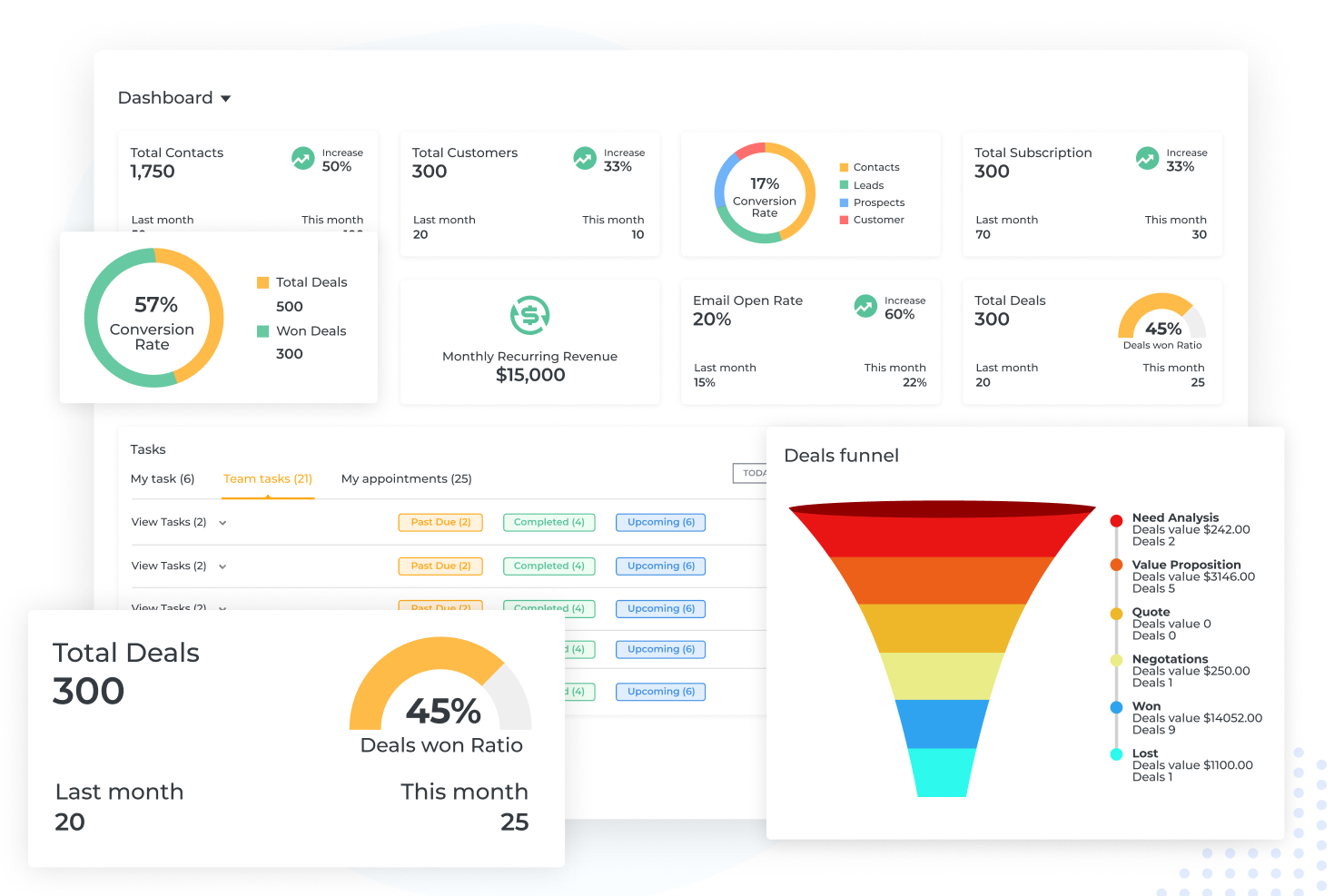
Saleoid is designed for small businesses and startups that need a practical way to manage leads, customer relationships, and sales activities without committing to a costly CRM platform. It gives growing teams an affordable starting point for organizing their sales process and reducing repetitive work.
GoHighLevel offers a broad range of CRM, marketing, and agency management features, which can be useful for businesses that need an extensive toolkit. However, startups and small businesses may not need all those capabilities from the beginning. Saleoid is worth considering if your priorities are managing contacts, tracking sales opportunities, and organizing follow-ups while keeping software costs manageable.
Saleoid vs. GoHighLevel: Which Is Better for Small Businesses?
Best for: Startups, small businesses, solo founders, consultants, and small teams looking for affordable CRM and sales management tools.
Key features: Contact and lead management, sales pipeline organization, and automation capabilities. Check the current plan details to confirm that the specific workflows and integrations your business needs are available.
Pricing: Saleoid’s Custom plan costs $5 per month with two-year billing or $15 per month with monthly billing. It includes one user, 2,500 contacts and companies, and five automations. The Growth plan costs $29.40 per month with two-year billing or $49 per month with monthly billing, and includes five users and 5,000 contacts and companies. The Premium plan costs $119.40 per month with two-year billing or $199 per month with monthly billing, and includes 15 users and 25,000 contacts and companies. Two-year prices are monthly equivalents billed for the full two-year term. See the Saleoid pricing page for current details.
Why consider it over GoHighLevel? Saleoid’s lower entry price may make it a practical option for startups and small businesses that need CRM capabilities without the higher initial commitment of a broader platform. Compare both products based on the features, integrations, automation limits, and team capacity you actually need.
Limitation: Businesses that need extensive agency-specific capabilities, white-label SaaS resale, or advanced sub-account management should verify Saleoid’s current offerings and compare them with GoHighLevel before choosing.
Verdict: Saleoid is worth considering for startups and small businesses that want an affordable CRM starting point, clear plan limits, and room to expand as their needs change. Choose the platform that best matches your team’s current requirements and expected growth.
2. Monday CRM: When Your Agency Thinks in Boards, Not Pipelines

Monday CRM suits agencies where project management and CRM overlap. This is common in creative, digital, and consulting teams. The visual board interface lets you track deals, manage client onboarding, assign tasks, and automate status updates all in one workspace.
However, it’s more flexible than a traditional CRM, which makes it adaptable to unusual workflows, but that flexibility also means it requires some upfront configuration to get right. Once it’s set up around your process, though, it tends to stick. Teams use it because it matches how they already think about work.
Best for: Digital, creative, or consulting agencies where client work and sales overlap heavily.
Key features: Custom pipelines, automation recipes, cross-board workflows, email integration, team workload management, and a broad integration library.
Pricing: Starts at $12/user/month with a reasonably capable free trial.
Why it beats GHL here: Far simpler to set up and maintain for agencies that don’t need marketing automation or funnel building. Just clean client and deal management.
Limitation: Monday CRM lacks native email marketing and lead nurturing automation. If your agency needs to run campaigns or automated follow-up sequences directly from your CRM, you’ll need to connect a separate tool or look at ActiveCampaign instead.
Verdict: A strong pick for creative and consulting agencies that want a flexible, visual workspace. But this is not the right fit if automated outreach or deep sales pipelines are central to how you operate.
3. ClickUp CRM: One Workspace for Projects and Client Management
ClickUp started as a project management tool and built CRM functionality into it. It’s a natural fit for agencies that are already using ClickUp for delivery work and want to pull client management into the same platform rather than maintaining two separate tools.
The CRM features aren’t as deep as a dedicated CRM, but for agencies whose main headache is context switching between a project tool and a separate CRM, consolidating into ClickUp can remove a real friction point.
Best for: Agencies already using ClickUp for project delivery who want to centralise client management.
Key features: Custom CRM views, pipeline tracking, client portals, task automation, email integration, and a single workspace for sales and delivery.
Pricing: Generous free plan. Paid from $7/user/month. Strong value for combined project and CRM use.
Why it beats GHL here: If you only need CRM as one part of a broader agency workspace, ClickUp avoids the cost and complexity of a dedicated platform like GHL.
Limitation: ClickUp’s CRM capabilities are shallower than dedicated platforms. Deal reporting, lead scoring, and contact intelligence are limited. Teams with a high-volume sales process or complex pipelines will likely outgrow it quickly.Verdict: If you’re already using ClickUp and want to avoid a second tool, but if sales and client management are core business functions rather than a side workflow, then the
4. DashClicks: When You Want to Offer More without Building More
DashClicks is built for agencies that don’t just manage clients but also deliver services at scale. It combines CRM functionality with white-label fulfillment, meaning you can sell services like SEO, ads, and websites without hiring a large in-house team.
The CRM side handles contacts, deals, and communication, but the real strength lies in how tightly it connects sales with service delivery. It works best when you actually plan to use its fulfillment ecosystem, not just the CRM.
Best for: Agencies that want to resell marketing services and scale without building a large internal team.
Key features: White-label dashboard, CRM and pipeline tracking, fulfillment marketplace, reporting, client communication tools, and automated onboarding workflows.
Pricing: Starts at $199/month for the core platform.
Why it beats GHL here: Stronger fulfillment ecosystem. From managing clients to actually delivering services, you can do it all without building everything yourself.
Limitation: At $199/month, DashClicks is a significant commitment for early-stage agencies that aren’t yet reselling services at volume. The pricing only justifies itself once you’re actively using the fulfillment marketplace. The CRM alone doesn’t warrant the cost.
Verdict: A smart choice for growth-stage agencies building a productized service model, but too expensive to adopt purely as a CRM. If fulfillment isn’t part of your plan yet, start elsewhere.
5. Systeme.io: When You Want Simplicity Over Setup
Systeme.io focuses on doing a few core things well. These include funnels, email automation, and basic contact management, but it keeps everything easy to use from day one.
The CRM here is lightweight. You can track contacts, segment leads, and automate follow-ups, but it’s not built for deep pipeline management or complex sales processes. It’s designed for solo business owners and small teams who care more about launching campaigns quickly than managing detailed deal stages.
Best for: Freelancers, solo founders, and small agencies running funnels and simple sales processes.
Key features: Funnel builder, email marketing, automation workflows, contact management, course hosting, and landing pages.
Pricing: Starts at $17/month for the first paid plan.
Why it beats GHL here: Much easier to get started. No heavy setup required. Just a simple system that works out of the box.
Limitation: Systeme.io is not a real CRM in the traditional sense. There’s no deal pipeline, no contact activity tracking, and no sales reporting. If you’re managing multiple client relationships or need visibility into where leads are in your sales process, you’ll hit its ceiling quickly.
Verdict: The right tool for solopreneurs and freelancers who need funnel and email automation, not client management. Don’t choose it if you’re expecting CRM depth. Instead, choose it if you want to launch fast and keep things simple.
6. EngageBay: When You Want All-in-one at an Affordable Pricing
EngageBay sits in the middle ground between simple tools and expensive enterprise platforms. It offers CRM, marketing automation, and customer support features in one system, without pushing you into high pricing tiers too early.
The CRM is fully functional, with deal pipelines, contact tracking, and automation, but it’s the combination of sales and marketing tools that makes it useful. You can manage leads, run campaigns, and track conversations without switching platforms.
Best for: Small agencies and growing businesses that want sales, marketing, and support in one place.
Key features: CRM with deal pipelines, email marketing, automation workflows, helpdesk, landing pages, and contact tracking.
Pricing: Starts at $12.74/user/month for the basic paid plan.
Why it beats GHL here: More balanced as a complete business system without forcing you into agency-style complexity or pricing.
Limitation: EngageBay’s automation builder and reporting tools aren’t as sophisticated as dedicated platforms like ActiveCampaign. Teams with complex, behaviour-based automation workflows may find the capabilities limiting as their needs scale.
Verdict: One of the better value-for-money options for small agencies that need CRM, marketing, and support under one roof. It covers the essentials well, but just don’t expect enterprise-grade automation depth.
7. ActiveCampaign: When Automation Is Your Priority
ActiveCampaign is less about visual pipelines and more about what happens after a lead enters your system. It’s built for teams that rely heavily on email marketing, segmentation, and automated customer journeys to drive conversions.
The CRM is solid, with deal tracking and pipeline management, but it really shines when combined with its automation engine. You can create detailed workflows based on behaviour, engagement, and timing, making it powerful for nurturing leads over time. The downside is that it requires more setup and ongoing optimisation compared to simpler tools.
Best for: Agencies and businesses that depend on email marketing and advanced automation to convert leads.
Key features: CRM with pipelines, advanced automation builder, email marketing, segmentation, lead scoring, and integrations.
Pricing: Starts at $15/month (scales with contacts).
Why it beats GHL here: Stronger and more flexible automation capabilities, especially for email-driven workflows and lead nurturing.
Limitation: ActiveCampaign’s pricing scales with your contact list, which can become expensive quickly for agencies managing large audiences. It’s also noticeably harder to set up than simpler tools. Expect a learning curve before you get full value from the automation engine.
Verdict: The strongest choice on this list for automation-led agencies, but only worth it if you’re committed to building and maintaining email workflows. If you want automation without the setup overhead, a simpler tool will serve you better.
Which GoHighLevel Alternative Is Right for Your Agency

The right GoHighLevel alternative depends completely on the type of agency you’re running. It also depends on your client volume, your budget, and which parts of your workflow actually need software support. Let’s see the breakdown of which one fits your specific situation.
A. Which GoHighLevel Alternative Is Best for a Solo Agency or Freelancer?
If you’re just starting out or running a solo setup, Saleoid is the easiest way to get going. It covers CRM, client tracking, and follow-ups without any technical setup. You can literally start using it the same day. No long onboarding, no tutorials before you send your first email. And at just $5/month, you’re not committing to a big expense before your business actually grows.
On the other hand, Systeme.io is a better fit if your work is more focused on funnels and landing pages than managing pipelines. If your main focus is lead generation, email campaigns, and basic automation, its free plan (up to 2,000 contacts) gives you enough room to test things without spending anything.
Simple way to decide: If your work revolves around clients and deals, go with Saleoid. If it’s more about funnels and lead capture, Systeme.io will suit you better.
B. Which GoHighLevel Alternative Is Best for a Growing Agency Balancing Sales and Delivery?
As agencies grow, managing sales and delivery in separate tools starts becoming messy. Leads slip through cracks, and teams waste time switching between platforms.
This is where Saleoid and Monday CRM fit well. Both of them let you handle both sales and project workflows in one place. You can move deals through your pipeline, automatically create onboarding tasks when a deal closes, assign work to your team, and track progress. All of this happens without jumping between tools.
It does take some initial setup, but once it’s in place, teams usually adapt quickly because the interface is visual and intuitive.
C. Which GoHighLevel Alternative Is Best for Budget-Constrained Agencies?
If budget is your main concern, Saleoid is the most cost-effective option here. Starting at $5/month, it gives you CRM, pipeline tracking, automation, and communication tools, and much more without charging per user. That’s a big advantage as your team grows.
EngageBay is another good option if you need more than just CRM. It includes email marketing, automation, and a helpdesk along with sales tools. Pricing starts around $12.74/user/month, which is still reasonable compared to more expensive platforms.
If you want something simple and affordable, Saleoid is the better pick.
If you need marketing and support tools along with CRM, EngageBay is a better option.
D. Which GoHighLevel Alternative Is Best for Agencies That Need White-Label Capabilities?
If white-labeling is important for your agency, DashClicks stands out.
It gives you a branded dashboard that you can show to clients under your agency’s name. Also, it comes with a built-in fulfillment marketplace, which means you can offer services like SEO, ads, or web design without hiring a full team.
This is quite different from GoHighLevel. GHL focuses on letting you resell the software itself, while DashClicks focuses on helping you resell services.
If your business model is selling marketing services, DashClicks is a more practical choice.
If you want to resell a SaaS platform, GoHighLevel still leads in that area.
E. Which GoHighLevel Alternative Is Best for Funnel-Focused or Lead Generation Agencies?
For agencies focused on funnels and lead generation, Systeme.io is a strong fit.
It covers landing pages, opt-in forms, email sequences, and automation, all in one place, without adding unnecessary CRM complexity. The interface is simple, setup is quick, and pricing is easy to justify, especially for client work.
It doesn’t go deep into pipeline tracking or advanced reporting, but if your main deliverable is building funnels rather than managing long-term client relationships, that won’t be a problem.
So, if your agency sells funnels and lead generation services, Systeme.io is one of the most practical options at this price point.
F. Which GoHighLevel Alternative Is Best for Automation-Heavy Agencies?
If your agency depends heavily on email automation, ActiveCampaign is one of the best tools available.
It’s built specifically for advanced workflows. Things like behavioral triggers, segmentation, lead scoring, and multi-step email journeys based on how users interact.
While GoHighLevel includes automation, it treats email as just one part of a larger system. ActiveCampaign, on the other hand, goes much deeper in this area.
The downside is that it doesn’t include funnels, white-labeling, or some of the broader features GHL offers.
If email automation is a core part of how you generate and convert leads, ActiveCampaign is a stronger, more focused solution.
G. Which GoHighLevel Alternative Is Best for Agencies Already Using Project Management Tools?
If your team already uses ClickUp for managing projects, then ClickUp CRM is a natural extension.
Instead of managing sales and delivery in separate tools, you can handle everything in one workspace. When a deal closes, it moves directly into project execution without needing manual data transfer or switching platforms.
While its CRM features aren’t as advanced as dedicated tools, it solves a real problem by keeping everything connected.
If your biggest issue is juggling multiple tools, bringing CRM into ClickUp can simplify your workflow significantly.
FAQs on GoHighLevel Alternatives for Agencies
Some of the best GoHighLevel alternatives for agencies include Saleoid, Monday CRM, DashClicks, Systeme.io, EngageBay, and ActiveCampaign. These tools offer CRM, automation, and client management features with simpler setup and more flexible pricing.
Agencies often look for GoHighLevel alternatives because of the steep learning curve, higher pricing for small teams, and the number of features they may not need. Many agencies prefer simpler CRM and automation tools that are easier to manage.
GoHighLevel can be expensive for small agencies, especially when automation is needed. Smaller agencies often look for more affordable alternatives that offer CRM and automation without high monthly costs.
Saleoid and ClickUp CRM are among the best GoHighLevel alternatives for small agencies because they offer CRM, automation, and client management at a lower cost and with easier setup compared to GoHighLevel.
Yes, export contacts from GHL as a CSV, then import directly into Saleoid. Simple automations can be rebuilt in 1–2 hours. Complex multi-branch workflows may take a day.
Saleoid starts at $5/month, making it the most affordable all-in-one option for solo agencies. ClickUp also has a usable free plan. Systeme.io’s free plan supports up to 2,000 contacts. They are significantly cheaper than GHL.
Final Take!
Most agencies reading this list will fall into the first or third category, which is solo or small teams where the budget and simplicity arguments point clearly to Saleoid. If that’s where you are right now, the honest recommendation is to start there.
Get your CRM and follow-up workflows running properly, and layer in more specialized tools only when you’ve outgrown what a lean, focused platform can do. Starting with the most powerful tool on the market is rarely the right move when you’re not yet using 50% of the one you have. Ready to make a decision? Compare the top GoHighLevel alternative for agencies side by side.
Saleoid is not affiliated with or endorsed by any third-party brands mentioned. All trademarks, product names, and logos belong to their respective owners and are used for identification/comparison only. Details may change-verify on each vendor’s site.