

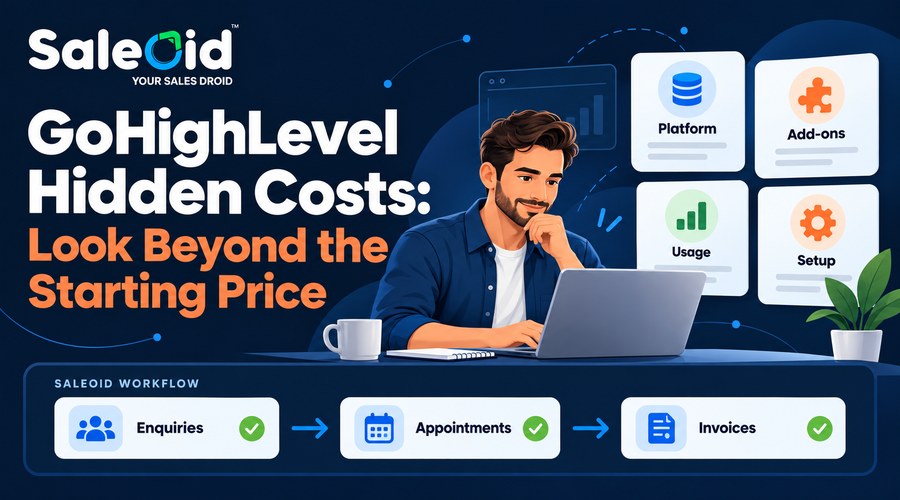

GoHighLevel hidden costs can include paid AI subscriptions, SMS and calling usage, email charges, WhatsApp fees, premium workflow executions and optional add-ons. The $97 Starter subscription is a base price, not an all-inclusive bill. Your actual cost depends on enabled services, messaging volume, client accounts and any outside setup help.
For a small business, the problem is budgeting. A plan can look affordable until the follow-ups, automated replies and client services you intend to use add separate charges.
GoHighLevel publishes these costs across its pricing page and support documentation. “Hidden” here means easy to overlook during a buying decision, rather than proof that a charge is undisclosed.
This guide separates subscriptions, usage fees and optional purchases, then compares the starting commitment with Saleoid.
What does GoHighLevel’s advertised price actually cover?
GoHighLevel’s advertised price covers the core platform subscription. Access to a communication or automation feature does not necessarily include the cost of using it.
| GoHighLevel plan | Monthly billing | Annual billing | Account capacity |
| Starter | $97/month | $970/year | 3 sub-accounts |
| Unlimited | $297/month | $2,970/year | Unlimited sub-accounts |
| Agency Pro | $497/month | $4,970/year | Unlimited sub-accounts |
| Enterprise | Custom quote | Custom quote | Confirm in proposal |
GoHighLevel lists unlimited users and contacts. Unlimited supports phone and email rebilling without markup; Agency Pro adds SaaS Mode and phone and email rebilling with markup. Usage-based services remain separate.
A sub-account is a separate workspace for a business or client location. It is not another employee login. That distinction matters because several add-ons are charged per enabled sub-account.
Our GoHighLevel pricing guide explains the broader plan structure. Here, the focus is what gets added to the advertised price.
Which GoHighLevel hidden costs deserve the closest attention?
The main risks are recurring add-ons, variable communication charges and costs that multiply across client accounts.
Start with this budget formula:
Total cost = platform subscription + enabled add-on subscriptions + billable usage + outside services.
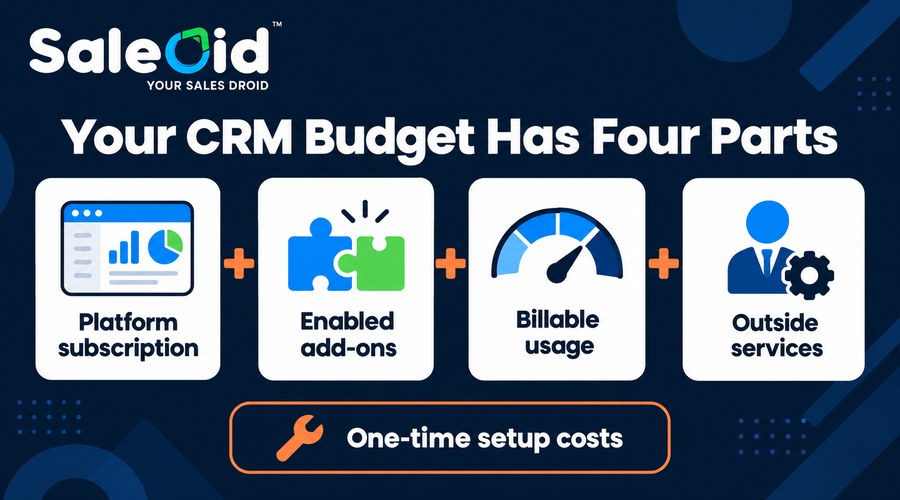
Keep one-time expenses separate. Registration, migration help or a paid setup project can make the first month more expensive than later months.
Also avoid assuming that every business pays every fee discussed below. A consultant using email and appointments has a different budget from an agency running voice automation for several clients.
1. AI subscriptions are charged per enabled location
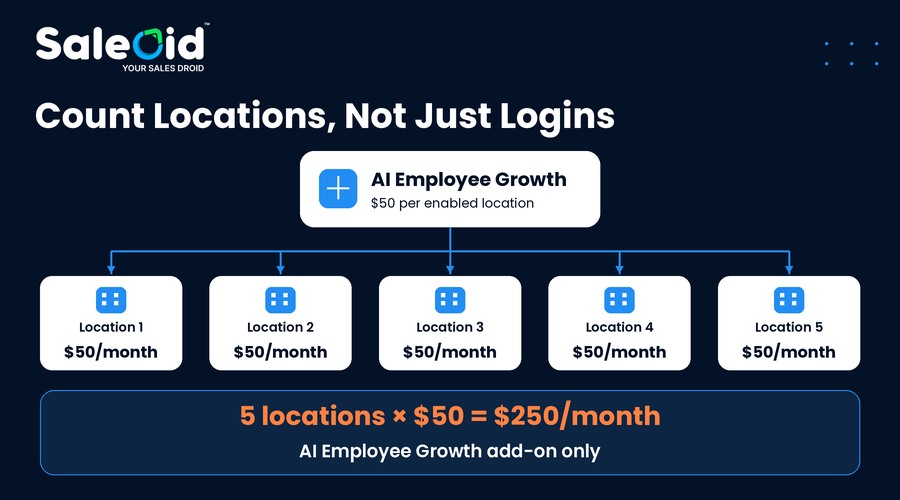
GoHighLevel offers pay-per-use AI, AI Employee Growth at $50 per month per enabled location, and AI Employee Unlimited at $97 per month per enabled location. Growth includes 1,000 Conversation AI Agent responses and 100 Voice AI minutes monthly. Unlimited coverage is subject to fair use.
For an agency, one subscription does not buy those AI allowances for every client. Enabling Growth for five locations adds $250 per month. If you promise an automated assistant to every client, your package price or margin must absorb that expense.
A response allowance also differs from a lead allowance. One prospect can require several exchanges before booking. Estimate conversation volume rather than counting enquiries alone.
2. Voice AI does not remove phone system charges
Voice AI coverage and telephone usage are separate billing categories. HighLevel’s AI billing guide says Phone System charges remain separate across its AI options. Growth’s inbound, outbound and widget Voice AI usage share the same monthly allowance; additional Voice AI usage is billable. This makes “unlimited AI” a poor shortcut for estimating your complete calling budget.
Before enabling an automated phone assistant, price both the AI service and the telephone connection. Ask what happens during transfers, longer calls and usage beyond an included allowance.
3. SMS costs depend on segments and carrier charges
HighLevel lists a US SMS base rate of $0.00747 per segment for outbound and inbound messages. A US/Canada local number costs $1.15 monthly. Recipient carrier fees are additional. A segment is a billable portion of a text message. Long messages can use multiple segments, while emojis or other Unicode characters can reduce the available character count.
For example, 5,000 outbound segments cost $37.35 in base SMS usage. That excludes replies, carrier fees, number rental and registration-related charges. Do not budget for 5,000 “messages” without checking their length. A multi-segment appointment reminder can cost more than a short confirmation.
4. US business texting adds registration and campaign fees
A2P 10DLC means application-to-person messaging through a standard US local phone number. HighLevel’s registration reference lists bundled initial fees of $22.50 for Sole Proprietor and Low Volume Standard brands, or $64 for High Volume Standard.
Monthly campaign fees vary by use case. Examples include $2 for a Sole Proprietor campaign, $1.50 for Low Volume Mixed, and $10 for Standard campaign use cases. HighLevel identifies these as third-party pass-through costs. These expenses are not unique to GoHighLevel. Nevertheless, they belong in a US texting budget.
5. Email sending and verification are separate expenses
HighLevel lists LC Email sending at $0.675 per 1,000 emails and verification at $2.50 per 1,000 checks. Its documentation also identifies incoming, outgoing and forwarded email activity as billable. At the published sending rate:
- 10,000 emails cost $6.75.
- 50,000 emails cost $33.75.
- 100,000 emails cost $67.50.
Verifying 10,000 addresses adds $25 if those checks are performed. The sending rate alone may be manageable. The practical concern is understanding which events generate charges and how often your workflows send.
List size is not monthly volume. A sequence sent to the same contact several times creates repeated sending activity.
6. WhatsApp has subscription and messaging costs
GoHighLevel lists WhatsApp integration at $10 monthly per enabled sub-account, with messaging costs separate.
Its support guide describes changes affecting service messages and utility messages inside the customer service window. It states that the first 1,000 service messages per phone number each month remain free. The same guide still lists a 5% processing fee, so confirm the applicable fees and current message rates in your account before committing.
Five WhatsApp-enabled client accounts therefore add $50 in monthly integration subscriptions before message usage.
7. Premium workflow actions can generate execution charges
HighLevel charges $0.01 per standard premium execution without a paid Workflow Pro plan, after 100 free lifetime executions per eligible sub-account. That free allowance does not reset monthly.
Workflow Pro Starter costs $10 monthly for 10,000 included premium executions, with additional executions at $0.008 each. Standard workflow actions do not consume these premium allowances. A workflow with multiple premium steps can generate more than one execution per contact.
For illustration, 5,000 billable premium executions cost $50 at the standard rate after the free allowance is exhausted. A bundle could cost less, depending on eligible activity. Review the action types before estimating. External model usage and features with separate pricing need their own calculation.
Which optional add-ons can increase the bill further?
GoHighLevel’s optional purchases can turn a relatively simple CRM budget into several subscriptions.
| Optional purchase | Published recurring price |
| Online listings management | $30/month per sub-account |
| Premium prospecting tool | $29/month per sub-account |
| Search Atlas SEO | $79/month per sub-account |
| Branded Client Portal App | $49/month per sub-account |
| Dedicated email IP | $59/month per IP |
| WordPress hosting | From $10/month per site |
| Premium support | $500/month |
| White label mobile app | $497/month |
| HIPAA compliance add-on | $297/month |
Write down what each add-on replaces. If you still pay for the previous service, the purchase expands your software bill instead of reducing it.
What could your actual GoHighLevel monthly bill look like?
The examples below show selected configurations, not average customer spending or guaranteed invoices. Each combines published rates with explicitly stated assumptions.
| Illustrative configuration | Calculation | Monthly subtotal |
| Starter with AI Growth for one location | $97 + $50 | $147 |
| Starter with AI Unlimited for one location | $97 + $97 | $194 |
| Starter with AI Growth and WhatsApp for one location | $97 + $50 + $10 | $157 |
| Unlimited with AI Growth for five locations | $297 + (5 × $50) | $547 |
| Agency Pro with AI Unlimited for five locations | $497 + (5 × $97) | $982 |
These subtotals exclude communication usage, premium executions, taxes and other purchases. Now take the first configuration and assume 10,000 outbound emails, 5,000 outbound SMS segments and one local number:
$147 + $6.75 + $37.35 + $1.15 = $192.25 monthly.
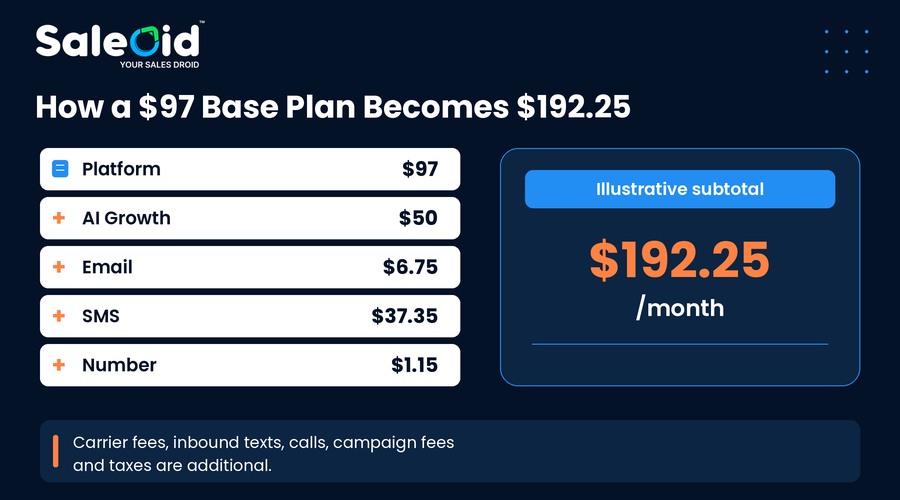
That remains a partial budget. Carrier fees, inbound texts, calls and applicable campaign fees still need adding. The lesson is practical: a $97 buying decision can become a substantially larger commitment once you price the workflow.
For agency-specific comparisons, review our GoHighLevel alternatives for agencies guide before building client packages around these assumptions.
Can wallet auto-recharges create unexpected card payments?
Yes, GoHighLevel’s wallet automatically adds prepaid funds when the balance falls below a configured threshold. Smart Adjustment can increase the recharge amount when top-ups occur frequently.
HighLevel’s current guide says wallet Auto Recharge cannot be disabled, while Smart Adjustment can be disabled. A recharge funds the wallet; usage charges then consume that balance.
This distinction matters when reconciling expenses. Counting a wallet top-up and the usage paid from it as two separate software costs would double-count the spending. However, the card payment still affects cash flow when it happens. Someone should own the recharge settings and review spending by client account.
What do setup, training and switching add to the cost?
Setup and switching can add staff time or outside service costs, but there is no single defensible price for every business. Your work may include cleaning contacts, mapping sales stages, configuring communications and testing automations. Hiring a consultant adds a quoted expense; doing it internally consumes time.
For a hypothetical example, eight setup hours valued at $40 per hour represent $320 of internal time. That is a planning assumption, not a GoHighLevel fee or an industry average. If you are reviewing why businesses are leaving GoHighLevel, include maintenance effort alongside the subscription comparison. Software that requires constant attention can be expensive even without a large invoice.
Does annual billing or a longer trial solve the cost problem?
Annual billing reduces the published core subscription cost, but it does not make separately billed services free. Calculate the annual software commitment and likely usage independently. A lower monthly equivalent can still leave you with an unsuitable workflow and a larger upfront payment.
GoHighLevel’s public pricing page advertises a standard 14-day trial. If you encounter a GoHighLevel 60 day trial offer, check its eligibility, renewal price and usage terms rather than assuming it applies to every signup. Use the trial to price normal operations. Run your real reminder templates, measure premium actions and list the subscriptions needed after the trial.
Is Saleoid a lower-cost option for your business?
Saleoid offers a lower core subscription starting point for a small team that does not need GoHighLevel’s agency resale model.
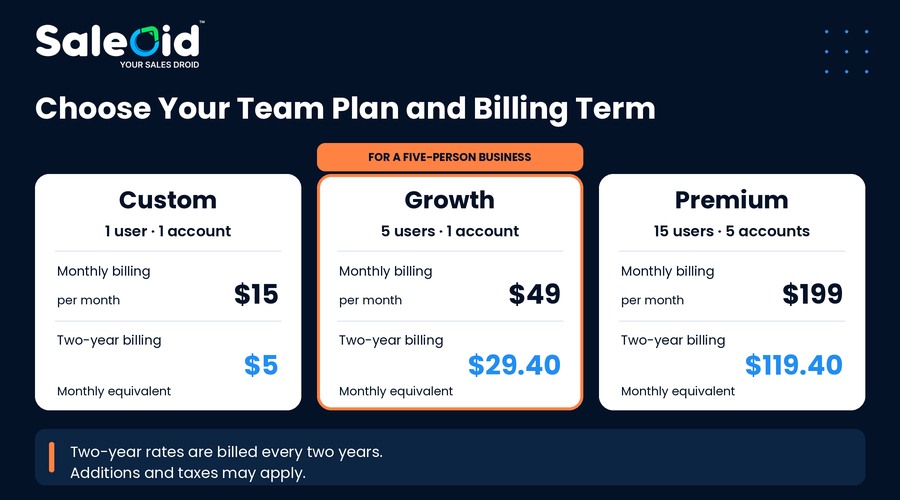
The current Saleoid pricing page lists:
| Saleoid plan | Monthly billing | Monthly equivalent on two-year billing | Included users | Included accounts |
| Custom | $15 | $5 | 1 | 1 |
| Growth | $49 | $29.40 | 5 | 1 |
| Premium | $199 | $119.40 | 15 | 5 |
The two-year rates are billed every two years. Calculated subscription commitments are $120, $705.60 and $2,865.60 respectively, before additions or taxes.
Growth lists 10,000 monthly emails, pipelines, appointments, project management, estimates and invoicing. Premium lists 50,000 monthly emails and adds multi-business capacity and a client portal. Custom uses paid app additions.
For five users managing one business, Growth’s $49 monthly subscription is $48 below GoHighLevel Starter’s $97 monthly subscription. This compares base subscriptions, not identical feature coverage or complete operating bills.
The workflow value is straightforward. Tracking an enquiry, scheduling the next conversation and issuing an invoice within one system can reduce handoffs and forgotten tasks.
For detailed fit, use our Saleoid vs GoHighLevel comparison.
What does transparent Saleoid budgeting require?
Saleoid’s published table separates subscription prices, billing periods, included capacity and paid additions. That gives buyers a concrete starting point for checking the budget. It would still be inaccurate to promise that every activity is free. Confirm additional seats, selected Custom apps, credits and communication charges before purchase.
The main Saleoid page also contains inconsistent automation figures between its summary and detailed table. Ask for the applicable limit in writing rather than building a purchase around an ambiguous allowance. Growth and Premium offer a 15-day trial. Test the chosen plan against the work your team actually performs.
How should you choose between GoHighLevel and its alternatives?
Choose according to the work you need to complete and the complete budget required to complete it. For an agency selling software subscriptions, SaaS Mode and rebilling may justify a different investment. Compare account capacity and resale requirements carefully; Saleoid’s Premium allowance is not unlimited client accounts.
Our guide to GoHighLevel for small businesses explores the single-business buying decision. If administration is your main concern, compare simpler alternatives to GoHighLevel.
If cost is the trigger, shortlist GoHighLevel alternatives based on your required workflow.
Use the broader best GoHighLevel alternatives pillar to compare options, then narrow the list through a realistic trial.
What should you confirm before paying for a CRM?
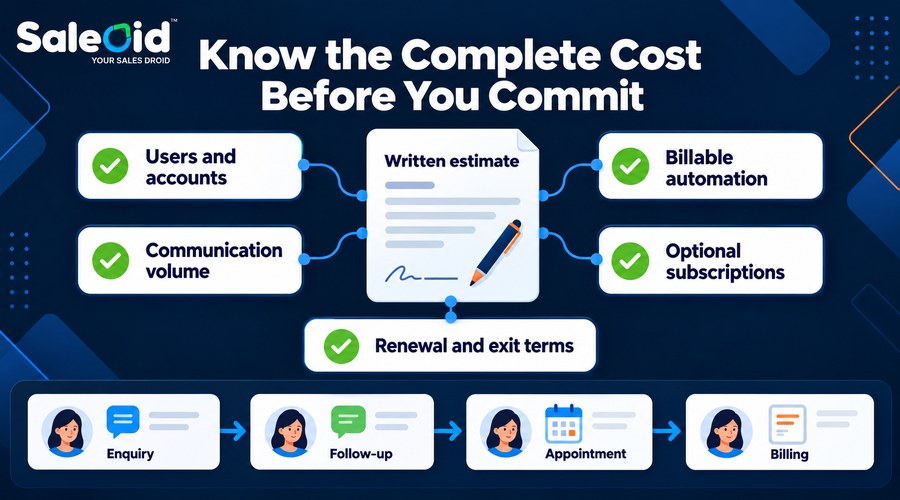
Request a written estimate based on your business, rather than a generic starting price.
- Specify capacity. List users, business accounts, contacts and expected growth.
- Define communication volume. Include outbound activity, replies and calling.
- Identify billable automation. Count premium actions and paid model usage separately.
- Approve optional subscriptions. Give each purchase a purpose and an owner.
- Confirm renewal and exit terms. Check billing period, trial end date, cancellation and data export.
When comparing GoHighLevel competitors, apply the same assumptions to every quote. Then test one complete customer journey. Capture an enquiry, follow up, book an appointment and send the relevant billing document. Record what your team can complete and what still needs another purchase.
Reduce GoHighLevel hidden costs by pricing the complete workflow
GoHighLevel hidden costs are easiest to control before you subscribe. Separate the platform fee from usage, per-account purchases and implementation work. Compare alternatives to GoHighLevel using your actual requirements. Then review Saleoid’s pricing plans and test Growth or Premium with the 15-day trial. Choose the plan whose complete cost you understand before the first renewal.
FAQs
The $97 price is GoHighLevel’s monthly Starter subscription, not a guaranteed all-inclusive operating bill. Optional subscriptions and usage-based services can add costs. Before signup, identify the channels and paid tools your workflow needs. A business using only basic CRM functions has a different budget from one using voice automation and regular texting.
The Unlimited platform subscription and AI Employee Unlimited are separate products. Buying the platform plan does not automatically purchase the paid AI subscription for each location. Review the specific AI option, its coverage and fair-use conditions. Phone System charges remain separate even where Voice AI is covered.
Yes, native SMS and LC Email activity can generate separate usage charges. SMS budgeting also needs message segments, carrier charges and applicable registration expenses. Estimate the bill from actual reminders and follow-up sequences, including replies, rather than assuming that access to a marketing feature includes unlimited sending.
GoHighLevel lists unlimited users, so adding employee logins does not create a standard per-seat subscription charge. However, employees can increase billable communication activity. Adding a client workspace is a separate decision: account capacity depends on the platform plan, while enabled services may create additional per-account subscriptions.
Your expense depends on data cleanup, workflows, communication configuration and whether you hire outside help. Ask for a defined scope and a written quote. If you configure the account internally, budget staff time and assign responsibility for testing and maintaining the finished setup.
Saleoid is worth evaluating when your priority is managing customer relationships and daily business work within a smaller subscription budget. Check the selected plan’s users, accounts and required features before deciding. Compare complete operating costs, including any additions, and use a trial to confirm that the workflow fits your team.
Note: Pricing checked October 9, 2026. All amounts are in US dollars. Examples exclude applicable taxes and any costs explicitly identified as additional.