



HubSpot’s pricing page is one of the cleanest in the CRM industry. It lists round numbers, has a smooth toggle between monthly and annual billing, and makes the entry points look entirely reasonable.
Then you get the invoice.
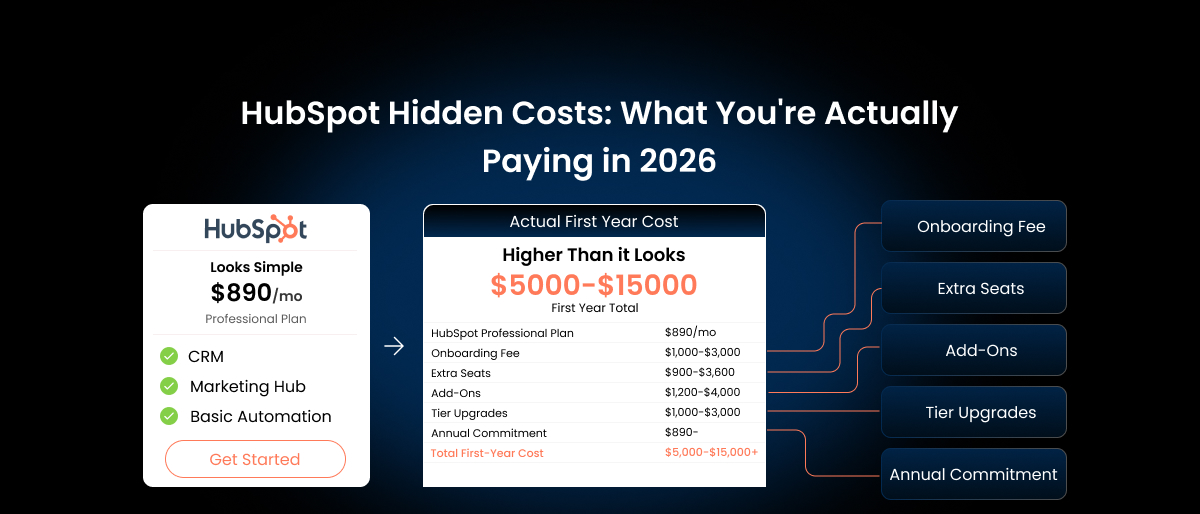
The gap between what HubSpot’s pricing page shows and what businesses actually pay is not a rounding error. For a typical small business team of five to ten people, the difference between the headline price and the real first-year cost can be $5,000 to $15,000. Not because HubSpot is doing anything deceptive, the fees are disclosed, just not prominently, but because the platform’s pricing is layered in a way that rewards careful reading and punishes assumptions.
This guide breaks down every layer: what the hidden costs are, how they stack, and what a realistic total looks like for a small business. All figures are verified from HubSpot’s own pricing pages and Knowledge Base as of May 2026.
If you’re still weighing whether the platform justifies the spend at all, start here first: Is HubSpot actually worth it for small businesses?
The Headline Price Is Just the Starting Point
Most people evaluating HubSpot anchor on one number: Marketing Hub Professional at $890/month. That’s the plan where automation, workflows, sequences, and proper reporting actually live. Below that, HubSpot’s Starter tier gives you a CRM with a $7/seat/month price tag but deliberately withholds the features that justify paying for a marketing platform in the first place.
So, $890/month seems like the real number to evaluate. Except it isn’t. Here’s what that $890/month actually buys before the hidden costs kick in:
- 3 core seats (everyone else costs extra)
- 2,000 marketing contacts (your list probably isn’t 2,000)
- Marketing automation, workflows, A/B testing, reporting
- No invoicing or billing
- No WhatsApp marketing
- No project management
- No client portal
- A mandatory onboarding fee you haven’t paid yet
By the time you account for the costs below, a “starter” Marketing Hub Professional setup for a five-person team regularly crosses $1,100–$1,200/month before a single add-on, and $15,000+ in year one when onboarding is included.
Hidden Cost 1: The Mandatory Onboarding Fee
This is the most commonly cited pricing surprise in HubSpot reviews, and the one that catches the most people off guard during contract signing.
Onboarding fees by Hub and tier (2026):
| Hub | Professional | Enterprise |
|---|---|---|
| Marketing Hub | $3,000 | $7,000 |
| Sales Hub | $1,500 | $3,500 |
| Service Hub | $1,500 | $3,500 |
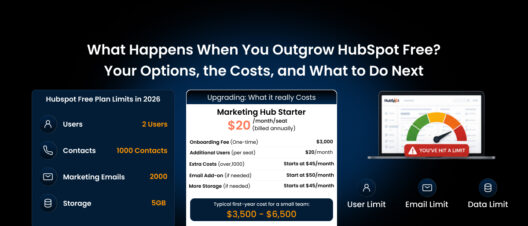
These fees are mandatory and non-refundable for Professional and Enterprise tiers. HubSpot requires them for all new customers signing directly; they are not optional line items you can negotiate out of a direct purchase. The fee covers guided onboarding sessions, training, and setup support, whether you use those sessions or not.
The fee is billed at contract start. Before you’ve sent a single automated email, before you’ve set up a single pipeline, $3,000 leaves your account.
Year 1 impact: If you sign up for Marketing Hub Professional in January, your January invoice is not $890. It’s $890 + $3,000 = $3,890. For a small business that planned their software budget around $890/month, this is a significant first-month shock.
One path around this: signing through a certified HubSpot Solutions Partner can sometimes get the onboarding fee waived or absorbed as part of their implementation service. If you’re going to pay for HubSpot Professional regardless, this is worth exploring before signing directly.
Saleoid charges zero onboarding fees. No mandatory setup cost, no surprise invoice on day one. You pay for the plan, nothing else.
👉 See Saleoid’s Transparent Pricing →
Hidden Cost 2: Contact Tier Overages
HubSpot’s Marketing Hub doesn’t charge you based on how many contacts are in your CRM. It charges based on your marketing contacts, the contacts you have permission to email and actively market to.
This sounds reasonable until you understand how the tier jumps work.
Marketing contact tiers (Marketing Hub Professional):
| Contacts Included | Monthly Cost Added |
|---|---|
| Base (2,000 included in $890/mo) | $0 overage |
| Up to 5,000 contacts | +$250/month |
| Up to 10,000 contacts | +$500/month |
| Up to 15,000 contacts | +$750/month |
| Up to 20,000 contacts | ~$1,000+/month |
At 20,000 contacts, a modest list for a business that’s been actively marketing for two or three years, you’re paying $890 + $1,000+ = $1,890+/month just for Marketing Hub Professional. That’s more than double the headline price for a list size many small businesses reach naturally.
The automatic upgrade trap: HubSpot automatically upgrades your contact tier when you exceed your current limit. If you’re at 4,950 contacts and import a list of 100 people, your tier jumps to the 5,000–10,000 bracket immediately, and your bill increases by $250/month from that point forward. HubSpot does not automatically downgrade you if you later clean your list. You have to request a downgrade manually, and it takes effect at your next renewal, not immediately.
This one-way ratchet means that contact growth, which should be a sign of business success, directly and disproportionately increases your monthly bill.
With Saleoid, your bill doesn’t grow every time your contact list does. No per-contact tiers, no automatic upgrades, no one-way ratchet. Compare Saleoid vs HubSpot on Pricing →
Hidden Cost 3: Per-Seat Charges
HubSpot moved to a seat-based pricing model, and the seat structure is more complex than most comparison articles explain.
Seat types and costs at Professional tier (2026):
| Seat Type | Cost | What It Gives |
|---|---|---|
| Core Seat | $50/month | Access to CRM and hub features at your plan tier |
| Sales Hub Seat | $100/month | Full Sales Hub Professional capabilities |
| Service Hub Seat | $100/month | Full Service Hub Professional capabilities |
| View-Only Seat | $0 | Read-only access on paid plans |
Marketing Hub Professional includes 3 core seats in the $890/month base price. Every additional team member who needs to actively use the platform costs $50–$100/month depending on what they need access to.
The compounding problem: Core seat pricing is based on the highest-tier Hub in your account. If you have Marketing Hub Professional and add a Sales Hub Enterprise seat for one team member, the core seats for all your other users reprice to Enterprise rates. Adding a single senior sales rep at Enterprise level can trigger a platform-wide seat repricing.
Real-world example: 10-person team, Marketing Hub Professional:
| Item | Cost |
|---|---|
| Marketing Hub Pro base (3 seats included) | $890/month |
| 7 additional core seats × $50 | $350/month |
| Contact tier (10,000 contacts) | $500/month |
| Monthly total | $1,740/month |
| Annual total | $20,880/year |
| Year 1 total (add $3,000 onboarding) | $23,880 |
Consider a 10-person team using a single Hub with a modest 10,000-contact list. The estimate excludes Sales Hub, Service Hub, and Commerce Hub and covers only Marketing Hub pricing.
Hidden Cost 4: The Hub-by-Hub Model
HubSpot is not one product. It’s a collection of Hubs, Marketing, Sales, Service, Content, Operations, Commerce, each sold separately with their own pricing tiers, seat structures, and in some cases their own onboarding fees.
This matters because the features most small businesses actually need don’t all live in Marketing Hub.
Features and which Hub they require:
| Feature | Hub Required | Minimum Cost to Access |
|---|---|---|
| Email marketing & automation | Marketing Hub Pro | $890/month |
| WhatsApp marketing | Marketing or Service Hub Pro | $890/month |
| Sales sequences & meeting links | Sales Hub | $100/seat/month |
| Invoicing & payments | Commerce Hub | Free tier available, Pro add-on extra |
| Customer/client portal | Service Hub Pro | $100/seat/month |
| Custom reporting across Hubs | Operations Hub Pro | $720/month |
| Advanced website CMS | Content Hub Pro | $450/month |
A small business that needs CRM, email automation, invoicing, a client portal, and WhatsApp marketing isn’t looking at $890/month. They’re looking at Marketing Hub Pro + Service Hub Pro seats + Commerce Hub, potentially $1,500–$2,500/month before contact overages and extra seats.
HubSpot’s Customer Platform bundle exists at $1,300/month and is often cheaper than buying Hubs individually, but still carries all the same hidden costs (overages, seat charges, onboarding, annual lock-in) on top of a higher base price than Saleoid
The fundamental pricing architecture of HubSpot means that every capability you add costs a meaningful increment. There is no single tier that gives you everything a small business typically needs.
Hidden Cost 5: The Annual Commitment Lock-In
HubSpot’s Professional and Enterprise plans require an annual commitment. Monthly billing is available but costs 20–30% more per month. Most customers sign annual to access the better rate, and most don’t fully absorb what that means until they want to leave.
What annual commitment means in practice:
- You cannot cancel mid-contract and stop being charged
- If you sign in January and want to leave in August, you pay through December
- Downgrading mid-contract is also not permitted, you can only downgrade at renewal
- Contact tier increases take effect immediately; contact tier decreases require a manual request and take effect at renewal
For a business paying $1,740/month on Marketing Hub Professional with a 10,000-contact list, leaving five months early means paying $8,700 for a platform you’ve stopped using.
This isn’t a penalty fee, it’s the structure of the contract. But it becomes a hidden cost when businesses sign without fully reading how the commitment works.
Hidden Cost 6: HubSpot Credits
Introduced in recent platform updates, HubSpot Credits are the internal currency for AI-powered features, custom integrations, and premium services. Credits don’t roll over month to month, unused credits expire.
Credit allocations by tier:
| Tier | Monthly Credits Included |
|---|---|
| Starter | 500 |
| Professional | 5,000 |
| Enterprise | 10,000 |
Teams running AI-powered content generation, AI prospecting agents, or heavy integration workflows can exhaust their credit allocation before the month ends. Additional credits are available for purchase at rates that vary based on usage volume. For teams not actively monitoring their credit consumption, this can surface as an unexpected line item on the monthly invoice.
The Real Year-One Cost: Three Scenarios
Based on verified 2026 pricing, here’s what a realistic year-one total looks like for different small business profiles.
5-Person Team: Marketing Hub with 5,000 Contacts
| Item | Cost |
|---|---|
| Marketing Hub Professional (3 seats) | $890/month |
| 2 additional core seats × $50 | $100/month |
| Contact tier: 5,000 contacts | +$250/month |
| Monthly total | $1,240/month |
| Annual subscription | $14,880 |
| Onboarding fee (one-time) | $3,000 |
| Year 1 total | $17,880 |
10-Person Team: Marketing + Sales Hubs with 10,000 Contacts
| Item | Cost |
|---|---|
| Marketing Hub Professional (3 seats included) | $890/month |
| 7 additional core seats × $50 | $350/month |
| Contact tier: 10,000 contacts | +$500/month |
| 3 Sales Hub seats × $100 | $300/month |
| Monthly total | $2,040/month |
| Annual subscription | $24,480 |
| Onboarding fees (Marketing + Sales) | $4,500 |
| Year 1 total | $28,980 |
Same 10-Person Team on Saleoid Unlimited
| Item | Cost |
|---|---|
| Saleoid Unlimited — all modules, unlimited users | $39/month |
| Annual total | $468 |
| Onboarding fee | $0 |
| Year 1 total | $468 |
The gap isn’t a rounding difference. Scenario 2 costs 62 times more in Year 1 than Scenario 3 for a team size where Saleoid’s unlimited-user pricing provides the same coverage.
Why HubSpot’s Pricing Architecture Works This Way
It’s worth being fair here: HubSpot is not hiding these costs. The onboarding fees are listed on the pricing page. The contact tier structure is documented in detail. The seat types are explained in the Knowledge Base.
The pricing architecture works the way it does because HubSpot was built for mid-market and enterprise companies where a $20,000 annual software spend for a 10-person marketing team is a normal budget line. The platform delivers real value at that scale, the features, the integrations, the reporting depth, and the ecosystem are genuinely enterprise-grade.
The problem is that small businesses arrive at HubSpot’s pricing page looking at $890/month and making a budget decision based on that number. The actual invoice with onboarding, contact overages, additional seats, and potential Hub add-ons, lands somewhere that a carefully planned $1,000/month software budget can’t absorb.
That’s not a dishonest pricing model. It’s a misalignment between who HubSpot was built for and who evaluates it based on the headline price.
Is HubSpot Worth It for Your Business?
That depends entirely on your business size, your contact volume, your team headcount, and whether the features you’re actually paying for are features you’ll genuinely use.
For a marketing team of 10+ people running serious multi-channel campaigns with a $2,000+/month software budget, the question is worth exploring carefully. For a small business of five people with a growing contact list trying to manage leads, send email campaigns, invoice clients, and communicate via WhatsApp, there are platforms that include all of that at a fraction of HubSpot’s true cost.
Before you decide, read our full breakdown: Is HubSpot Worth It for Small Businesses in 2026? →
And if you’ve already done the maths and concluded it isn’t. Here’s where most small businesses go instead →
HubSpot Hidden Costs: Quick Reference Summary
| Hidden Cost | What It Is | Typical Impact |
|---|---|---|
| Onboarding fee | Mandatory at Professional+ | $3,000–$7,000 in Year 1 |
| Contact tier overages | Auto-triggers at tier limits | +$250–$1,000+/month |
| Per-seat charges | $50–$100/user beyond included seats | +$300–$700/month for 10-person team |
| Hub-by-hub model | Each feature lives in a separate paid Hub | $1,500–$2,500+/month for complete stack |
| Annual commitment | Cannot cancel or downgrade mid-contract | 4–6 months extra billing if you leave early |
| HubSpot Credits | AI features billed via internal currency | Variable; overages billed at usage |
| Budget rule of thumb | Add 20–30% on top of the listed plan price | $1,100–$1,200/month actual for Marketing Pro |
Frequently Asked Questions
The main ones are the mandatory onboarding fee ($3,000–$7,000 for Professional and Enterprise), contact tier overages ($250–$1,000+/month depending on list size), per-seat charges for additional users ($50–$100/seat/month beyond included seats), and the cost of additional Hubs if you need invoicing, a client portal, or advanced sales features. As a rule of thumb, budget 20–30% above HubSpot’s listed plan price for the true monthly cost.
Yes, for new Professional and Enterprise customers purchasing directly from HubSpot. The fee is non-refundable and billed at contract start. Signing through a certified HubSpot Solutions Partner can sometimes reduce or waive this fee.
HubSpot charges based on marketing contacts, the contacts you actively market to, not every contact stored in your CRM. Marketing Hub Professional includes 2,000 marketing contacts. Every additional 5,000 contacts adds approximately $250/month. If you exceed your tier, HubSpot automatically upgrades you to the next tier, but does not automatically downgrade if your contact count drops later.
No. Every team member who needs active access to Professional or Enterprise features requires a paid seat at $50–$100/month. The only free seat type is View-Only, which provides read-only access. Teams with 10+ users at Professional tier regularly pay $400–$700/month in seat fees alone on top of the base Hub price.
For a 5-person team on Marketing Hub Professional with a 5,000-contact list, expect approximately $17,880 in Year 1 (including the $3,000 onboarding fee and contact overages). For a 10-person team also using Sales Hub, expect $25,000–$30,000 in Year 1. These figures are based on standard 2026 list pricing before any add-ons.
You’ve now seen exactly what HubSpot costs. Here’s the honest alternative: Saleoid covers CRM, marketing automation, invoicing, WhatsApp, and more with no hidden fees, no seat repricing traps, and no $3,000 onboarding charge waiting for you at checkout. Start Free trial for 15 days →
Disclaimer: The pricing, features, fees, and other information presented in this article are based on publicly available data from the vendor’s official website, reputable third-party review platforms, and experiences shared by verified customers. While every effort has been made to ensure accuracy at the time of writing, product offerings and pricing may change over time. Readers should verify the latest information directly with the respective provider before making a purchasing decision.