

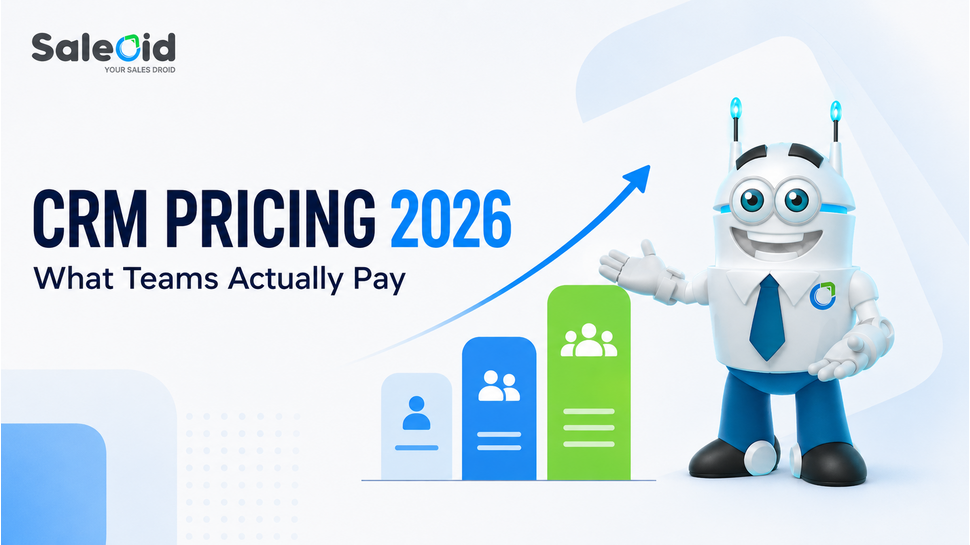

CRM software pricing can look affordable on a product page and become expensive fast once more people need access. The real cost depends on seats, plan thresholds, billing commitments, included users, and usage-based charges, and not the number on the homepage banner.
This comparison shows what teams of 1, 3, 5, 10, and 20 users actually pay for Saleoid, HubSpot, Salesforce, Zoho CRM, Bigin by Zoho CRM, Attio, and GoHighLevel, using each vendor’s own published 2026 pricing. It’s built for founders and operators evaluating an AI CRM for small businesses who don’t want to lose sight of total cost as the team grows.
At 20 users, the annual-billing monthly equivalent in this comparison ranges from $49 for Saleoid to $1,680 for Attio, a 34.3x spread. The gap comes mainly from pricing architecture and plan thresholds, not the entry price shown in an ad.
How this CRM Pricing Comparison was Calculated
The comparison uses the lowest published paid plan that supports each stated team size and converts annual prices into monthly equivalents where necessary. This approach helps businesses comparing CRM for small businesses options understand the actual cost as their team grows.
Free plans are documented separately because their user, contact, and feature limits make them unsuitable as direct substitutes for every paid scenario. Taxes, optional add-ons, implementation services, and variable AI, email, SMS, calling, and payment charges are excluded unless mandatory and publicly quantifiable.
Annual and two-year monthly equivalents are not necessarily what you pay month to month, always confirm the upfront commitment before purchasing.
Key Findings
- Per-user CRM pricing compounds quickly. A $25 seat becomes $500/month for 20 users, before usage charges, add-ons, or implementation fees.
- Flat and bundled pricing softens the growth penalty. GoHighLevel Starter stays $97/month from 1 through 20 users, while Saleoid moves teams into user-inclusive bundles instead of charging per seat.
- Free CRM plans have real seat limits. HubSpot allows up to 2 free users, Zoho CRM allows 3, Bigin allows 1, Salesforce allows 2, and Attio allows 3.
- An annual monthly equivalent isn’t a month-to-month price. Buyers may need to pay 12 or 24 months upfront to unlock the advertised rate.
- Seat caps create pricing cliffs. Attio Plus tops out at 10 seats, so a 20-user comparison requires the pricier Pro tier.
- Usage-based charges add up. AI, email, SMS, calling, and payment processing fees sit outside the base subscription for most vendors.
CRM Pricing Questions Buyers Ask
1. How much does CRM software cost per user in 2026?
Across this seven-product sample, publicly listed entry paid CRM pricing ranges from $7 per user/month (Bigin Express, annual billing) to $45 per seat/month (standalone HubSpot Smart CRM Professional, annual billing). Salesforce Starter is $25/user/month, Zoho CRM Standard is $14/user/month on annual billing, and Attio Plus is $35/user/month on annual billing. Saleoid and GoHighLevel don’t fit a simple per-seat comparison because they use bundled or flat subscription models instead.
2. What is the cheapest paid CRM for a 20-user team?
Using annual-billing monthly equivalents, Saleoid is the lowest-priced paid subscription in this comparison at $49/month for up to 20 users. GoHighLevel Starter follows at an effective $80.83/month when its $970 annual price is divided by 12. For businesses looking for the best affordable CRM, these figures provide a useful starting point, but they compare published subscription access rather than identical feature sets or usage volumes.
3. Why does per-user CRM pricing get so expensive?
A per-user or per-seat model multiplies the license price by every paid user. A CRM advertised at $14/user costs $280/month for 20 users. A $45 seat costs $900/month for the same team, which is why many businesses end up limiting CRM access to their sales team, even when service, ops, or admin staff need the same customer context.
4. Is a free CRM really free?
A free CRM can carry a $0 subscription price, but it normally limits users, contacts, automations, pipelines, branding, email volume, or support. Free CRM software works best when those limits match the business. It becomes less useful as a pricing benchmark once the comparison requires 5, 10, or 20 active users.
CRM Pricing Comparison Table for 2026
The table below shows the public pricing model used for the main calculations. Annual prices are expressed as a monthly equivalent so vendors can be compared on a common basis.
| CRM | Pricing model | Monthly | Annual equivalent | User rule | Commitment note |
| Saleoid | Custom + bundles | $5 Custom* | $25 Starter | 1/3/10/20 | 2-year rate for $5 |
| HubSpot | Per seat | $50 | $45 | Paid seat basis | Annual commitment for $45 |
| Salesforce | Per user | $25 | $25 | Per paid user | Monthly or annual |
| Zoho CRM | Per user | $20 | $14 | Per paid user | Monthly or annual |
| Bigin | Per user | $9 | $7 | Per paid user | Monthly or annual |
| Attio | Per user + seat caps | $44 Plus | $35 Plus | Plus up to 10 | Pro required above 10 |
| GoHighLevel | Flat platform price | $97 | $80.83** | Unlimited users | $970 annual |
* Saleoid Custom is $5/month only with two-year billing; annual Starter is shown because no annual Custom Plan rate was confirmed.
For a closer look at plans, costs, and pricing models, read our AI CRM pricing guide.
Monthly paid subscription cost by team size
| CRM | 1 user | 3 users | 5 users | 10 users | 20 users |
| Saleoid | $29 | $29 | $49 | $49 | $99 |
| HubSpot Smart CRM Pro | $50 | $150 | $250 | $500 | $1,000 |
| Salesforce Starter | $25 | $75 | $125 | $250 | $500 |
| Zoho CRM Standard | $20 | $60 | $100 | $200 | $400 |
| Bigin Express | $9 | $27 | $45 | $90 | $180 |
| Attio | $44 | $132 | $220 | $440 | $2,100* |
| GoHighLevel Starter | $97 | $97 | $97 | $97 | $97 |
Saleoid monthly billing uses Starter for up to 3 users, Growth for up to 10, and Unlimited for up to 20. Attio Plus is capped at 10 seats, so the 20-user scenario uses Pro at $105 per user/month.
Annual-billing monthly equivalent by team size
| CRM | 1 user | 3 users | 5 users | 10 users | 20 users |
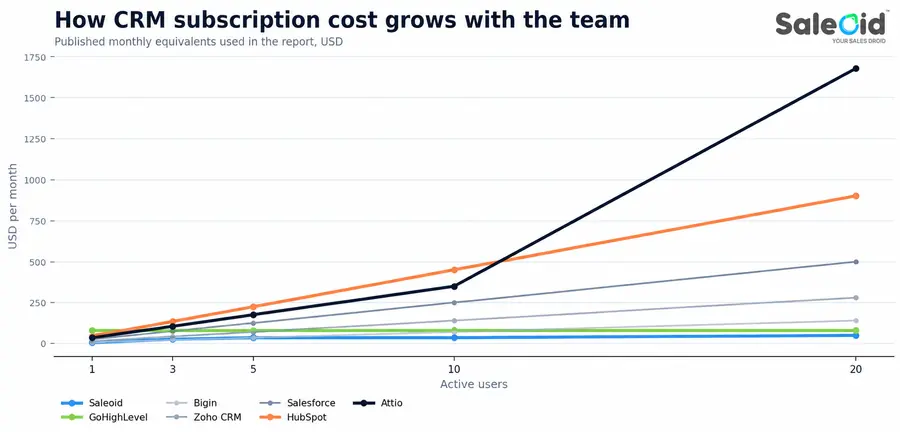
| Saleoid | $5 | $25 | $35 | $35 | $49 |
| HubSpot Smart CRM Pro | $45 | $135 | $225 | $450 | $900 |
| Salesforce Starter | $25 | $75 | $125 | $250 | $500 |
| Zoho CRM Standard | $14 | $42 | $70 | $140 | $280 |
| Bigin Express | $7 | $21 | $35 | $70 | $140 |
| Attio | $35 | $105 | $175 | $350 | $1,680* |
| GoHighLevel Starter | $80.83 | $80.83 | $80.83 | $80.83 | $80.83 |
These are monthly equivalents, not necessarily monthly payments. Attio’s 20-user pricing uses Pro at $84 per user/month billed annually. Saleoid’s annual billing uses its user-inclusive bundles.
What a 20-user CRM team pays
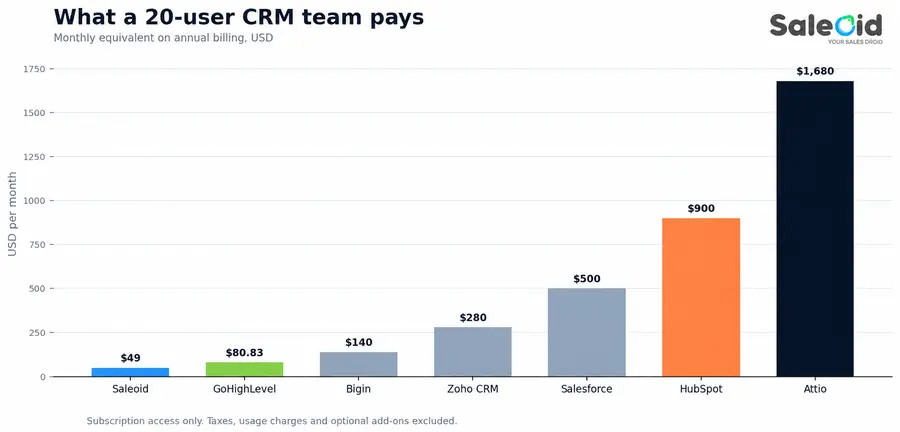
| Plan used for 20 users | Monthly equivalent | Annual subscription | Reason |
| Saleoid Unlimited | $49 | $588 | 20 users included |
| GoHighLevel Starter | $80.83 | $970 | Unlimited users |
| Bigin Express | $140 | $1,680 | $7 per user |
| Zoho CRM Standard | $280 | $3,360 | $14 per user |
| Salesforce Starter | $500 | $6,000 | $25 per user |
| HubSpot Smart CRM Pro | $900 | $10,800 | $45 per seat |
| Attio Pro | $1,680 | $20,160 | $84 per user; Plus cap exceeded |
This measures published subscription cost, not value, ROI, or feature parity. A more expensive platform may still offer capabilities a specific buyer needs, a cheaper product isn’t automatically the best CRM for every organization.
What the pricing models mean
1. Per-user or per-seat pricing
HubSpot Smart CRM Professional, Salesforce Starter, Zoho CRM Standard, Bigin Express, and Attio’s paid plans use per-user or per-seat pricing in the scenarios studied. Easy to calculate, but access gets more expensive as the team grows, total cost is the seat price multiplied by paid users, subject to plan caps and minimums.
2. Flat platform pricing
GoHighLevel Starter costs $97/month or $970/year and includes unlimited users and contacts. The main plan limit is three subaccounts rather than team seats, so cost-per-user actually falls as the team grows, though the platform remains oriented toward agencies and marketers. Telecom and AI usage charges apply separately.
3. User-inclusive bundled pricing
Saleoid bundles users into three tiers: Starter includes 3 users, Growth includes 10, and Unlimited includes 20. This creates pricing steps instead of a per-seat charge. The $39 two-year Unlimited rate shouldn’t be read as literally “unlimited users”, it includes up to 20 users, 10 accounts, and 20,000 contacts and companies. The plan name refers to the highest packaged tier; individual resources still have published limits.
4. Modular CRM pricing
Saleoid also offers a Custom Plan starting at $5/month with two-year billing. It includes 1 user, additional users cost $6 each, and optional apps cost $1 each per month (no app is listed above $1). This suits a founder who wants core CRM software first and to add appointments, forms, invoicing, or marketing tools gradually.
Vendor-by-vendor CRM pricing analysis
1. Saleoid pricing in 2026
Saleoid combines a custom CRM plan with pre-built small-business bundles and transparent CRM pricing. The Custom Plan starts at $5/month with two-year billing, includes one user, and charges $6 per additional user; optional applications are $1 each per month. The bundled plans include broader functionality and fixed user allowances.
| Plan | Users | Monthly | Annual eq. | 2-year eq. | Annual upfront | 2-year upfront |
| Starter | 3 | $29 | $25 | $19 | $300 | $456 |
| Growth | 10 | $49 | $35 | $25 | $420 | $600 |
| Unlimited | 20 | $99 | $49 | $39 | $588 | $936 |
The Custom Plan isn’t always the cheapest choice as seats increase. At 5 users, core Custom CRM would cost $29/month on the two-year rate, while the Growth bundle costs $25 and includes up to 10 users plus additional applications. At 20 users, Custom CRM would reach $119/month, compared with $39 for the two-year Unlimited bundle, a clear signal to switch to a bundle once a team crosses a few users.
2. HubSpot Smart CRM pricing in 2026
HubSpot offers free CRM functionality for up to two users and 1,000 contacts. Standalone Smart CRM is listed in Professional and Enterprise editions: Professional is $50/seat paid monthly or $45/seat with an annual commitment; Enterprise starts at $75/seat and requires sales contact for a full quote.
HubSpot also markets Starter access from $10/seat on its AI CRM page, but Starter, standalone Smart CRM Professional, and individual Hub products aren’t interchangeable, confirm which Hub, seat type, automation level, and credit allowance your workflow needs before multiplying by the advertised seat price. Smart CRM Professional includes 3,000 HubSpot Credits; additional credits are $0.010 each, reset monthly, and don’t roll over. These variable AI costs aren’t included in this comparison’s seat calculations.
If HubSpot doesn’t fit your budget or requirements, exploring HubSpot alternatives can help you find a CRM with pricing and features that better match your business needs.
3. Salesforce CRM pricing in 2026
Salesforce Free Suite includes two user licenses. Starter Suite is $25/user/month, billed monthly or annually, a 10-user team costs $250/month and a 20-user team costs $500/month. Transaction fees may apply. Pro Suite starts at $100/user/month with annual billing and a contract, so we exclude it from the entry-level paid-cost table.
For businesses comparing HubSpot vs Salesforce, the main differences come down to pricing, user limits, features, and how each platform scales as your team grows.
4. Zoho CRM pricing in 2026
Zoho CRM has a free edition for up to three users. The Standard paid edition costs $20/user per month or $14/user per month with annual billing. Local taxes applies in addition. We use the Standard edition for the paid team calculations because it is the lowest publicly listed paid Zoho CRM tier in scope.
Zoho also sells Professional and Enterprise editions with deeper automation, process management, and AI capabilities, businesses that need features outside Standard should recalculate cost at the applicable higher tier rather than treating $14 as a universal Zoho CRM price. If the pricing or features do not fit your needs, looking at a Zoho alternative can help you find a better match.
5. Bigin pricing in 2026
Bigin is designed for small businesses moving from spreadsheets. Free supports one user and 500 records. Express costs $9/user monthly or $7/user/month with annual billing; Premier is $12/user/month annually and adds AI and higher automation limits. Express is used for the entry paid-cost comparison.
Bigin doesn’t impose a paid-user limit on Express or Premier, every user needs a license. The Free plan becomes less relevant as soon as a second user needs access. Bigin also allows customers to add licenses or change plans, with refund windows subject to its published conditions.
6. Attio pricing in 2026
Attio Free supports up to three seats. Plus is $44/user monthly or $35/user/month annually and supports up to 10 seats. Pro is $105/user monthly or $84/user/month billed annually with unlimited seats. Because Plus stops at 10 seats, a 20-user Attio team must move to Pro in this comparison.
This produces a clear pricing cliff – 10 Plus seats cost $350/month on annual billing, while 20 Pro seats cost $1,680/month. That increase reflects both a larger team and a higher edition. Attio also uses AI credit allowances and offers paid workspace-credit additions, excluded from the subscription-only totals here.
7. GoHighLevel pricing in 2026
GoHighLevel Starter is $97/month or $970/year, including unlimited users, unlimited contacts, and three subaccounts, the subscription costs the same for 1, 3, 5, 10, or 20 users. The annual monthly equivalent is $80.83.
GoHighLevel also offers Unlimited at $297/month and Agency Pro at $497/month, designed for agencies needing unlimited subaccounts, rebilling, or SaaS Mode. We use the Starter plan in this comparison because it supports the team sizes covered here. Email, SMS, calling, and premium AI usage have separate charges, while optional add-ons can significantly increase the total cost.
Businesses comparing a GoHighLevel alternative can also consider platforms with simpler pricing and features that better match their team size and requirements.
Feature Context: What the Entry Price may not Answer
A CRM pricing comparison is most useful when readers understand that subscription access doesn’t guarantee identical operational coverage. This comparison doesn’t cover estimates, reporting, mobile access, APIs, or third-party integrations, it uses the following focused small-business feature context:
- Contact and company management
- Sales pipeline
- Tasks and follow-ups
- Email integration
- Basic automation
- Appointments
- Forms and lead capture
- Invoicing
- Roles and permissions
- AI assistance
These capabilities can sit in different editions, add-ons, or companion products. An entry CRM plan may manage contacts and deals but restrict AI, advanced automation, permissions, or invoicing. The correct comparison is the lowest price for the workflow a business actually needs, not simply the cheapest plan name.
| CRM | Entry-plan context | AI pricing context | Costing implication |
| Saleoid | Core CRM + optional $1 apps | AI packaged in Unlimited | Appointments/forms/invoicing available through bundles or apps |
| HubSpot | Free, Starter, Smart CRM and Hubs differ | Credits used by some AI agents | Confirm Hub and seat type before costing |
| Salesforce | Starter covers small-business CRM | Assistive AI included in suite messaging | Higher automation in Pro |
| Zoho CRM | Standard is entry paid tier | Deeper Zia capabilities in higher tiers | Professional/Enterprise may be required |
| Bigin | Express covers basic paid CRM | Premier introduces fuller AI toolkit | Price rises per user |
| Attio | Plus limited to 10 seats | Credit allowances vary by plan | 20 users require Pro |
| GoHighLevel | Broad all-in-one Starter platform | AI and communications can be usage-based | Agency model and subaccounts matter |
Hidden CRM costs to check before buying
- Billing commitment: A low monthly equivalent may require 12 or 24 months of payment upfront.
- Additional users: Confirm whether every employee needs a paid seat and whether view-only or free seats exist.
- Plan upgrades: Seat caps or feature requirements can force a business into a higher edition.
- AI consumption: AI agents, enrichment, and generated content may consume credits after the included allowance.
- Communication usage: You may pay based on your use of SMS, email, phone numbers, calling minutes, and WhatsApp conversations.
- Marketing contacts: Some CRM ecosystems charge separately for contacts used in marketing campaigns.
- Onboarding and migration: The product or edition may include onboarding and migration, offer them as optional services, or require them.
- Payment processing: Transaction fees are separate from the CRM subscription in many systems.
- Taxes: Local VAT, GST, or sales tax may be added at checkout.
- Cancellation and refunds: Annual and multi-year terms can reduce flexibility even when the monthly equivalent is lower.
From spreadsheets to paid CRM: the cost of doing nothing
For many small businesses, the previous software cost is zero because teams manage leads and customer information through spreadsheets, mobile phones, and personal inboxes. That doesn’t mean the existing process has no cost, manual follow-up, duplicated entry, missing context, and limited team visibility all consume time even when there’s no subscription invoice.
Saleoid customer feedback indicates that some customers moved from spreadsheets and mobile-phone workflows rather than from another paid CRM. Its published CRM case studies show how those teams use the platform, reporting operational outcomes such as leads generated, bookings, appointments, projects, and revenue. Because previous software costs and controlled before-and-after measurements weren’t available for this comparison, those outcomes aren’t used to calculate CRM ROI or claimed as results caused solely by pricing.
How to calculate the real cost of CRM software
Use three calculations instead of relying on one advertised price:
1. Monthly subscription cost = base platform fee + paid seats + mandatory plan upgrades.
2. Annual cash cost = monthly equivalent × 12 + onboarding + mandatory add-ons.
3. Total CRM cost of ownership = subscription + implementation + migration + training + usage charges + connected paid tools.
A fourth metric is useful for growth planning:
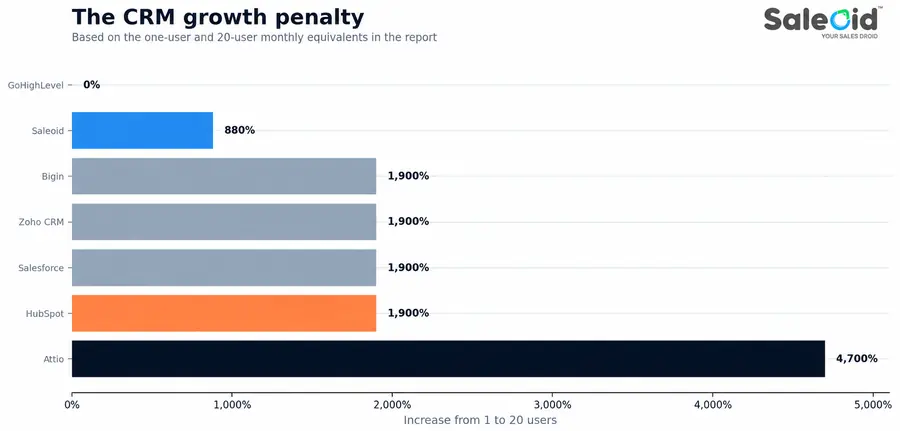
CRM Growth Penalty: ((20-user monthly cost − 1-user monthly cost) ÷ 1-user monthly cost) × 100. A pure per-seat plan produces a 1,900% increase from one to 20 users. Flat platform pricing produces 0%, while tiered bundles fall between those outcomes.
Which CRM pricing model fits which business?
A free CRM works best when:
- Only one to three people require access
- The business primarily needs contacts, a basic pipeline, and simple follow-ups
- Free-plan branding, automation, and support limits are acceptable
- There’s a clear upgrade plan before limits become operational problems
Per-user CRM pricing makes sense when:
- Every paid seat creates clear business value
- Only a defined sales or customer team needs access
- The organization prefers predictable linear licensing
- Advanced controls justify the higher cost as headcount grows
Bundled or flat CRM pricing is a better fit when:
- Several employees need shared customer access
- The business wants to avoid a charge for every additional team member
- The plan’s included-user allowance matches expected growth
- The broader platform model fits the actual operating workflow
Modular CRM pricing works well when:
- The business wants to start with core CRM and add capabilities gradually
- A founder or small team doesn’t need a complete suite on day one
- You can see clear pricing for optional applications.
- The buyer will review when a bundle becomes cheaper than adding seats and apps separately
Final takeaway
The most important CRM pricing lesson for 2026 is simple: compare the cost of the team you expect to have, not only the team you have today. Per-user CRM software can stay affordable for one or two people and become a substantial fixed expense at 10 or 20 users. Flat, modular, and user-inclusive bundles reduce that direct growth penalty, but introduce different limits, commitments, and product models.
In this comparison, Saleoid has the lowest 20-user annual-billing monthly equivalent at $49, followed by GoHighLevel at $80.83. Bigin, Zoho CRM, Salesforce, and HubSpot scale linearly on the paid plans selected. Attio shows the largest 20-user total because its Plus tier stops at 10 seats and the comparison must move to Pro.
These findings don’t establish one universal best CRM. They show why small businesses should calculate seats, commitments, plan thresholds, AI credits, communication usage, and required applications before choosing CRM software. The best CRM pricing is the model that stays understandable and sustainable as the business grows.
Compare Saleoid with the team you plan to build
The right CRM should support the business after your next hire, not only the business today. Review Saleoid’s affordable CRM pricing, or build a custom CRM plan around the tools your team actually needs.