

Quick Answer:
If you need a one-line answer: HubSpot is better suited for small businesses than Salesforce, it’s easier to set up, has a functional free tier, and doesn’t require a dedicated CRM administrator to run. But here’s the part most comparison articles skip. At the tier where HubSpot actually becomes useful for a growing small business, it costs $890/month plus a mandatory $3,000 onboarding fee. And Salesforce’s average small business implementation starts at $5,000–$15,000 before you’ve touched a feature.
For most small businesses, the honest conclusion isn’t “HubSpot or Salesforce.” It’s “neither of these was built for us.”
This guide gives you the full picture, including pricing that doesn’t hide the fine print, a feature comparison that reflects real-world use, and a clear breakdown of who each platform actually serves. We’ll also show you why thousands of small businesses are skipping this debate entirely and choosing a genuinely affordable all in one CRM for small businesses built for how they actually work.
Why Small Businesses Keep Asking This Question
Every year, “HubSpot vs Salesforce” ranks among the most searched CRM queries on the internet, and it makes sense. Both are the most recognized names in CRM software. Both have significant marketing budgets making sure you see them. And both have free trials that make them seem accessible until the bill arrives.
But the businesses Googling “HubSpot vs Salesforce for small business” aren’t enterprise finding teams with six-figure software budgets. They’re a 5-person agency trying to organize their pipeline.
A consultant who needs CRM and email automation together. A growing service business that wants to stop managing clients across three separate tools. These businesses have a real problem worth solving. They just often end up evaluating two platforms that were never designed with them in mind.
Let’s look at both honestly.
What Is HubSpot, and Who Is It Actually Built For?
HubSpot started as an inbound marketing company and built its CRM later. That history matters because it explains why HubSpot’s most powerful features sit inside Marketing Hub, and why the platform is structured as multiple separate Hubs (Marketing, Sales, Service, Content, Operations) that each carry their own pricing tier.
HubSpot is genuinely well-suited for small to mid-market businesses with a marketing-first focus. These include teams that want to do inbound campaigns, run email sequences, score leads, and track attribution in one place without needing a developer. Its interface is clean. Its free CRM tier is real and usable. And its onboarding, compared to Salesforce, is far less intimidating.
The catch is in the tier jumps. HubSpot’s free and Starter plans are, by design, limited enough to push growing businesses toward Professional, where the useful automation, reporting, and workflow features actually live. And Professional is where the pricing conversation changes completely.
What Is Salesforce, and Who Is It Actually Built For?
Salesforce was built from day one as an enterprise CRM. It pioneered cloud-based customer relationship management in 1999 and has spent the last 25 years building the most customizable, extensible, and complex CRM platform in the world. In 2026, it powers sales operations for over 150,000 companies, a significant number of which are large enterprises with dedicated Salesforce administrators, implementation partners, and six-figure annual contracts.
Salesforce’s Starter Suite at $25/user/month sounds accessible. But that plan lacks the marketing automation most small businesses need, and the moment you outgrow it, you’re looking at Pro Suite at $100/user/month, a 4x price jump with no intermediate option. The average Salesforce implementation for a small or mid-sized business starts at $5,000–$15,000 in setup costs alone, before a single lead is entered.
For small businesses without a technical team, a Salesforce admin, or an enterprise budget, the platform routinely delivers less value than its cost justifies, not because it isn’t powerful, but because that power requires significant investment to access.
HubSpot vs Salesforce: Real Pricing for Small Businesses (2026)
This is the section most comparison articles get wrong. Here are the actual numbers and not headline prices, but what a typical 5-person small business actually pays.
HubSpot Pricing (2026)
| Plan | Cost | What’s Missing |
|---|---|---|
| Free CRM | $0 | No automation, limited reporting, HubSpot branding on all emails |
| Starter | $15–$20/seat/month | Still no real workflow automation |
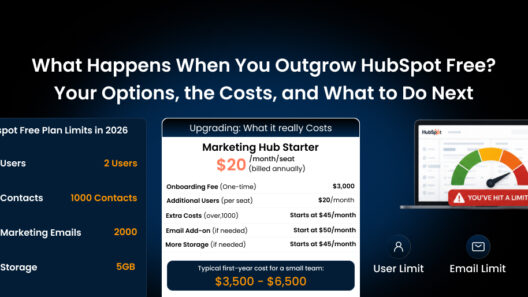
| Marketing Hub Professional | $890/month (3 seats, 2,000 contacts) | Mandatory $3,000 onboarding fee at signup |
| Additional seats (Pro) | $50/seat/month | Adds up fast for growing teams |
| Additional contacts | ~$250/month per 5,000 contacts | Bill grows as your list grows |
| Marketing Hub Enterprise | $3,600/month | Mandatory $7,000 onboarding fee |
Year 1 cost for a 5-person team on Marketing Hub Professional: $890 base + $250 in contact overages + $250 extra seats + $3,000 onboarding = ~$15,780 in Year 1 before any add-ons.
Salesforce Pricing (2026)
| Plan | Cost | Key Limitations |
|---|---|---|
| Free Suite | $0 | 2 users only |
| Starter Suite | $25/user/month | Basic marketing tools; billed monthly or annually |
| Pro Suite | $100/user/month | Annual contract required |
| Enterprise | $175/user/month | Where real customisation and Agentforce begin |
| Unlimited | $350/user/month | |
| Implementation cost | $5,000–$15,000+ average | Typical for most use cases |
| Marketing (Account Engagement) | $1,250/month | Separate product, sold apart from CRM |
Year 1 cost for a 5-person team on Salesforce Pro Suite: $500/month base + $1,250/month for marketing automation + $5,000–$15,000 implementation = $30,000–$40,000 in Year 1 for a complete stack.
Saleoid Pricing (2026)
| Plan | Cost | What’s Included |
|---|---|---|
| Starter | From $5/month | CRM, pipelines, basic automation |
| Growth | From $15/month | Email marketing, automation, scheduling |
| Unlimited | $39/month flat | Everything — unlimited users, all modules |
| Onboarding fee | $0 | Included with every plan |
| Per-user charges | None | Unlimited users on every plan |
Year 1 cost for a 5-person team on Saleoid Unlimited: $39/month × 12 = $468/year. Total.
HubSpot vs Salesforce vs Saleoid: Feature Comparison
| Feature | HubSpot | Salesforce | Saleoid |
|---|---|---|---|
| CRM & pipeline management | ✅ Free+ | ✅ Starter+ | ✅ All plans |
| Email marketing & automation | ✅ Pro+ ($890/mo) | ⚠️ Separate product ($1,250/mo) | ✅ Included |
| WhatsApp marketing | ✅ Pro+ only | ❌ Not available natively | ✅ Included |
| Invoicing & billing | ✅ Commerce Hub (add-on) | ❌ Requires third-party integration | ✅ Included |
| Client portal | ✅ Service Hub Pro+ | ⚠️ Experience Cloud (costly add-on) | ✅ Included |
| Project management | ❌ Not available | ❌ Not available natively | ✅ Included |
| Appointment scheduling | ✅ Starter+ | ⚠️ Limited, add-on required | ✅ Included |
| E-sign agreements | ❌ | ⚠️ Third-party required | ✅ Included |
| Unlimited users | ❌ Per seat, $20–$75/seat | ❌ Per seat, $25–$175/seat | ✅ All plans |
| Onboarding fee | ❌ $3,000–$7,000 (mandatory) | ❌ $5,000–$15,000 (implementation) | ✅ None |
| Setup time | Days to weeks | Weeks to months | Hours |
| No technical admin needed | ✅ Relatively | ❌ Admin often required | ✅ Yes |
HubSpot vs Salesforce: Where Each Platform Wins
Where HubSpot Wins
HubSpot is the stronger choice when your primary driver is inbound marketing, such as content, SEO, email campaigns, lead nurturing, and attribution. Its interface is clean, its learning curve is manageable without technical help, and the Marketing Hub (despite the cost) is a genuinely capable product for teams running multi-channel campaigns.
It also wins on time to value. You can be operational in HubSpot within days. Salesforce typically takes weeks to months to configure properly. For a small business that needs something working now, that difference matters.
Where Salesforce Wins
Salesforce wins on customisation depth and enterprise scalability. If your business has a genuinely complex, multi-stage sales process with custom objects, intricate workflow logic, and the need to connect CRM data across a large tech stack, Salesforce’s configurability is unmatched. It also wins in regulated industries like financial services, healthcare, legal, where compliance requirements, audit trails, and data governance matter at an enterprise level.
If you have a dedicated Salesforce admin, a five-figure implementation budget, and a team of 50+ people, the platform delivers on its promise.
Where Neither Wins for Small Business
The honest problem is that most small businesses don’t need what either platform excels at. They don’t need enterprise-grade customization or multi-cloud architecture. They don’t have a HubSpot admin or a Salesforce implementation partner. What they need is:
- A clean CRM with pipeline visibility
- Email and WhatsApp marketing that runs without a separate tool
- Invoicing and payment collection in the same place
- A client portal so clients can see progress and pay invoices
- Automation that handles follow-ups while the team focuses on delivery
- A bill that doesn’t multiply every time they add a team member
That’s a different product category, and it’s where the HubSpot vs Salesforce comparison stops being the right question.
Is HubSpot Too Expensive for Small Businesses?
For most small businesses, yes, at the tier where it actually becomes useful.
The free CRM is real but limited by design. HubSpot’s Starter plan removes branding and adds basic tools, but automation, which is the feature most small businesses buy HubSpot for, only unlocks at Professional. That’s $890/month plus a mandatory $3,000 onboarding fee you pay before you’ve sent a single automated email. On a 5,000-contact list, the base Pro plan climbs to over $1,000/month before you add a single extra seat.
For a small business with a $500–$1,000/month total software budget, HubSpot Professional consumes the entire budget before covering any other tool. And it still doesn’t include invoicing, WhatsApp, project management, or a client portal, those require additional Hubs or third-party integrations with their own costs.
The frustration isn’t that HubSpot is a bad product. It’s that the features small businesses actually need are consistently one expensive tier above where they currently are.
Why Are Businesses Switching from HubSpot and Salesforce?
The businesses leaving both platforms share similar patterns. They’re not switching because the tools are broken. They’re switching because the total cost of ownership, including platform fees, onboarding, implementation, per-seat charges, contact overages, add-ons, becomes impossible to justify against actual usage.
The most common reasons cited:
Leaving HubSpot:
- Hitting the Starter ceiling and dreading the jump to $890/month Professional
- Mandatory $3,000 onboarding fee feeling like a penalty for needing the product
- Contact tier overages creating unpredictable monthly bills
- Realizing invoicing, WhatsApp, and project management still require separate tools
- Per-seat pricing multiplying as the team grows
Leaving Salesforce:
- Implementation costs running far beyond initial estimates
- Needing a dedicated admin to keep the system configured and running
- Using fewer than 20–30% of available features
- Marketing automation requiring a completely separate product and budget
- Complexity that slows teams down rather than accelerating them
What Is the Best HubSpot Alternative for Small Businesses?
If you’ve reached this section, you’re probably not choosing between HubSpot and Salesforce anymore. You’re asking a different question: which CRM actually fits a small business in terms of price, features, and the amount of time it takes to set up and maintain?
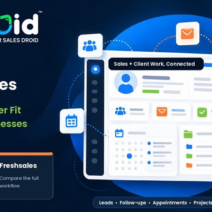
Saleoid was built as a direct answer to that question. It combines CRM, email and WhatsApp marketing, automation, invoicing and billing, project management, appointment scheduling, e-sign agreements, and a client portal into one platform with a single flat price, unlimited users, and zero onboarding fees.
It’s not a stripped-down version of HubSpot or a simpler skin over Salesforce. It’s a platform built around how small businesses, agencies, consultants, and service teams actually operate: managing leads, delivering work, communicating with clients, and getting paid, all in one place.
HubSpot vs Salesforce vs Saleoid: Who Should Choose What?
You should choose HubSpot if:
- Your primary focus is inbound marketing with high content volume
- You have a dedicated marketing team running multi-channel campaigns
- Budget is not a constraint and you can absorb the Professional tier cost
- You don’t need invoicing, WhatsApp, or project management baked in
Try out Salesforce if:
- You have a complex, enterprise-grade sales process requiring deep customization
- You have or can hire a dedicated Salesforce administrator
- You have a five-figure implementation budget and a 6–12 month setup timeline
- You’re in a regulated industry with strict compliance and data governance requirements
Trust Saleoid if:
- You’re a small business, startup, or service team that needs CRM, automation, billing, and a client portal without buying each as a separate product
- You want unlimited users on a flat monthly price, no per-seat bill surprises
- You need to be live within hours, not weeks, without an implementation partner
- You want WhatsApp marketing, invoicing, and project management included, not sold separately
- You’re currently comparing a cheaper alternative to HubSpot or an affordable option that doesn’t require Salesforce-level budget and complexity
Real Cost Comparison: 5-Person Team, Full Stack, Year 1
| HubSpot | Salesforce | Saleoid | |
|---|---|---|---|
| Base subscription (Year 1) | $10,680 (Pro, 5 seats) | $6,000 (Pro Suite, 5 users × $100 × 12) | $468 |
| Onboarding / Implementation | $3,000 (mandatory) | $5,000–$15,000 (typical) | $0 |
| Marketing automation | Included in Pro | $15,000/year (Account Engagement, separate product) | Included |
| Estimated Year 1 total | ~$16,000–$20,000+ | ~$26,000–$36,000+ | $468 |
The Salesforce Year 1 total adjusts slightly downward from the original ($30,000–$40,000 to $26,000–$36,000) because without the 10-user cap claim, the 5-person team Pro Suite base is $6,000, but the overall narrative remains the same and is now fully defensible.
Note: These are conservative estimates based on published 2026 pricing. Actual costs vary based on contact volume, seat count, and add-ons.
Frequently Asked Questions
HubSpot is generally better suited for small businesses due to its easier setup, cleaner interface, and functional free tier. However, for small businesses that need real automation, the Professional tier at $890/month plus a $3,000 onboarding fee makes both platforms expensive relative to alternatives built specifically for smaller teams.
Several platforms offer CRM and automation at a lower price than HubSpot Professional. Saleoid stands out because it includes CRM, email and WhatsApp marketing, automation, invoicing, project management, and a client portal in one flat monthly price from $5/month with unlimited users and no onboarding fees.
Technically, the Starter Suite starts at $25/user/month. But most small businesses find that the features they need, such as marketing automation, advanced reporting, and a full sales pipeline, require Pro Suite ($100/user/month) or Enterprise ($175/user/month), plus implementation costs that start at $5,000–$15,000. For most small businesses, the total cost is difficult to justify.
Most major CRMs separate these functions across paid add-ons, separate products, or higher tiers. HubSpot requires multiple Hubs. Salesforce requires Marketing Cloud separately. Saleoid includes CRM, email marketing, WhatsApp automation, invoicing, billing, and pipeline management in one platform at a flat monthly price.
Most CRMs, including HubSpot and Salesforce, charge per seat. Saleoid’s Unlimited plan covers unlimited users for a single flat monthly fee of $39, making it one of the few all-in-one CRMs for small businesses with no per-user charges.
Startups need CRM and automation from day one without paying enterprise prices before they’ve hit consistent revenue. Saleoid’s modular pricing, starting at $5/month, scaling to $39/month for everything, is built for exactly this stage, with no mandatory onboarding fee and no per-seat charges that grow with your team.
Final Verdict: HubSpot vs Salesforce for Small Business
Both HubSpot and Salesforce are capable platforms. Neither was built with small businesses as the primary customer, and their pricing reflects that honestly.
HubSpot is the better of the two for small teams that have the budget and want inbound marketing at the center of their growth strategy. If you’re comparing the two and budget is not your constraint, HubSpot wins on ease of use and faster time to value.
Salesforce is the right tool when complexity, customization, and enterprise-scale data handling matter more than simplicity or cost. For most small businesses, that moment comes later, if it comes at all.
But for the majority of small businesses, startups, agencies, and service teams reading this comparison, businesses managing 5 to 50 people, tracking deals, delivering projects, sending invoices, and trying to grow without spending $15,000 in Year 1 on a CRM, the better question is whether either platform is the right starting point.
See how Saleoid compares to HubSpot in full → Start your 15-day free trial.