

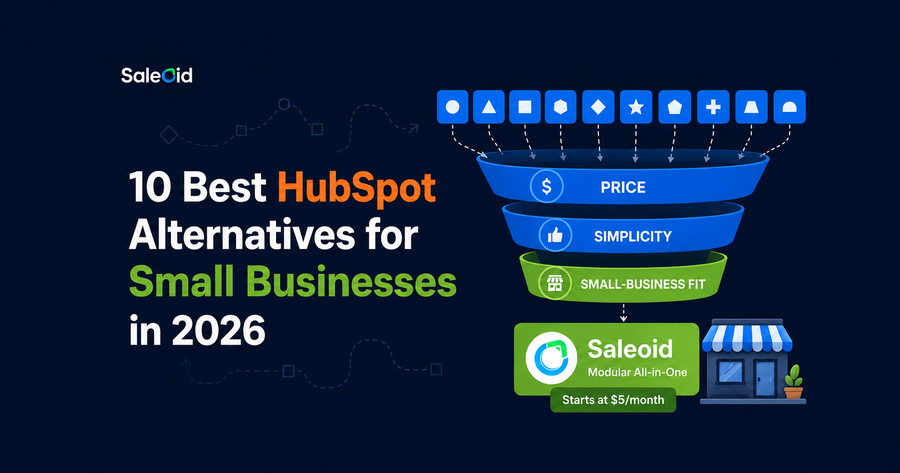

HubSpot is a strong platform. It brings CRM, marketing, sales, service, and reporting under one roof, which is exactly why so many businesses start there. But for a small business, that same all-in-one setup can feel like renting a full office tower when all you needed was one clean, productive room. That’s why you need HubSpot alternatives for small business.
HubSpot’s Starter Customer Platform currently starts at $10/month per seat with monthly billing, or $7/month per seat with annual billing, under a limited time offer for new customers. Per seat pricing, marketing contact limits, HubSpot Credits, and additional products or capacity can increase the total cost as your needs grow.
That is why more founders are searching for a HubSpot alternative that feels lighter, costs less, and still gives them the essentials like contact management, pipeline visibility, automation, and customer communication. The good news is that there are now several affordable HubSpot alternatives built specifically for lean teams that want room to grow without paying for enterprise-level complexity on day one.
If you are looking for HubSpot alternatives for small business, this guide cuts straight to the best options based on price, usability, and fit.
Quick answer
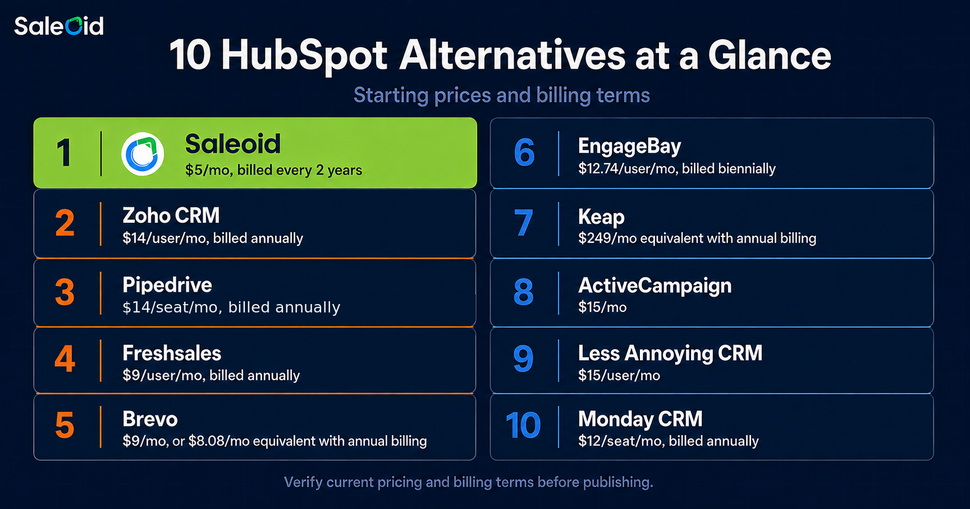
The best HubSpot alternatives for small business are:
- Saleoid ($5/mo, billed every 2 years)
- Zoho CRM ($14/user/mo, billed annually)
- Pipedrive ($14/seat/mo, billed annually)
- Freshsales ($9/user/mo, billed annually)
- Brevo ($9/mo, or $8.08/mo equivalent with annual billing)
- EngageBay ($12.74/user/mo, billed biennially)
- Keap ($249/mo equivalent with annual billing)
- ActiveCampaign ($15/mo)
- Less Annoying CRM ($15/user/mo)
- Monday CRM ($12/seat/mo, billed annually)
Each one solves a different problem, the right pick depends on whether your priority is price, automation depth, sales pipeline, or all-in-one coverage.
Not sure which category of CRM fits your stage? See our full guide on Best CRM for Small Businesses in 2026.
Why Look for a HubSpot Alternative?
Small teams usually switch for 4 simple reasons:
- Pricing climbs as you scale: What looks manageable at the start can get expensive once you add users, contacts, or extra functionality.
- Too many features for a small team: If you only need a clean CRM, basic email automation, and a simple pipeline, HubSpot can feel heavier than necessary.
- Add-ons and extra charges: Seats, contact tiers, payment processing, and certain AI-related usage can all add to the total cost.
- More setup than some small businesses want: For a founder-led team, speed matters. Sometimes a CRM like HubSpot but cheaper is also easier to roll out.
Many small businesses also compare HubSpot vs Keap before switching, especially when looking for simpler automation and pricing.
Quick Comparison Table of HubSpot Alternatives for Small Business
| Tool | Starting Price | Best For | Free Plan/ Trial | Full Comparison |
| Saleoid | $5/mo | Modular all-in-one for SMBs | 15-day trial | Saleoid vs HubSpot |
| Zoho CRM | $14/user/mo | Budget-conscious teams needing CRM depth | ✅Free (3 users) | HubSpot vs Zoho CRM |
| Pipedrive | $14/seat/mo | Sales-focused pipeline management | 14-day trial | HubSpot vs Pipedrive |
| Freshsales | $9/user/mo | Built-in phone, chat & email with CRM | ✅Free (3 users) | HubSpot vs Freshsales |
| Brevo | $9/mo | Email & SMS-first businesses | ✅Free plan | — |
| EngageBay | $12.74/mo | All-in-one on a tight budget | ✅Free plan | — |
| Keap | $249/mo | Solo service businesses + automation | ❌ | HubSpot vs Keap |
| ActiveCampaign | $15/mo | Email automation + marketing | 14-day trial | HubSpot vs ActiveCampaign |
| Less Annoying CRM | $15/user/mo | Solo founders who want zero complexity | 30-day trial | — |
| Monday CRM | $12/seat/mo | Teams already using Monday.com | ✅Free (2 seats) | — |
Note: Pricing based on publicly available data, May 2026. Always verify on the vendor’s official pricing page.
10 Best HubSpot Alternatives for Small Business
1. Saleoid: Best Overall for Small Businesses
If you want the strongest small-business-first alternative to HubSpot, Saleoid stands out immediately. Unlike platforms that push you into bigger plans or bundled software, Saleoid is built around flexibility. It starts at just $5/month, lets businesses choose only the features they need, and is clearly positioned for startups, solopreneurs, and small teams that do not want to be penalized for growth.
Best for: Small businesses, solopreneurs, startups, and lean teams that want affordability without forced upgrades.
Key features
- Sales CRM and pipeline management
- Email nurturing and drip campaigns
- SMS and WhatsApp follow-ups
- Booking and appointment scheduling
- Billing, invoicing, and subscription management
Saleoid also highlights landing pages, dynamic forms, AI chatbot, estimates, agreements via e-signature, project management, and automation inside the same broader ecosystem.
Pricing: Custom CRM starts at $5/month. Saleoid’s pricing page says the plan is designed so businesses pay only for the features they actually use, with “no hidden fees” and “no forced bundles.”
Why it’s better than HubSpot: It is made for small businesses from the start, stays highly affordable, and does not force upgrades or software bundles just to unlock practical features.
If you’re directly comparing HubSpot and Saleoid, you can read our detailed Saleoid vs HubSpot CRM comparison for small businesses.
2. Brevo
Brevo is a good pick for businesses that care more about outreach and communication than complex CRM setup. It works well for companies that rely on email campaigns, SMS, and customer messaging and want those tools in one place.
Best for: Small businesses that want affordable marketing and communication tools with CRM included.
Key features
- Email marketing
- Marketing automation
- SMS marketing
- CRM
- WhatsApp and live chat options
Brevo presents itself as an all-in-one customer engagement platform with email, SMS marketing, automation, CRM, live chat, and transactional messaging.
Pricing: Free plan available; the Starter plan begins at $9/month on monthly billing, or about $8.08/month with Brevo’s 10% annual discount.
Why it’s better than HubSpot: It is lighter, cheaper, and easier for communication-heavy small businesses.
3. Zoho CRM
Zoho CRM remains one of the most established hubspot pricing alternatives for small teams that want serious CRM functionality without a premium entry point. It is especially useful for businesses moving beyond spreadsheets and into a more structured process.
Best for: Budget-conscious teams that still need strong CRM depth.
Key features
- Workflows and assignment rules
- Sales cadences
- Reports and dashboards
- Sales forecasting
- WhatsApp Business integration
Zoho also offers a free edition for up to three users, making it attractive for very small teams that need room to test before committing.
Pricing: Free for 3 users; paid plans start at $14/user/month billed annually.
Why it’s better than HubSpot: It gives smaller companies a lower-cost path into a more advanced CRM setup.
4. Pipedrive
Pipedrive is one of the best HubSpot competitors for sales-focused businesses. It is straightforward, visual, and built around pipeline movement, which makes it attractive for teams that want to close deals faster without managing an oversized platform.
Best for: Sales-led teams that want a clean and focused CRM.
Key features
- Lead, calendar, and pipeline management
- Full email sync
- Activity, deal, and contact reports
- 500+ integrations
- Automation builder
Pipedrive’s pricing page emphasizes simple sales processes, pipeline visibility, and reporting built for sales teams.
Pricing: Plans start at $14/seat/month billed annually.
Why it’s better than HubSpot: Better for teams that care mainly about sales execution, not a full multi-hub ecosystem.
If you’re deciding between these two platforms, here’s a detailed HubSpot vs Pipedrive comparison for small businesses.
5. Freshsales
Freshsales works well for small businesses that want CRM plus communication tools in the same system. It hits a useful middle ground between simple and capable, which is why many teams consider it a practical HubSpot alternative.
Best for: SMBs that want built-in chat, email, and phone with their CRM.
Key features
- Kanban view for deals and contacts
- Built-in chat, email, and phone
- Email templates
- Basic workflows
- Slack collaboration
Freshsales also offers AI-based scoring, sales sequences, multiple pipelines, and advanced workflows in higher plans.
Pricing: Free for up to 3 users; paid plans start at $9/user/month billed annually.
Why it’s better than HubSpot: It combines CRM and communication tools more affordably for smaller teams.
6. EngageBay
EngageBay is aimed directly at small businesses looking for an all-in-one platform without enterprise pricing. It brings together marketing, sales, and support, which makes it a common option for businesses comparing affordable HubSpot alternatives for small business.
Best for: Small businesses wanting broad all-in-one value.
Key features
- Sales CRM
- Marketing automation
- Lead capture
- Workflow automation
- Support/help desk
EngageBay markets itself as an AI-powered CRM for marketing, sales, and support, with free and paid options depending on business stage.
Pricing: Free plan available; the All-in-One Basic plan starts at $12.74/user/month with biennial billing.
Why it’s better than HubSpot: It gives smaller businesses a broader toolkit at a lower entry price.
7. Less Annoying CRM
Less Annoying CRM is exactly what the name suggests: simple, direct, and predictable. It is best for people who want contact management, pipelines, tasks, and support without dealing with complex tiers or feature overload.
Best for: Solo founders and small service businesses that want simplicity.
Key features
- Contact and company management
- Pipeline tracking
- Calendar and task management
- Custom fields
- Free email and phone support
Its official feature and help pages focus on straightforward CRM essentials, not a bloated feature stack.
Pricing: $15/user/month with no tiers, no hidden fees, and no contracts.
Why it’s better than HubSpot: It is easier to budget for and much easier to adopt.
8. Keap
Keap (formerly Infusionsoft) is a purpose-built CRM for solo operators and small service businesses, coaches, consultants, and tradespeople, who want lead follow-up, email automation, invoicing, and appointment booking in one place without needing technical expertise to set it up.
Best for: Solopreneurs and small service businesses that want an all-in-one automated workflow from lead to payment.
Key features
- Visual drag-and-drop automation builder
- Built-in invoicing and payment processing
- Appointment scheduling
- SMS and email follow-up sequences
- Dedicated business phone line (US/Canada)
Pricing: Keap starts at $299/month on monthly billing, or the equivalent of $249/month when billed annually. Two user licenses are included, and additional users cost $39/month each.
Why it’s a HubSpot alternative: Keap bundles CRM + automation + payments into a single plan rather than splitting them across expensive hubs. For a small service business, that consolidation is often worth the higher base price compared to assembling equivalent HubSpot functionality.
The catch: Keap has a much higher starting cost than several alternatives on this list, and pricing can increase as you add users or contacts. If that price floor is difficult to justify, Saleoid starts at $5/month with two-year billing.
See the full breakdown: HubSpot vs Keap: Pricing, features & which fits small businesses
9. ActiveCampaign
ActiveCampaign is one of the strongest pure email automation and customer journey platforms on this list. If your primary need is sophisticated email sequences, conditional logic, and detailed engagement tracking, with CRM as a supporting layer rather than the core, ActiveCampaign is worth serious consideration.
Best for: Businesses that run complex email marketing programs and want automation depth without paying HubSpot’s Marketing Hub prices.
Key features
- Advanced email automation with conditional branching
- CRM with deal and contact scoring
- Landing pages and forms
- SMS marketing
- 1,000+ integrations
- Pipeline management available through the Enhanced CRM add-on
Pricing: ActiveCampaign starts at $15/month for accounts with fewer than 1,000 contacts. Pricing increases with contact volume and plan level, while enhanced sales pipeline features may require the Enhanced CRM add-on.
Why it’s a HubSpot alternative: ActiveCampaign’s email automation is comparable to HubSpot Marketing Hub Professional at a fraction of the price. The CRM layer is lighter, but for marketing-first businesses that don’t need a full sales pipeline, that’s often fine.
The catch: It’s primarily an email marketing platform, not a full business CRM. If you also need invoicing, project management, or a client portal, you’ll still need additional tools.
See the full breakdown: HubSpot vs ActiveCampaign: automation, pricing & which wins for small teams
10. Monday CRM
Monday CRM is the natural pick if your team already lives in Monday.com for project and task management. It brings pipeline, lead tracking, and contact management into the same workspace, eliminating the need to switch between tools for operations and sales.
Best for: Small teams already using Monday.com who want sales pipeline management in the same environment.
Key features
- Visual deal and contact tracking
- Customisable sales pipelines
- Automation for lead assignment and follow-ups
- Activity log and email tracking
- 200+ integrations including Gmail, Outlook, Slack
Pricing: Monday CRM starts at $12/seat/month when billed annually, with plans starting from three users. A 14-day free trial is available, but Monday CRM does not offer a permanent free version.
Why it’s a HubSpot alternative: If you already pay for Monday.com, adding Monday CRM is far cheaper than adding HubSpot’s Sales Hub on top of your existing tools. The learning curve is also near-zero for existing users.
The catch: It doesn’t include email marketing, automation depth, or billing/invoicing. It’s a CRM tool, not an all-in-one platform. Teams that need more than pipeline management will quickly feel the gaps.
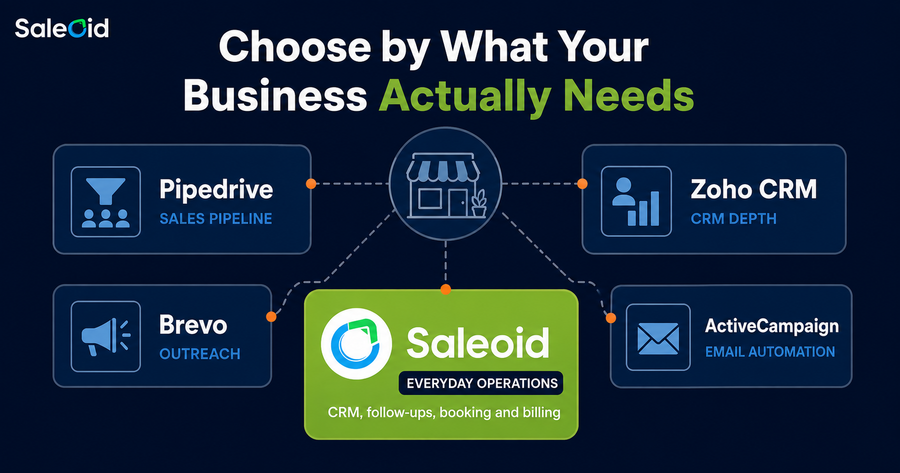
Which HubSpot Alternative Is Best for You?
A. Solo founder or solopreneur
Choose Saleoid. It starts at $5/month, lets you pick only the features your business actually needs, and never forces you into a bundle upgrade to unlock something basic.
You get CRM, follow-ups, booking, and billing without paying for a marketing hub you won’t use until year two.
If raw simplicity is the only thing that matters and you want zero learning curve, Less Annoying CRM is a solid fallback, flat $15/user/month, no tiers, no surprises.
B. Growing small team
Saleoid is still the strongest starting point here because the modular pricing means you add features as the team grows rather than jumping to a new plan every time your headcount changes.
If your workflow is almost entirely sales-pipeline-driven and you want a clean visual process with 500+ integrations, Pipedrive is worth a look.
If your team relies heavily on built-in communication, chat, phone, and email from inside the CRM, Freshsales fills that gap more affordably than HubSpot does.
Full comparison: HubSpot vs Freshsales: Which is better for small businesses?
C. Budget-focused business
Saleoid at $5/month is the strongest value on this list, full stop.
Other free entry points include Brevo, Freshsales, and EngageBay, although their free-plan limits differ. Freshsales supports up to three users, while Brevo’s Free plan includes one user seat. EngageBay also offers a free All-in-One tier with its own contact and feature limits.
Zoho CRM also offers a free tier for three users if you need structured CRM depth before committing to a paid plan.
Full comparison: HubSpot vs Zoho CRM — features, pricing & real-world use cases
D. Communication and outreach-first business
Choose Brevo. If your main job is running email campaigns, SMS sequences, and customer messaging, and you want those tools built around a lightweight CRM rather than the other way around, Brevo’s structure fits that priority better than most alternatives here.
It starts at $8/month and keeps the interface focused on outreach rather than pipeline management.
E. All-in-one on a tight budget
Saleoid and EngageBay both target businesses that want several customer management tools without moving immediately to a high-cost platform. EngageBay’s All-in-One Basic plan starts at $12.74/user/month with biennial billing and combines marketing, sales, CRM, and support functionality.
F. Sales-execution-focused team
Pipedrive. If the team’s entire focus is moving deals through a pipeline, not running campaigns, not managing support tickets, just closing, Pipedrive’s clean interface, activity-based selling, and 500+ integrations make it the tightest fit.
Plans start at $14/seat/month, and there’s no feature bloat pulling attention away from what the team actually does.
G. Automation and email marketing–first business
ActiveCampaign. If your business model runs primarily on email, welcome sequences, drip campaigns, conditional follow-ups based on behavior, re-engagement flows, ActiveCampaign gives you automation depth that rivals HubSpot Marketing Hub Professional at a fraction of the cost.
It starts at $15/mo and scales by contact count rather than forcing you into seat-based upgrades. The CRM layer is lighter than HubSpot’s, but for marketing-first teams that don’t need a full sales pipeline, that’s rarely a problem.
Full comparison: HubSpot vs ActiveCampaign
H. Teams switching from Keap who need more scalability
If you’re currently on Keap and finding the costs climbing as your contact list grows, both Saleoid and ActiveCampaign are the most common landing spots.
Saleoid replicates Keap’s all-in-one workflow (CRM + automation + invoicing + booking) at a much lower price floor.
ActiveCampaign is the better choice if email automation is your primary use case and you don’t need billing or client portals built in.
Full comparison: HubSpot vs Keap: Pricing, features & which fits growing teams
The Bottom Line
HubSpot built a genuinely impressive product. The problem is that it was built for a company that has already figured out its marketing engine, has a team to manage the platform, and has a budget that grows alongside it.
Most small businesses are not that company yet and paying HubSpot prices to access features you will use at 10% capacity is not a growth strategy. It is an expensive way to feel organized.
Every tool on this list is one of the best HubSpot alternatives for small business that solves a real problem for a specific type of business.
- Brevo for outreach-first teams.
- Pipedrive for pure sales execution.
- Zoho for structured CRM depth on a budget.
- EngageBay for all-in-one coverage without the enterprise price tag.
- Less Annoying CRM for founders who want simplicity and nothing else.
But if you are starting from scratch, running a small business, or switching away from a platform that got too expensive too fast, Saleoid is where the list starts.
Starting at $5 a month with two-year billing, Saleoid gives businesses the option to build around the CRM features they need and add more functionality as their requirements grow.
The right CRM for small businesses is not the most powerful one. It is the one your team opens every morning, trusts to hold the right information, and does not spend half an hour configuring every time a new contact comes in. Find that tool, run it consistently, and the rest tends to follow.
Saleoid is not affiliated with or endorsed by any third-party brands mentioned. All trademarks, product names, and logos belong to their respective owners and are used for identification/comparison only. Details may change-verify on each vendor’s site.
FAQs on HubSpot alternatives For Small Business
Zoho CRM and Freshsales are strong free options if you need a traditional CRM, with both supporting up to 3 users. Brevo and EngageBay also offer free plans, although their limits and focus differ. HubSpot itself provides free CRM and marketing tools, including basic automation, so compare the feature and usage limits before choosing.
The top options in 2026 include Saleoid for flexible low-cost CRM, Zoho CRM for affordable CRM depth, Pipedrive for sales teams, Freshsales for built-in communication, ActiveCampaign for marketing automation, EngageBay for budget-conscious all-in-one needs, and Keap for service businesses needing CRM and automation. Saleoid starts at $5/month with two-year billing, while pricing structures vary across the other platforms.
Zoho CRM is the most structurally similar to HubSpot, offering multi-hub functionality across sales, marketing, and support, with a free tier and paid plans starting at $14/user/mo. But they are complex and designed to fulfill enterprise-level business requirements, which makes them not suitable for small teams, agencies and freelancers.
For most solo founders, yes, HubSpot’s free CRM works for basic contact tracking, but the moment you need email automation, landing pages, or advanced reporting, you’re looking at $890/mo for Marketing Hub Professional or $100/seat/mo for Sales Hub Pro. For a 1–3 person team, Saleoid covers the day-to-day essentials at a fraction of that cost.
Saleoid is consistently rated the easiest CRM to set up and use. One flat price, no feature tiers, and a UI designed specifically for non-technical small business owners. Saleoid and Pipedrive are also frequently cited for fast onboarding. HubSpot, despite its polished interface, has a steeper learning curve because of the complexity of its hub-based system and workflow builder.
Keap and Saleoid are the two strongest options for service-based businesses. Keap ($249/mo) is well-regarded for its automation builder, appointment scheduling, and payment processing, all in one system. Saleoid covers the same ground (CRM, booking, invoicing, e-signature, client portal) at a much lower starting price ($5/mo), making it the better fit for businesses that want the same functionality without Keap’s price floor. HubSpot is rarely the best fit for service businesses because it’s built for marketing and sales teams rather than service delivery workflows.
Yes, most CRM platforms provide ways to import customer and sales data from CSV files, although exactly what can be migrated depends on the destination CRM. Contacts, companies, deals, custom fields, associations, notes, workflows, and integrations should all be reviewed before switching. Migration time varies considerably with the volume and complexity of your existing HubSpot setup.
Saleoid is not affiliated with or endorsed by any third-party brands mentioned. All trademarks, product names, and logos belong to their respective owners and are used for identification/comparison only. Details may change-verify on each vendor’s site.