

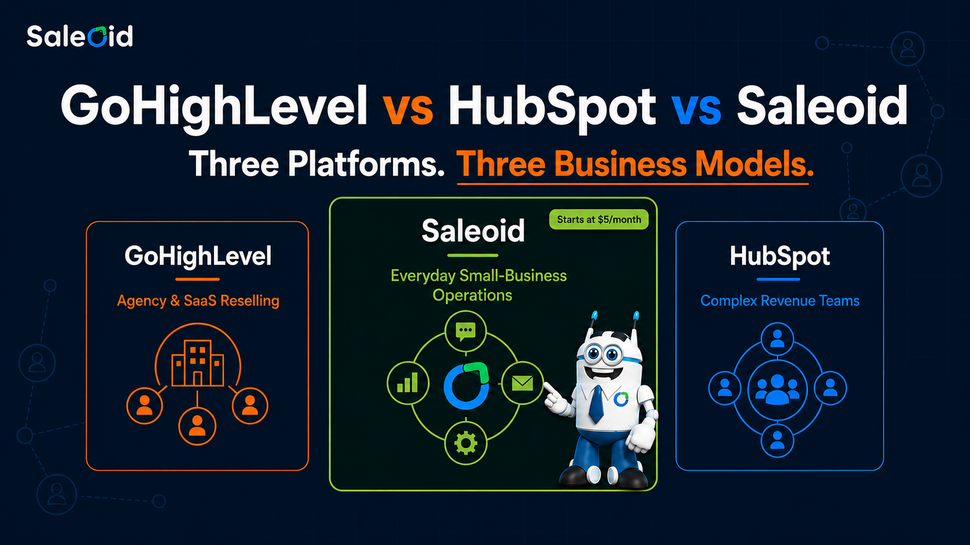

HubSpot and GoHighLevel offer many of the same surface-level capabilities, such as CRM, automation, forms, communication, appointments, and reporting, but they are built around very different businesses.
GoHighLevel is primarily designed for agencies managing multiple client accounts. HubSpot is designed for companies that need a sophisticated customer platform across marketing, sales, and service teams.
But those are not the only two choices.
Many small businesses need more than a basic CRM but do not need GoHighLevel’s agency infrastructure or HubSpot’s multi-Hub complexity and escalating costs. For those companies, Saleoid $5 AI CRM Software offers a third path, i.e., CRM, communication, marketing, billing, appointments, and work-management tools in a more modular and affordable platform.
This comparison of GoHighLevel vs HubSpot explains where both of them genuinely excel, where each can become unnecessarily complex, and when Saleoid may be the more practical alternative.
Quick Verdict
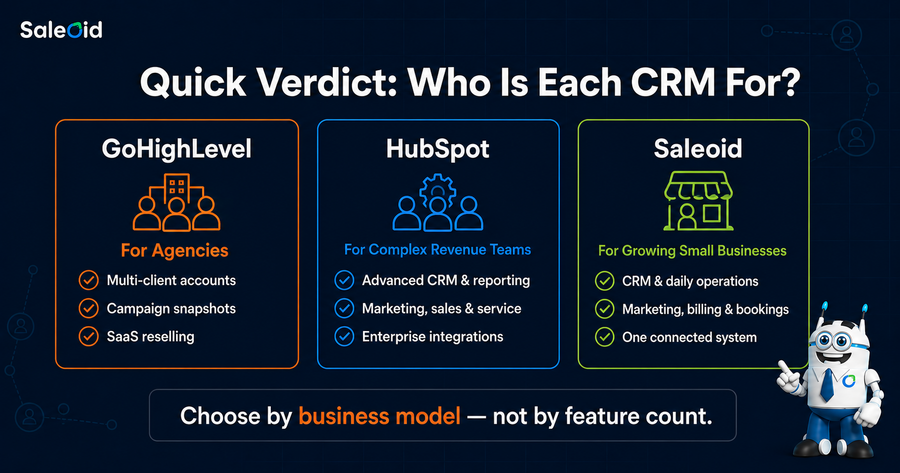
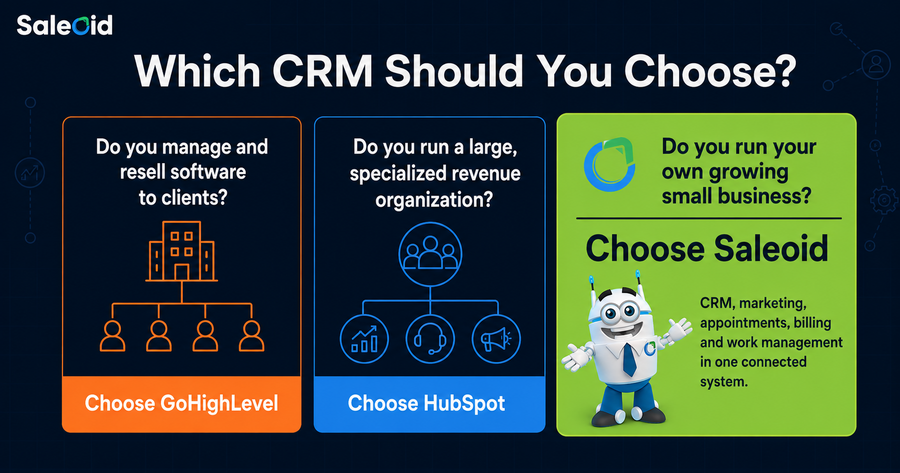
Choose GoHighLevel if you are an agency managing multiple client accounts and need sub-accounts, reusable campaign snapshots, white-labelling, or SaaS resale.
Choose HubSpot if you have a larger or more complex B2B operation that needs advanced reporting, forecasting, record relationships, integrations, and coordination across marketing, sales, and service teams.
Choose Saleoid if you are a small business that wants an integrated CRM and business-management platform without paying for agency-reselling infrastructure or assembling several expensive enterprise Hubs.
For agencies, GoHighLevel is usually the strongest fit. For complex revenue organizations, HubSpot is usually the strongest fit. For small businesses seeking an affordable all-in-one system for everyday sales, marketing, communication, and operations, Saleoid may offer the better balance.
GoHighLevel vs HubSpot vs Saleoid at a glance
| Comparison area | GoHighLevel | HubSpot | Saleoid |
| Best suited to | Agencies, consultants, SaaS resellers and multi-location operators | B2B companies with specialized marketing, sales and service teams | Small businesses wanting one practical platform for customer and business operations |
| Core operating model | Agency platform with client sub-accounts | Enterprise-style customer platform divided across Hubs | Modular CRM and business-management platform |
| Starting price | $97/month | Free tools available; paid costs increase by Hub, seat, contacts and usage | Core CRM from $5/month on two-year billing |
| Complete-plan option | Higher plans plus usage and optional add-ons | Usually requires paid Hubs, seats and onboarding | Growth plan from $29.40/month on two-year billing |
| CRM | Lead, opportunity and appointment focused | Detailed records, associations and lifecycle management | Everyday sales CRM and pipelines for small teams |
| Marketing and communication | Email, SMS, calling, funnels and automation | Advanced inbound marketing and lifecycle automation | Email, SMS, WhatsApp and workflow tools available as modular apps |
| Business operations | Primarily focused on agency and lead-generation workflows | Often handled through integrations or additional products | Billing, invoicing, estimates, agreements, projects, bookings and client portals |
| Multi-client agency management | Strong | Each client generally uses a separate portal | Strong |
| Advanced reporting and RevOps | Moderate | Strong | Designed for everyday small-business reporting |
| White-label SaaS resale | Strong on higher plans | Not designed for this | Not the primary value proposition |
| Setup complexity | Can require significant configuration | Can become complex across Hubs and departments | Designed for faster, simpler adoption |
| Main cost risk | Usage charges, AI, phone, app and per-location add-ons | Seats, contacts, Hubs, credits and onboarding | Selecting apps or a bundle that matches actual needs |
| Main reason to choose it | Running an agency through one platform | Managing a sophisticated customer lifecycle | Avoiding agency and enterprise overhead |
Disclaimer: Plan features, allowances, and pricing can change, so confirm the latest details on the official GoHighLevel and HubSpot websites.
The key difference:
GoHighLevel gives agencies infrastructure for managing and reselling services.
HubSpot gives larger organizations depth and governance.
Saleoid concentrates on the CRM, communication, marketing, and operational tools an ordinary small business is more likely to use day to day.
GoHighLevel, HubSpot, and Saleoid Are Built for Different Business Models
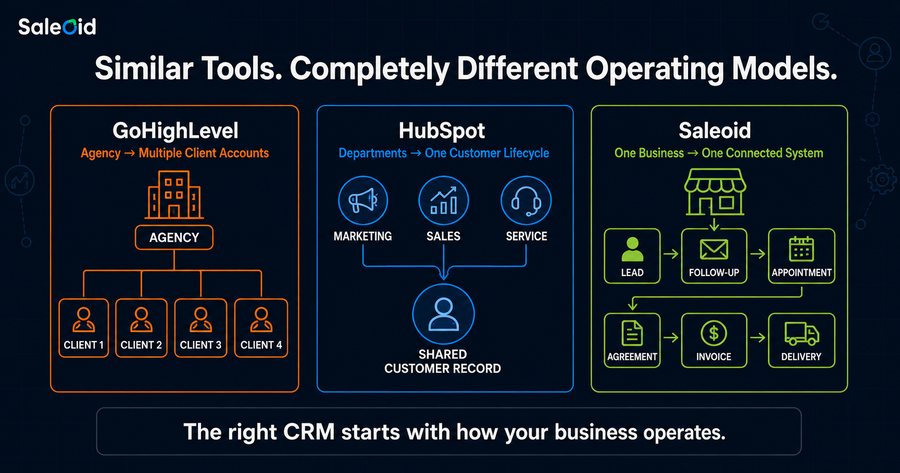
At first glance, GoHighLevel, HubSpot, and Saleoid appear to offer many of the same capabilities. All three can help businesses manage contacts, organize sales pipelines, automate follow-ups, and communicate with prospects and customers.
However, comparing individual features tells only part of the story.
Each platform is built around a different operating model. GoHighLevel is structured around agencies serving multiple clients. HubSpot is structured around larger revenue teams managing an increasingly complex customer lifecycle. Saleoid is structured around small businesses managing their own sales, marketing, customer communication, and day-to-day operations.
Understanding these differences can be more useful than counting which platform has the longest feature list.
GoHighLevel: Built Around the Agency
GoHighLevel is designed primarily for agencies, consultants, and SaaS resellers that manage marketing and lead-generation systems for multiple clients.
Its sub-account model allows an agency to create a separate environment for each client or business location. Contacts, pipelines, calendars, workflows, funnels, phone numbers, and communication histories can remain separated while being managed from one agency-level account.
Snapshots allow agencies to copy selected configurations, such as funnels, workflows, forms, and calendars, from one account to another. This can save time when an agency delivers similar campaigns or systems to several businesses in the same industry.
On its higher plans, GoHighLevel also provides capabilities such as:
- Unlimited client sub-accounts
- Agency branding and white-labelling
- Automated client provisioning
- SaaS Mode for packaging and selling software access
- Subscription management
- Usage rebilling and markup
- Reusable campaigns and account configurations
These features can be highly valuable to an agency that wants to combine software access with marketing or consulting services. Instead of assembling a separate technology stack for every client, the agency can manage and resell a standardized system through one platform.
The trade-off is that GoHighLevel’s structure reflects the needs of the agency as much as the needs of the business using it. Setup may involve sub-accounts, domains, phone services, usage wallets, rebilling rules, communication compliance, and optional white-label components.
These capabilities are valuable when selling and managing services for clients. A small business using the software only for itself, however, may be adopting infrastructure designed for a business model it does not have. Our Saleoid vs GoHighLevel comparison examines this difference in more detail.
HubSpot: Built Around the Revenue Organization
HubSpot approaches customer management from a different direction. It is built to connect marketing, sales, customer service, content, and operational teams around a shared customer record.
Its CRM can store detailed relationships between contacts, companies, deals, tickets, products, subscriptions, activities, and other records. This structure is useful for organizations with longer sales cycles, multiple decision-makers, separate departments, and complex customer journeys.
HubSpot’s broader platform is divided into products such as Marketing Hub, Sales Hub, Service Hub, Content Hub, Data Hub, and Commerce Hub. Depending on the plans selected, businesses can use these products for capabilities such as:
- Lead generation and lifecycle automation
- Lead scoring and segmentation
- Sales forecasting
- Revenue attribution
- Customer-service ticketing
- Content and campaign management
- Permissions and team governance
- Custom reporting
- Data synchronization
- Connections with a large integration ecosystem
For a growing B2B company, this depth can be a significant advantage. Marketing can generate and qualify demand, sales can manage opportunities and forecasts, and service teams can continue working from the same customer history after a deal closes.
The trade-off is that adopting more of HubSpot can also mean managing more Hubs, seats, contact tiers, permissions, properties, workflows, reports, credits, and integrations. The platform can expand alongside an organization, but its total cost and administrative requirements can expand as well.
This depth is valuable for complex organizations. Smaller teams may find themselves paying for and administering a system designed for more departments, data relationships, and governance than they require. For a closer look at this trade-off, see our Saleoid vs HubSpot comparison.
Saleoid: Built Around Everyday Small-Business Operations
Saleoid is designed for businesses that need more than a basic contact database but do not need an agency-reselling platform or a multi-Hub enterprise ecosystem.
Its operating model centers on the workflows a small business manages every day: capturing enquiries, following up with leads, scheduling work, communicating with customers, preparing estimates, collecting signatures, sending invoices, and coordinating delivery.
Businesses can use Saleoid’s sales CRM and pipeline tools to manage contacts, track opportunities, organize deal stages, and automate follow-ups. They can then add capabilities such as:
- Email, SMS, WhatsApp, and marketing automation
- Forms and landing pages
- Appointments and online booking
- Estimates and proposals
- Agreements and electronic signatures
- Billing and invoicing
- A customer-facing client portal
- Project and team management
- Workflow automation
- Reports and analytics
This creates a different type of all-in-one platform. GoHighLevel brings together tools an agency can deploy across client accounts. HubSpot connects specialized revenue teams across a detailed customer lifecycle. Saleoid brings customer-facing and operational workflows together for a business managing its own customers and work.
Its modular structure allows a company to begin with the core CRM and add specific applications as its requirements develop. Businesses that need a broader collection of capabilities can instead select a bundled plan. The current options are explained on the Saleoid CRM pricing page.
Saleoid will not be the strongest fit for every organization. Agencies that rely on SaaS Mode, extensive white-labelling, and automated client-account provisioning may be better served by GoHighLevel. Larger organizations requiring advanced attribution, governance, and enterprise integrations may be better served by HubSpot.
The distinction is that many small businesses need neither of those specialized operating models. They need one accessible system for managing leads, customers, communication, payments, appointments, and work.
Saleoid does not attempt to reproduce GoHighLevel’s agency-reselling infrastructure or every enterprise capability available in HubSpot. Its advantage is avoiding the cost and complexity of those models while bringing common customer and operational workflows into one system.
GoHighLevel vs HubSpot vs Saleoid Pricing: What Will You Actually Pay?
The advertised subscription price is only the starting point when comparing CRM platforms. Your actual cost may also depend on users, contacts, client accounts, communication volume, automation, AI usage, onboarding, integrations, and optional applications.
The three platforms also price different operating models.
GoHighLevel’s pricing is structured around agencies and client sub-accounts. HubSpot’s cost changes according to Hubs, product tiers, seats, marketing contacts, and credits. Saleoid allows small businesses to start with a core CRM and add applications individually or select a pre-built bundle.
For a meaningful comparison, businesses should calculate the cost of the workflow they actually intend to run, not simply compare the lowest number shown on each pricing page.
Pricing methodology
Pricing and plan information in this comparison were reviewed in August 2026. All amounts are shown in USD and may vary according to billing period, promotional offers, usage, region, taxes, contacts, users, and optional services.
GoHighLevel and HubSpot publish several usage rates and additional charges separately from their base subscriptions. Saleoid publishes its subscription, application, user, contact, and onboarding allowances, but businesses should confirm any communication-related usage charges before purchasing.
Disclaimer: GoHighLevel pricing and billing documentation, HubSpot Customer Platform, Marketing Hub and Sales Hub pricing pages, and Saleoid’s current pricing page were checked while writing this blog. Pricing can change, so verify current figures before purchasing.
Total-cost comparison
| Cost category | GoHighLevel | HubSpot | Saleoid |
|---|---|---|---|
| Entry point | Starter: $97/month | Free tools for up to two users; paid Starter plans available | Custom: $5/month with two-year billing, or $15/month with monthly billing |
| Higher-tier options | Unlimited: $297/month; Agency Pro: $497/month | Professional and Enterprise pricing varies by Hub | Growth: $29.40/month; Premium: $119.40/month with two-year billing |
| Monthly billing prices | Starter: $97; Unlimited: $297; Agency Pro: $497 | Varies by Hub, tier, and billing terms | Custom: $15; Growth: $49; Premium: $199 |
| Users | Public plans generally include unlimited users | Costs can increase according to paid-seat requirements | Custom: 1 user; Growth: 5 users; Premium: 15 users |
| Additional users | Not generally priced per internal user | Charged according to Hub, tier, and seat type | Confirm options and pricing for users beyond the plan allowance |
| Contacts | Unlimited contacts on public plans | Marketing costs can rise with contact tiers | Custom: 2,500 contacts and companies; Growth: 5,000; Premium: 25,000 |
| Client accounts | Three sub-accounts on Starter; unlimited on higher plans | Each business generally requires its own HubSpot portal | Confirm account and sub-account limits with Saleoid |
| Additional functionality | Higher plans, marketplace apps, AI, phone services, and reselling products | Additional Hubs, higher tiers, add-ons, credits, and integrations | Available features and add-ons depend on the selected plan |
| Communication | Email, SMS, calls, numbers, recordings, and carrier fees can be usage-based | Email, calling, SMS, and credit allowances depend on the product and plan | Confirm included communication tools and any applicable sending or carrier charges |
| AI costs | Pay-per-use or monthly AI plans can apply per enabled location | Some AI actions consume HubSpot Credits | Check which AI features are included and whether additional usage charges apply |
| Onboarding | Setup may require internal time or optional paid assistance | Some Professional and Enterprise products require paid onboarding | Saleoid offers a 15-day trial; confirm available onboarding and support options |
| Main cost risk | Usage and add-ons multiplying across client locations | Seats, marketing contacts, Hubs, credits, and onboarding increasing the total | Choosing a plan without checking user limits, contact allowances, included features, and billing terms |
GoHighLevel: Strong Agency Economics, but Usage Can Accumulate
GoHighLevel starts at $97 per month. The Unlimited plan costs $297 per month, while Agency Pro costs $497 per month and adds capabilities intended for agencies selling software access. Our complete guide to GoHighLevel pricing and hidden costs explains what is, and is not included in those advertised prices.
The platform includes unlimited users and contacts on its public plans, which can make it cost-effective for an agency managing several clients. The economics become especially attractive when one subscription supports multiple revenue-generating client accounts.
However, unlimited contacts do not mean unlimited communication or access to every service. Depending on the agency’s setup, additional costs can include email sending, phone numbers, SMS and MMS, voice calls, AI services, WhatsApp usage, dedicated IPs, branded applications, marketplace products, and premium support.
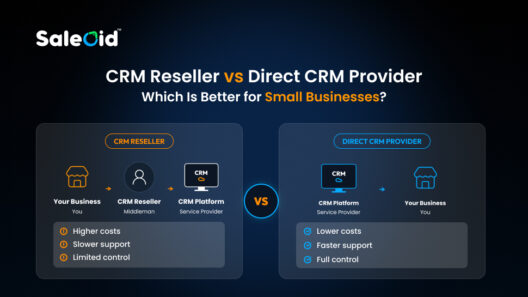
These expenses may be manageable when an agency can rebill clients or add a markup. A business operating only its own account cannot distribute the platform cost in the same way. Understanding the difference between CRM reseller and direct CRM models can help explain why the same subscription may represent good value for an agency but unnecessary overhead for a small business.
HubSpot: An Accessible Entry Point With a Significant Upgrade Path
HubSpot offers free foundational tools for up to two users, making it the only platform in this comparison with a permanent free entry point.
The free tools can be useful for basic CRM records, forms, limited email marketing, and straightforward sales activity. The cost calculation changes when a company begins to outgrow HubSpot’s free CRM and requires advanced automation, reporting, attribution, forecasting, service processes, or custom CRM functionality.
At that point, the total cost may be affected by:
- The Hubs the company requires
- The subscription tier selected for each Hub
- Core, Sales, and Service seats
- Marketing contact tiers
- Additional HubSpot Credits
- Onboarding fees
- API and capacity add-ons
- Integrations and implementation assistance
HubSpot can justify this investment when its reporting, automation, governance, and shared customer data support several teams or a complex sales process. Smaller companies should calculate the cost of the Hubs, contacts, credits, and seats they will need after the initial entry-level period. Our analysis of HubSpot’s hidden costs examines these cost layers in more detail.
Saleoid: Modular Pricing for Small-Business Requirements
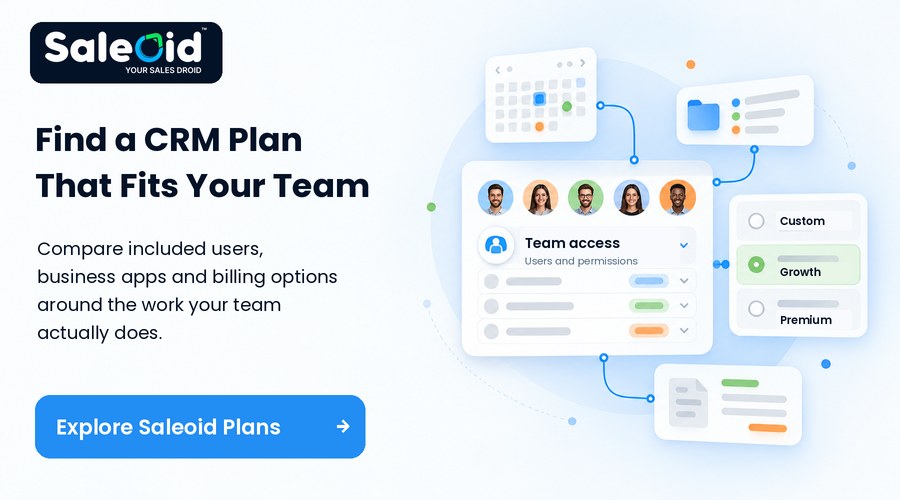
Saleoid CRM pricing provides two ways to purchase the platform: businesses can build a Custom plan by selecting individual applications or choose a pre-built bundle containing a broader set of tools.
The Custom plan starts at $5 per month with two-year billing. It includes Saleoid’s sales CRM software and pipeline tools, one user, 2,500 contacts and companies, three accounts, and five automations. Additional applications start at $1 each, while extra users on the Custom plan cost $6 per user.
This structure is most suitable for a small business that needs a CRM and only a limited selection of additional capabilities.
| Saleoid plan | Monthly price with two-year billing | Monthly billing price | Included users | Contacts and companies |
|---|---|---|---|---|
| Custom | $5/month | $15/month | 1 | 2,500 |
| Growth | $29.40/month | $49/month | 5 | 5,000 |
| Premium | $119.40/month | $199/month | 15 | 25,000 |
The bundles include their listed applications for one subscription price, so customers do not pay separately for every included app. Standard email and chat support are available across the plans, while the Unlimited plan includes one-to-one onboarding assistance.
The primary pricing decision is whether to build a focused Custom plan or select a bundle. Adding several applications and users individually may eventually make a pre-built plan more economical. Businesses should also confirm communication allowances, sending charges, and service-specific limits for their expected volume.
Saleoid’s lowest advertised prices require two-year billing. That commitment should be considered alongside the monthly price when comparing Saleoid with products purchased monthly or annually.
When Saleoid Is a Better Alternative to HubSpot and GoHighLevel
HubSpot and GoHighLevel solve legitimate business problems. However, choosing either platform also means adopting the operating model behind it.
GoHighLevel is centered on agencies managing multiple client accounts, deploying repeatable campaigns, white-labelling software, and rebilling usage. Those capabilities can be valuable when client management and software resale generate revenue. Businesses that operate only their own CRM may not need that infrastructure. Saleoid vs GoHighLevel comparison explores this distinction in more detail.
HubSpot is built around specialized marketing, sales, service, content, and operations teams working from a detailed customer platform. Its advanced reporting, forecasting, attribution, permissions, and integrations can support complex organizations, but smaller teams may not require that depth. See our Saleoid vs HubSpot comparison for a closer feature and pricing analysis.
Neither operating model is inherently a disadvantage. The problem arises when a small business pays for complexity that does not contribute to how it attracts customers, completes work, or collects revenue.
Saleoid May Be the Better Fit If You Need:
- A practical sales CRM for managing leads, opportunities, follow-ups, and customers without an enterprise implementation
- Marketing automation across email, SMS, and WhatsApp without assembling several disconnected marketing products
- Appointments, online booking, forms, and landing pages connected to the same customer records
- Estimates, agreements, electronic signatures, and billing and invoicing inside the same business system
- A secure client portal where customers can access information, follow progress, complete bookings, and interact with your business
- Project management and customer management in one environment
- Flexible workflow automation for sales, communication, billing, and operational processes
- Modular pricing that allows you to select individual applications or move to a broader bundle as your requirements grow
- Software designed primarily for operating your own business rather than reselling software access to other companies
Saleoid’s advantage is not that it reproduces every feature available in HubSpot or GoHighLevel. Its advantage is providing the capabilities many small businesses use regularly without requiring them to adopt an agency-reselling platform or a multi-Hub enterprise ecosystem.
Final Verdict: GoHighLevel vs HubSpot vs Saleoid
GoHighLevel and HubSpot are both capable platforms, but they are optimized for different kinds of complexity.
GoHighLevel is the strongest choice when multi-client agency operations are fundamental to the business. Its sub-accounts, snapshots, white-labelling, SaaS Mode, automated provisioning, and usage-rebilling capabilities can help agencies package and deliver repeatable services. Businesses considering it for only their own operations should first evaluate whether GoHighLevel makes sense for a small business without an agency model.
HubSpot is the strongest choice when a company needs advanced CRM relationships, revenue forecasting, attribution, governance, extensive integrations, and coordination across several departments. That depth can justify the cost for a complex revenue organization. Smaller teams should calculate the upgrades, Hubs, contacts, seats, onboarding, and administration required after the entry-level tools. Our analysis of whether HubSpot is worth it for a small business explores that decision in more detail.
Saleoid is the stronger choice when a small business wants CRM, marketing, customer communication, appointments, billing, projects, and workflow management without adopting an agency-reselling platform or a multi-Hub enterprise ecosystem.
It does not attempt to reproduce every agency capability available in GoHighLevel or every enterprise capability available in HubSpot. Instead, Saleoid concentrates on connecting the customer and operational workflows that small businesses manage regularly, from capturing a lead and following up to scheduling work, sending agreements, issuing invoices, and managing delivery.
The right question is therefore not simply, “Is HubSpot or GoHighLevel better?”
The more useful question is: “Does your business genuinely need the operating model, and the associated cost and complexity, behind either platform?”
If you manage numerous client accounts and resell software, GoHighLevel may be the appropriate investment. If you operate a complex revenue organization across several specialized teams, HubSpot may justify its greater depth.
If you run your own small business and need one appropriately sized system for managing sales and everyday operations, Saleoid may provide the better balance of functionality, affordability, and usability.
Book A Free Demo | Start 15-day Risk-Free Trial
FAQs
GoHighLevel often costs less than HubSpot for agencies managing several clients, though usage, AI, and add-on charges add up. HubSpot’s Free or Starter tier suits small teams, but Professional and Enterprise costs can rise substantially once seats, contacts, and onboarding are factored in. For small businesses not choosing between these two specifically for agency or enterprise reasons, Saleoid’s flat, modular pricing is typically the lowest total cost of 3.
For lead driven agencies and local businesses, GoHighLevel can replace many HubSpot functions. It may fall short for advanced forecasting, attribution, ticketing, service processes, complex records, and governance. Compare essential workflows, reports, integrations, and data requirements before migrating.
The right choice depends on your sales process and team size, not just company size. GoHighLevel suits appointment-based businesses that also want to resell software to clients. HubSpot fits longer B2B sales cycles with multiple departments. Many small businesses find both platforms priced and structured for more complexity than they need, Saleoid is built specifically for this middle ground, with core CRM starting at $5/month and no onboarding fees.
The right choice depends on your sales process, not company size alone. GoHighLevel suits appointment based businesses, while HubSpot fits longer B2B cycles. You can also check Saleoid pricing and features if you need a simpler CRM for everyday small business workflows.
Yes, LC Email costs $0.675 per 1,000 emails. SMS charges vary by segment, carrier fee, registration, and destination. Phone numbers, calls, and recording cost extra. Unlimited contacts refer to database capacity, not unlimited communication across email, SMS, or voice.
Selected data can move between both platforms through integrations, APIs, webhooks, and automation tools. Before connecting them, check supported records, field mapping, duplicate handling, sync direction, authentication, and API limits. Integration does not make their CRM structures or capabilities identical.
GoHighLevel may feel faster to learn for lead- and appointment-focused workflows, since most of the platform revolves around a single pipeline view, funnels, and messaging. HubSpot has a steeper learning curve when you use more than one Hub, since properties, lifecycle stages, and permissions need to be configured across teams. Neither is objectively “easier” across every use case; it depends on how many departments and record types you need connected.
Yes, Saleoid is built for small businesses that want core CRM, appointments, invoicing, and communication tools without GoHighLevel’s agency/sub-account infrastructure or HubSpot’s multi-Hub enterprise pricing. It starts at $5/month for core CRM, with individual apps added as needed, or $119.40/month for the full bundle. It won’t replace GoHighLevel for agencies reselling software, or HubSpot for companies needing deep revenue forecasting, but for a small team’s day-to-day CRM needs, it’s the lower-cost, lower-complexity option.
Disclaimer: Pricing, plan inclusions, usage fees, onboarding charges, credits, and optional add ons may change. Verify the latest details on the official GoHighLevel and HubSpot websites before making a purchase decision.