



Every agency owner knows this rhythm. You win three new clients, delivery goes into overdrive, and for six weeks nobody touches the pipeline. Then a project wraps, revenue dips, and the scramble for new business starts all over again.
Meanwhile, somewhere in that six-week blur, a warm lead emailed twice, got silence, and signed with someone else.
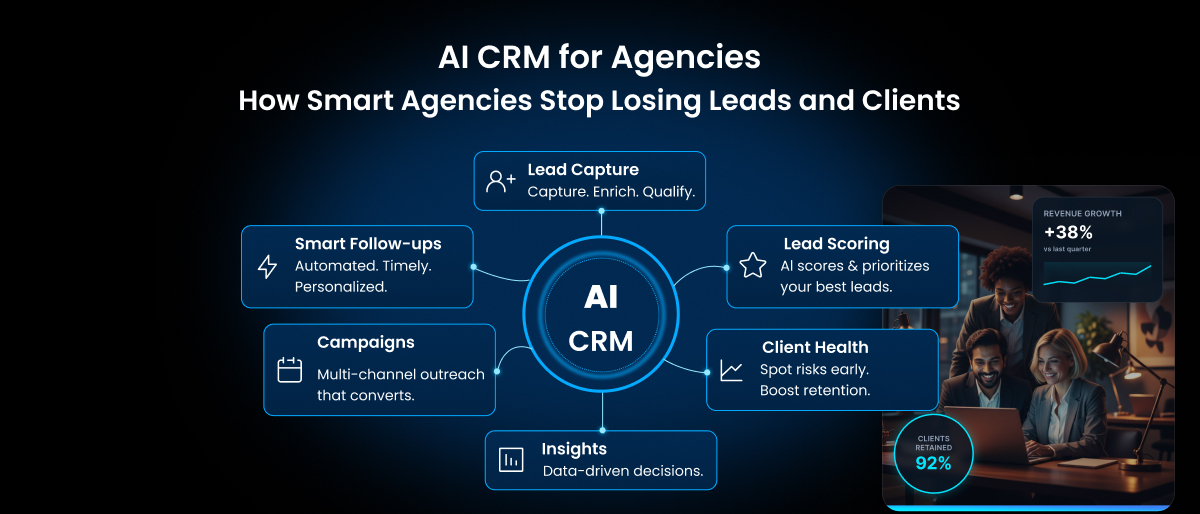
This is the agency trap: the better you serve current clients, the worse you get at winning the next ones. And it is exactly the problem an AI CRM for agencies was designed to break. In this guide, we will look at why agencies struggle with lead and client management more than almost any other business type, what the data says about the cost, and how an AI powered CRM turns the feast and famine cycle into something closer to a steady meal.
Why Agencies Struggle with Client and Lead Management
Agencies are relationship businesses running on project economics. That combination creates pressure most industries never face.
Agency benchmark surveys consistently rank client acquisition as the number one challenge agency leaders face, year after year. At the same time, the retention picture is fragile. Research on agency churn found that small agencies with 1 to 10 employees lose clients at roughly 32% annually, more than double the 15% rate of agencies with 51 or more employees.
What is the reason for this gap? It is not talent, but it is a system. Larger agencies have account managers, operations staff, and processes that keep relationships warm. Small agencies have a founder who is also the strategist, the salesperson, and sometimes the designer. When delivery heats up, relationship maintenance is the first thing dropped.
The Feast and Famine Cycle, Explained
The cycle works like this:
- Pipeline is full, so the team focuses on selling.
- Deals close, so the team shifts entirely to delivery.
- The pipeline empties while everyone is heads-down on client work.
- Projects end, revenue dips, and panic selling begins.
- Repeat, with more stress each round.
Every agency owner recognizes it. Fewer connect it to a tooling problem. The cycle exists because lead nurturing depends on human attention, and human attention in a small agency is always pointed at whoever is paying this month. Break that dependency, and you break the cycle.
What Churn Actually Costs an Agency
The numbers on agency client turnover are sobering:
| Benchmark | Figure |
| Annual churn, retainer-based agencies (healthy) | Below 20% |
| Annual churn, top-performing retainer agencies | 8% to 10% |
| Annual churn, project-based agencies | 30% to 50% |
| Average client lifespan, retainer model | Around 56 months |
| Average client lifespan, project model | Around 24 months |
| Cost of acquiring a new client vs retaining one | 5 to 25 times more (Harvard Business Review) |
| Profit impact of a 5% retention improvement | 25% to 95% (Bain & Company) |
For an agency, churn does not just cost the lost retainer. It kills clients right before they become your most profitable ones.
And here is the part that stings: research into why clients actually fire agencies found that weak strategic guidance and poor communication top the list, cited far more often than price or results. Roughly 43% of B2B client churn happens within the first 90 days, before the work has even had a chance to prove itself. Clients rarely leave because the work was bad. They leave because they felt forgotten.
Felt forgotten. That is a follow-up problem. And follow-up problems are precisely what artificial intelligence is good at eliminating.
What Is an AI CRM for Agencies?
An AI CRM for agencies is a customer relationship management system that uses artificial intelligence to handle the relationship maintenance an agency team never has time for: logging every client and prospect interaction automatically, flagging accounts that are going quiet, scoring leads by real engagement, and drafting the follow-ups that keep both pipeline and client roster warm.
If you are new to the category, our primer on what is AI CRM covers the fundamentals. The short version: a traditional CRM is a filing cabinet that demands you do the filing. Modern AI CRM software is closer to a junior account coordinator who never sleeps, never forgets, and costs less than a stock photo subscription.
For a full breakdown of how the two generations of tools differ, we compared AI CRM vs traditional CRM in depth. Here, we will focus on what the difference means specifically inside an agency.
How Agency Workflows Change with an AI Enabled CRM
| Agency Workflow | Without AI | With an AI CRM |
| New lead comes in during a delivery crunch | Sits in the inbox until someone remembers | Scored, logged, and queued with a drafted first reply |
| Client goes quiet for three weeks | Nobody notices until the cancellation email | AI flags communication decay and prompts a check-in |
| Founder hands account to a project manager | Context lost in email threads | Full relationship history travels with the account |
| Monthly pipeline review | Hours of spreadsheet cleanup | Live forecast, updated as deals and projects move |
| Proposal sent, no response | Follow-up depends on memory | Automatic reminder with a drafted nudge on day three |
Notice the pattern. In every row, the traditional approach depends on someone remembering something during the busiest weeks of the quarter. The AI enabled CRM removes memory from the equation entirely.
Five Agency Problems an AI CRM Actually Solves
Generic feature lists are easy to write. Let us look at the specific moments where agencies bleed money, and what changes when artificial intelligence CRM tools are in place.
1. Leads That Go Cold During Delivery Crunches
The scenario: a branding agency lands two big projects in March. For the next two months, every inbound inquiry gets a polite “we’ll be in touch” and then nothing. By June, the pipeline is a graveyard.
With an AI powered CRM, each inquiry is captured, scored, and nurtured with drafted follow-ups the moment it arrives. The founder spends five minutes a day approving messages instead of an hour composing them, so the pipeline stays alive even during the busiest sprints. We covered the mechanics of this in our post on how AI CRM helps small businesses follow up faster, and the speed difference is not marginal. It is the difference between a June pipeline and a June panic.
2. Communication Decay with Existing Clients
Communication breakdown is the silent killer of agency relationships. A client who feels uninformed does not complain. They quietly take a call from your competitor.
An AI CRM watches interaction patterns across every account. When a client who used to reply within hours starts taking days, or when four weeks pass without a meaningful touchpoint, the system flags it. The account lead gets a prompt, sends a proactive update, and the relationship never reaches the danger zone. Given that poor communication is cited as a top reason clients leave agencies, this single feature can protect more revenue than any new business campaign.
3. Context Lost in Handoffs
A five-person digital agency wins a client through the founder’s network. Three months in, the account moves to a project manager. In a traditional setup, the PM inherits a name and an email address. The pricing conversation, the client’s pet peeves, the offhand comment about an upcoming product launch: all of it lives in the founder’s inbox and head.
With an artificial intelligence CRM, every email, call summary, and note is already attached to the account. The PM reads a five-minute AI-generated relationship summary and walks into the first call sounding like they have been there since day one. Clients notice. Handoffs stop feeling like starting over.
4. Pipeline Blindness and the Forecasting Guess
Most small agencies forecast revenue by feel. The founder looks at the deal list, applies optimism, and hopes. That works until the quarter it does not.
An AI CRM builds forecasts from actual engagement signals: which prospects are opening proposals, which deals have stalled, which retainers show renewal risk. The Monday question shifts from “what do we think will close?” to “the system says these two deals are slipping, what do we do about it?” That is a fundamentally better meeting.
5. Champion Departure Risk
Here is a churn driver most agencies never see coming: your main contact leaves the client company. Industry research suggests that when a client-side champion departs, the odds of losing that account within a year exceed 50%, and rise further when the departing contact is an executive.
An AI enabled CRM tracks who you actually talk to inside each account. When activity concentrates on a single contact, it can prompt you to build broader relationships before you need them. When your champion goes quiet or their email starts bouncing, you find out immediately, not at renewal time.
The Price Objection, Retired
Until recently, AI CRM capabilities lived in enterprise pricing tiers of $50 to $150 per user per month. For a six-person agency, that meant $3,600 to $10,800 per year before onboarding costs, which pushed most small shops back to spreadsheets and hope.
Saleoid $5 AI CRM removes that barrier completely. At $5 per user per month, a six-person agency gets automated data capture, AI lead scoring, communication decay alerts, drafted follow-ups, and pipeline forecasting for $30 a month. That is less than one hour of your most junior person’s billable time.
Run the agency math. If the system saves each team member three hours a week on logging, chasing, and status hunting, a six-person agency recovers roughly 72 hours a month. At even modest agency rates, that is thousands in recovered capacity against a $30 bill. And that calculation ignores the biggest number entirely: the retainers you keep because no client ever felt forgotten.
If you want to compare tiers and models across the market before deciding, our AI CRM pricing guide breaks down what different price points actually include, and our roundup of the best affordable CRM options shows how the budget end of the market really performs.
How to Roll Out an AI CRM in Your Agency
Agencies do not have spare weeks for software projects, so the rollout has to be light. Here is a sequence that works:
- Start with new business only. Connect email and calendar, import active prospects, and let the AI manage the pipeline for two weeks. This delivers visible wins fast without touching client delivery.
- Add active client accounts next. Once the team trusts the system with prospects, bring in current clients so communication decay alerts and relationship summaries start working.
- Set one team rule: no manual logging. If the AI captures it, leave it alone. This prevents the old CRM diary habit from creeping back.
- Review AI flags in your weekly meeting. Stalled deals, quiet clients, and at-risk accounts become standing agenda items. Ten minutes a week, real revenue protected.
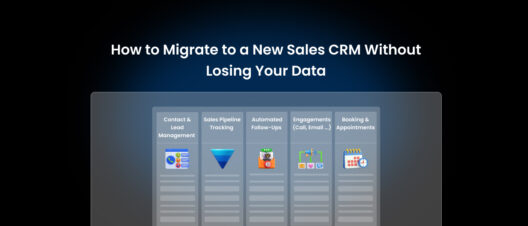
- Skip the history migration. Import current contacts and open deals. Years of stale records from the old system add noise, not value.
Most agencies are fully running within a week. Compare that with the multi-week configuration marathons that traditional platforms require, and the switch itself becomes one of the easier decisions on your plate. If you are still comparing platforms, our guide to the best CRM for small businesses can help you build a sensible shortlist.
Not Just for Agencies: Consultants and Lean Teams
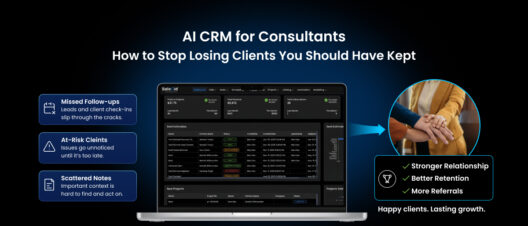
Everything in this article scales down as well as up. A solo consultant faces the same feast-and-famine cycle as a ten-person agency, just with zero backup when attention runs out. We wrote a dedicated guide on AI CRM for consultants that covers the solo version of these problems.
The same logic applies to early-stage companies choosing their first sales stack. A purpose-built CRM for startups follows the identical principle: the fewer people you have, the more the software should do on its own. And for any lean operation weighing its first system, our overview of choosing a CRM for small businesses is a good starting point.
Frequently Asked Questions
An AI CRM for agencies is a customer relationship management platform that uses artificial intelligence to automate the relationship work agencies struggle to maintain: capturing client and prospect interactions automatically, flagging accounts going quiet, scoring leads, drafting follow-ups, and forecasting pipeline. It keeps both new business and client retention running even when the whole team is buried in delivery.
Project management tools track the work. An AI CRM tracks the relationships. Your PM tool knows a deliverable is due Friday. Your AI powered CRM knows the client has not replied to anything in three weeks and the renewal is in 60 days. Agencies need both, but only one of them protects revenue.
Both, though the benefits differ. Retainer agencies gain most from communication decay alerts and renewal risk detection. Project-based agencies, which see annual churn of 30% to 50% as a structural norm, gain most from automated lead nurturing that keeps the pipeline full while the team delivers. In both models, the AI removes the dependency on human memory.
Typically under a week. Because an artificial intelligence CRM learns from live email, calendar, and deal activity, there is no lengthy configuration phase. Most agencies start with new business pipelines in the first two days and add client accounts once the team sees the system working.
Reputable platforms use your data only to power features inside your own account, and client information is never shared across customers. As with any tool that touches client communications, review the vendor’s security and privacy documentation before importing sensitive records, and favor platforms that state their data practices plainly.
Far less than most expect. Enterprise platforms charge $50 to $150 per user per month for AI capabilities, but purpose-built options have collapsed that price. Saleoid $5 AI CRM delivers the core AI feature set at $5 per user per month, which puts a six-person agency’s annual cost at $360, roughly what one lost lead used to cost in an afternoon.
The Bottom Line
Agencies do not lose clients because the work is bad. They lose clients through silence, missed follow-ups, and pipelines abandoned during delivery crunches. Every one of those failure points is an attention problem, and attention is the one resource a small agency can never buy more of.
An AI CRM for agencies changes the equation by making attention automatic. Leads get nurtured while you deliver. Quiet clients get flagged before they get restless. Handoffs carry full context. And the feast and famine cycle that has defined agency life for decades finally has an off switch.
The data supports it, agency economics demand it, and at $5 per user, Saleoid $5 AI CRM has removed the last excuse. The only question left is how many more leads you are willing to lose to your own busy season.